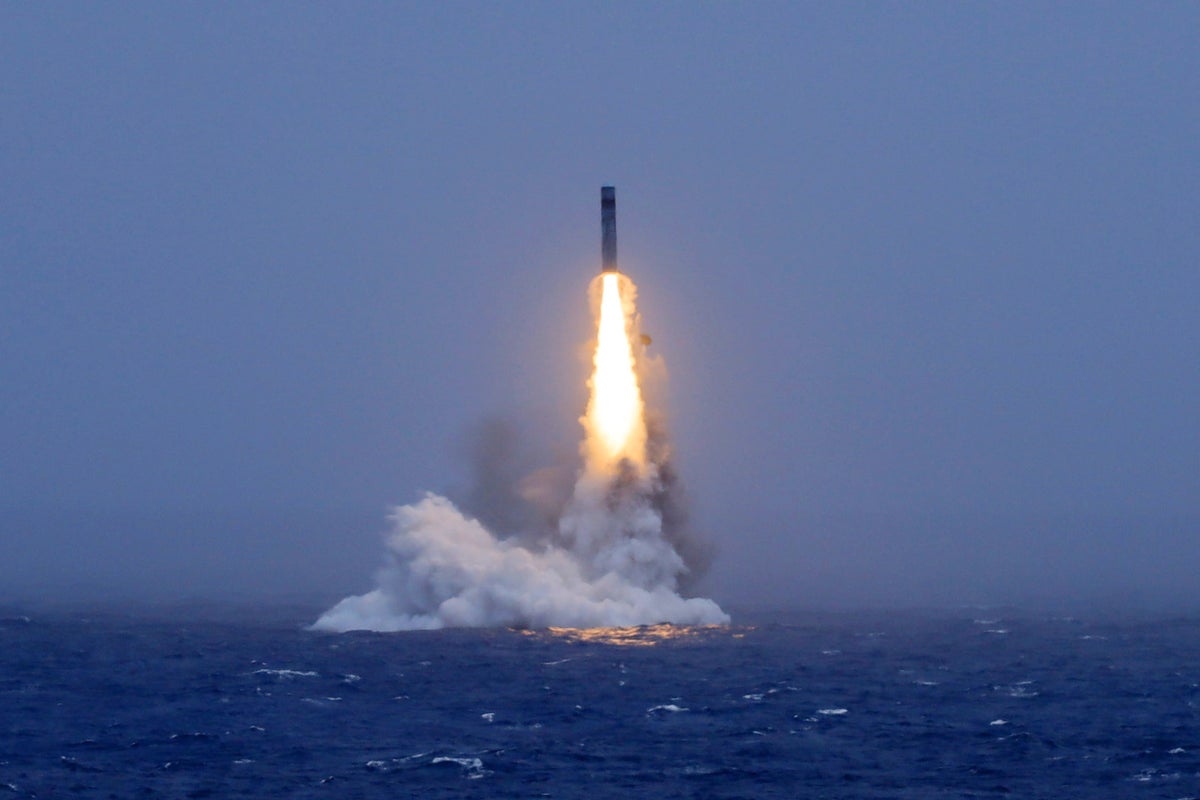
The hand-wringing from Washington was entirely predictable. When China launched an intercontinental ballistic missile (ICBM) into the Pacific Ocean, the Western defense establishment rolled out its standard script: "unprecedented," "destabilizing," and a "great concern to the region."
This reaction is completely wrong. It misreads the fundamental mechanics of nuclear deterrence.
For decades, the standard consensus among defense analysts has been that a quiet China is a safe China. We have been told that Beijing’s traditional opacity regarding its nuclear arsenal was a sign of restraint. Conversely, a public, high-profile test of a nuclear-capable delivery vehicle must mean we are sliding toward an aggressive, unhinged arms race.
The exact opposite is true. The open-water test of the DF-31AG or DF-41 variant into the Polynesian waters was not a provocation. It was a massive, stabilizing correction to a dangerously miscalculated strategic balance. By pulling back the curtain on its capabilities, Beijing didn't increase the risk of conflict; it dramatically lowered it.
We need to stop viewing international security through the panicked lens of political press releases and start looking at the cold, hard math of Mutually Assured Destruction (MAD).
The Myth of the Provocative Test
To understand why the mainstream narrative is flawed, you have to look at what actually happened. China launched an ICBM that traveled roughly 12,000 kilometers, landing precisely in a designated zone of the Pacific. They gave advance notice to regional powers, including the United States, Australia, and New Zealand. They didn't fly it over disputed territory. They didn't hide the telemetry.
The lazy consensus calls this a muscle-flexing exercise meant to intimidate neighbors. But anyone who has spent time analyzing missile trajectories and nuclear posture knows that true danger lies in ambiguity, not clarity.
Consider the alternative. For thirty years, Western intelligence agencies have guessed, estimated, and worried about the actual operational readiness of China’s Rocket Force. Does their hardware actually work? Are their liquid-fuel tanks filled with water instead of propellant, as some intelligence leaks wildly alleged? Is their command structure capable of executing a coordinated strike under pressure?
When an adversary’s capabilities are shrouded in doubt, two dangerous things happen:
- Worst-case scenario planning: Defense planners automatically assume the enemy is twenty feet tall and possesses flawless technology, leading to massive, unnecessary budget spikes and destabilizing counter-deployments.
- Miscalculation of resolve: Political leaders assume the adversary is weak, bluffing, or technologically inept, making them more likely to cross red lines in a crisis.
By launching that missile flawlessly into the Pacific, China answered every question simultaneously. They proved their solid-fueled, road-mobile systems can achieve maximum range with high precision. They proved their operational readiness.
In the brutal logic of nuclear strategy, a verified capability is a deterrent; an unverified capability is an invitation to gamble. China just took the gamble off the table.
Why Washington is Secretly Relieved
The public statements out of the Pentagon decry the lack of transparency, but behind closed doors, the mood is entirely different. I have listened to career defense bureaucrats and military planners talk about global strike capabilities for over fifteen years. They do not fear an opponent that tests openly. They fear an opponent that builds in total silence.
The United States operates on a doctrine of transparent strength. We routinely conduct Minuteman III test launches from Vandenberg Space Force Base out into the Pacific. We call them "Glory Trips." We do them to assure our allies and remind our adversaries that our leg of the triad works perfectly. We do not view our own tests as destabilizing. We view them as the bedrock of global peace.
When China adopts the exact same behavior—notifying neighbors, launching into open water, and demonstrating success—they are aligning themselves with standard superpower protocols. They are signaling that they want to play by the established rules of the nuclear club.
The real anxiety in Washington isn't that China tested a missile. The anxiety is that the test proves China has achieved genuine strategic parity. The era of treating Beijing like a second-tier nuclear power with a "minimal deterrence" posture is dead.
The Flawed Premise of Regional Panic
The media coverage immediately shifted to how Australia, Japan, and the Philippines are shaking in their boots. Let's dismantle this premise.
People frequently ask: Doesn't a longer-range Chinese missile directly threaten Taipei or Tokyo?
This question betrays a complete ignorance of military geography. China does not need an ICBM to target Taiwan, Japan, or US bases in Guam. They have thousands of medium-range and intermediate-range ballistic missiles (MRBMs and IRBMs) like the DF-21 and DF-26—specifically dubbed the "Guam Killer"—that have covered those targets for decades.
An ICBM is a weapon designed specifically to reach the continental United States. This test had absolutely nothing to do with regional coercion of littoral states. It was a peer-to-peer message aimed squarely at Washington.
Imagine a scenario where a regional crisis breaks out in the South China Sea. If Washington believes its homeland is completely immune to Chinese retaliation because China’s ICBMs are unproven or unreliable, the US leadership faces a much lower threshold for intervening conventionally or even considering a first strike. This asymmetry creates a profound incentive for conventional escalation.
Now, that illusion is gone. US planners know with absolute certainty that any direct kinetic conflict with China carries an immediate, viable risk to San Francisco, Chicago, and New York. That realization doesn't cause wars; it prevents them. It forces both sides to the diplomatic table with a level of seriousness that cannot be replicated by economic sanctions or strongly worded letters.
The Cost of the Contrarian Reality
Let’s be brutally honest about the downside of this reality. Acknowledging that China’s missile test stabilizes the strategic balance requires admitting that the US monopoly on global escalation dominance is over.
It means admitting that the Western Pacific is no longer an American lake where we can dictate terms without consequence. It means accepting that a multi-polar nuclear world is inherently more complex, requiring deep, ongoing communication channels rather than unilateral posturing.
The risk here isn't the hardware; it's the rhetoric. If Western leaders buy into their own public relations spin and treat a standard verification test as an act of war, they risk creating a self-fulfilling prophecy. They will misallocate billions of dollars toward reckless missile defense shields that do not work against hypersonic glide vehicles, while ignoring the vital, boring work of setting up hotlines and crisis management frameworks.
The Reality of Nuclear Math
Strategic stability is achieved when neither side believes they can launch a first strike without being utterly destroyed in return. For years, the rapid modernization of US missile defense systems and the deployment of high-precision conventional prompt global strike weapons threatened to upset that balance. It created a perception that the US could neutralize China’s retaliatory capability before it ever left the ground.
With one launch, China rebalanced the ledger.
They demonstrated that despite decades of US investment in radar networks, interceptors, and space-based tracking, they can still reliably deliver a payload across the planet. The status quo hasn't been shattered; it has been reinforced.
Stop reading the frantic press releases from politicians trying to justify next quarter's defense appropriations. The hardware worked. The notifications were sent. The deterrent is credible. The system is operating exactly as MAD intended.
Get used to it.