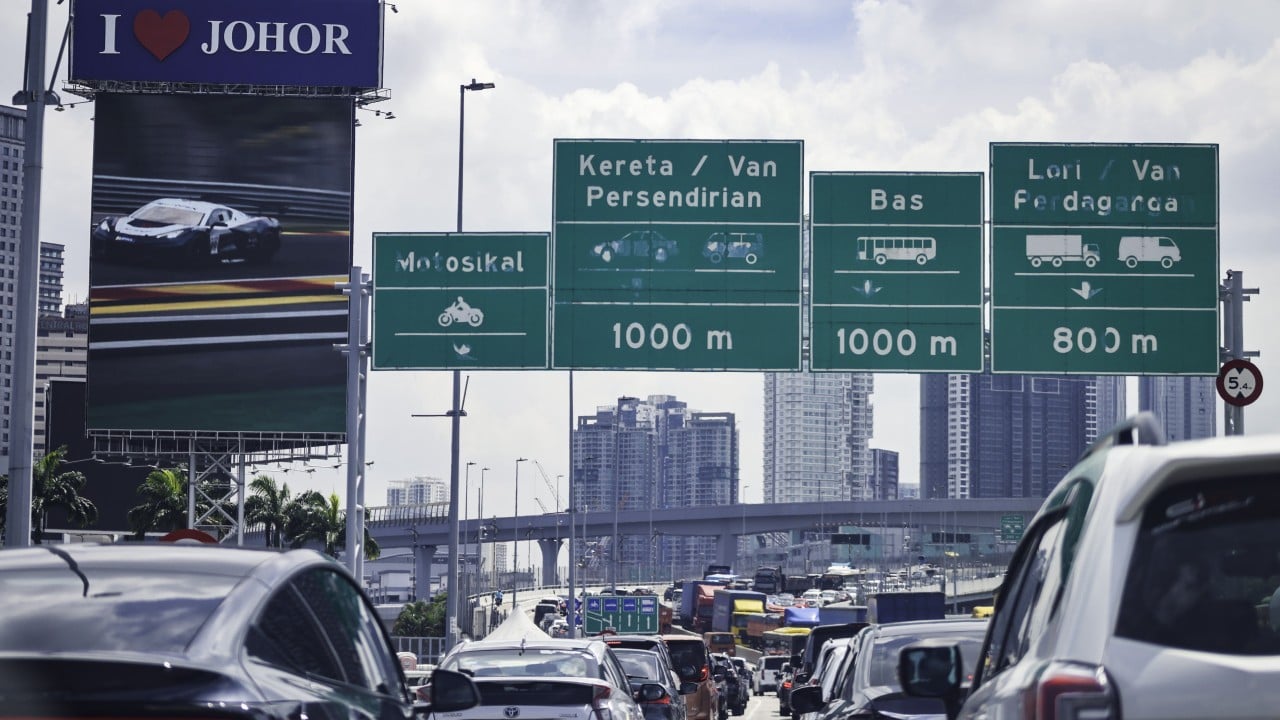
Mainstream political analysts love a predictable, lazy narrative. Every time Johor goes to the polls, the entire media apparatus hyper-focuses on a single stretch of concrete: the Johor-Singapore Causeway.
The current hand-wringing over the July 11 state election follows the exact same script. The commentary is utterly saturated with panic over the immigration department transitioning from the old MyIMMs platform to the new MyNIISe setup. Pundits are shouting from the rooftops that system crashes, five-hour immigration queues, and gridlocked bottlenecks at the Bangunan Sultan Iskandar and Tuas checkpoints will decide who runs the state. Home Ministry officials are scrambling to build emergency task forces and promise dedicated voting lanes as if a tactical traffic plan is the Holy Grail of democratic engagement. Meanwhile, you can explore similar events here: Why Baghdad Demanding Militia Disarmament is a Strategic Mirage.
It is a complete illusion. Traffic jams do not swing elections.
To believe that a long immigration queue determines the fate of a state government is to completely misunderstand the psychology of the cross-border worker and the cold, hard mathematics of Malaysian electoral mechanics. If a voter decides to stay in Singapore on polling day, it is not because the automated lanes crashed for two hours. It is because the political elite has given them absolutely zero structural reason to return. To see the complete picture, we recommend the detailed article by NPR.
Stop treating the Causeway as a volatile political swing variable. It is a symptom of economic reality, not a crystal ball for voter turnout.
The Flawed Mathematics of the Diaspora Backlash
The conventional consensus argues that high turnout among Johor-Singapore commuters inherently favors progressive, alternative coalitions like Pakatan Harapan, while a massive traffic bottleneck suppresses this group and hands an easy supermajority to the long-ruling Barisan Nasional machine.
This argument is mathematically lazy. Let us look at actual historical data rather than speculative theories.
During the March 2022 Johor state elections, voter turnout collapsed to a record low of just under 55 percent. The media blamed lingering pandemic border restrictions and travel friction. Yet, data compiled by institutions like the ISEAS-Yusof Ishak Institute revealed a far deeper, more uncomfortable structural reality. The drop in voter turnout was not uniform across the board. In ethnically dominant Malay polling districts—traditionally the bedrock of UMNO and Barisan Nasional—turnout remained resiliently high, hitting well over 60 percent. In highly mixed, urban, and non-Malay dominant districts—the exact areas where cross-border commuters reside—turnout plunged to the high 40s.
This 20-percent chasm was not caused by a sudden lack of buses or an extra hour at customs. It was caused by deep, systemic political disillusionment.
Imagine a scenario where the immigration lanes operate perfectly on July 11. Imagine zero wait times, instant passport scans, and clear roads. The mainstream model predicts an immediate surge of progressive voters flooding the ballot boxes. That is a fantasy. It ignores the reality of political fatigue.
Voters do not stay away because the journey is hard; they stay away because they perceive the outcome as irrelevant to their daily financial survival. I have watched political strategists blow millions of ringgit on transport subsidies and cross-border bus campaigns, only to realize that an uninspired electorate will simply pocket the convenience and stay home anyway.
The political entrenchment in Johor runs far deeper than infrastructure. Barisan Nasional relies on a hyper-localized, highly disciplined machinery that operates at the grassroots village level. Their voters do not need to cross an international border to cast a ballot; they live down the street from the polling station. Conversely, the opposition coalitions rely heavily on an idealized, highly volatile urban diaspora that requires constant ideological mobilization to move. When that mobilization fails, blaming the immigration system is just a convenient excuse for structural strategic failure.
The Economic Schism and Transactional Voters
To understand why the Causeway bottleneck argument is fundamentally flawed, you have to look at the massive economic disconnect driving the Johor-Singapore relationship.
The hundreds of thousands of Malaysians crossing that border every day are practicing a form of extreme economic pragmatism. They work in a hyper-efficient, high-value economy denominated in Singapore Dollars, but they maintain their households in a lower-cost economy denominated in Malaysian Ringgit. This dual existence completely alters their relationship with domestic politics.
When a commuter evaluates the performance of a state government, they are not looking at state-level legislation or political grandstanding. They look at three things:
- The strength of the Ringgit against the Dollar.
- The local cost of living and real estate inflation in Johor Bahru.
- The physical security of their families back home.
The current political rhetoric surrounding the Johor-Singapore Special Economic Zone (JSSEZ) demonstrates this perfectly. Politicians claim that aligning the state government with the federal administration is vital for the success of these macro-economic initiatives. But for the average worker who wakes up at 4:00 AM to ride a motorcycle across the bridge, these grand announcements sound like abstract white noise.
They know that the economic gravitational pull of Singapore is an unalterable reality, completely independent of which political party holds the Menteri Besar office in Kota Iskandar. The state government does not control the global macroeconomic factors that dictate foreign direct investment or currency valuations. Consequently, the cross-border worker views the domestic political landscape through a deeply cynical, transactional lens.
If the state government cannot directly fix domestic inflation or magically double local wages to match Singaporean purchasing power, the incentive to participate in a localized state election drops significantly. The bottleneck at the border is an accepted, baked-in cost of doing business for these workers. They endure it every single day for economic survival. To suggest that an extra hour of the same congestion on a Saturday morning will suddenly shock them into political paralysis or radical alignment shifts is a profound miscalculation.
Dismantling the Premise of the Digital Sabotage Narrative
A recurring question dominating political forums and media briefings is whether technical disruptions in border management constitute a form of structural suppression or "digital sabotage" designed to alter the election outcome.
Let us answer this brutally honestly. The systemic issues plaguing Malaysia's border infrastructure—such as the recent five-hour outage during the MyIMMs to MyNIISe transition—are the product of long-term bureaucratic inertia and procurement inefficiencies, not a coordinated conspiracy to stop people from voting.
More importantly, treating these technical failures as decisive political gatekeepers treats the Malaysian voter as an incredibly fragile actor. History proves the exact opposite. When an electorate is genuinely motivated by an existential political cause, physical and technical barriers become completely obsolete.
Look back at the 14th General Election in 2018. The logistics were deliberately challenging, mid-week polling dates were enforced, and postal voting systems were highly convoluted. What happened? Ordinary citizens organized massive, decentralized volunteer networks. Strangers coordinated flight pooling, diaspora groups physically carried thousands of ballots across international lines, and voters stood in torrential rain for hours. They did not care about the friction because the political objective was clear and compelling.
If the voter turnout among cross-border workers drops on July 11, it will not be because the MyNIISe system suffered a glitch. It will be because none of the competing coalitions—whether it is the incumbent Barisan Nasional trying to secure a 40-seat supermajority, or Perikatan Nasional attempting to rally the rural base—have provided a narrative powerful enough to make people care.
When politicians scream about border disruptions, they are setting up a pre-emptive scapegoat. If Pakatan Harapan loses ground in urban mixed seats, they can blame the Home Ministry’s immigration hiccups. If the ruling coalition underperforms, they can claim they were sabotaged by administrative bottlenecks. It is a classic diversionary tactic designed to avoid admitting a harsh truth: their campaigns are failing to resonate with a tired, pragmatic workforce.
The Real Battleground is Localized, Not Transnational
The obsession with the Causeway distracts from the actual structural variables that will decide the July 11 polls. Johor’s political geography is highly fragmented, and the race will be won or lost in the shifting dynamics of the local electorate, not the international transit lanes.
First, consider the internal competition within the Malay electorate. Perikatan Nasional, led by Bersatu and PAS, is aggressively targeting rural and semi-urban Malay seats, banking on low voter turnout among non-Malay communities to maximize their electoral weight. They know that if the urban, cross-border demographic stays home out of sheer apathy, the mathematical weight of the local conservative vote increases exponentially. This has nothing to do with traffic jams and everything to do with differential motivation levels between distinct voter segments.
Second, the structural realities of the First-Past-The-Post system mean that multi-cornered fights and razor-thin margins in key seats like Puteri Wangsa or Johor Bahru-area constituencies are decided by local machinery and candidate popularity, not macroeconomic sentiment. A shift of just a few hundred local votes in a quiet residential neighborhood matters far more than ten thousand disconnected workers staying in Singapore.
The downside to acknowledging this contrarian reality is that it forces political parties to do the hard work of actual governance and policy innovation. It is incredibly easy to demand dedicated immigration lanes or launch a task force. It is incredibly difficult to draft long-term economic strategies that resolve the structural wage disparities forcing citizens to flee across the border in the first place.
Stop watching the traffic cameras at Woodlands and Tuas to predict the future of Malaysian democracy. The queues on the bridge are completely static. The real movement is happening in the quiet, disillusioned living rooms of Johor, where voters have looked at the political options on offer and decided that the circus simply isn't worth the trip.
This video analysis details the mid-campaign dynamics of the major coalitions competing in the Johor state election, offering critical context on how the ground sentiment is shaping up away from the border checkpoints.