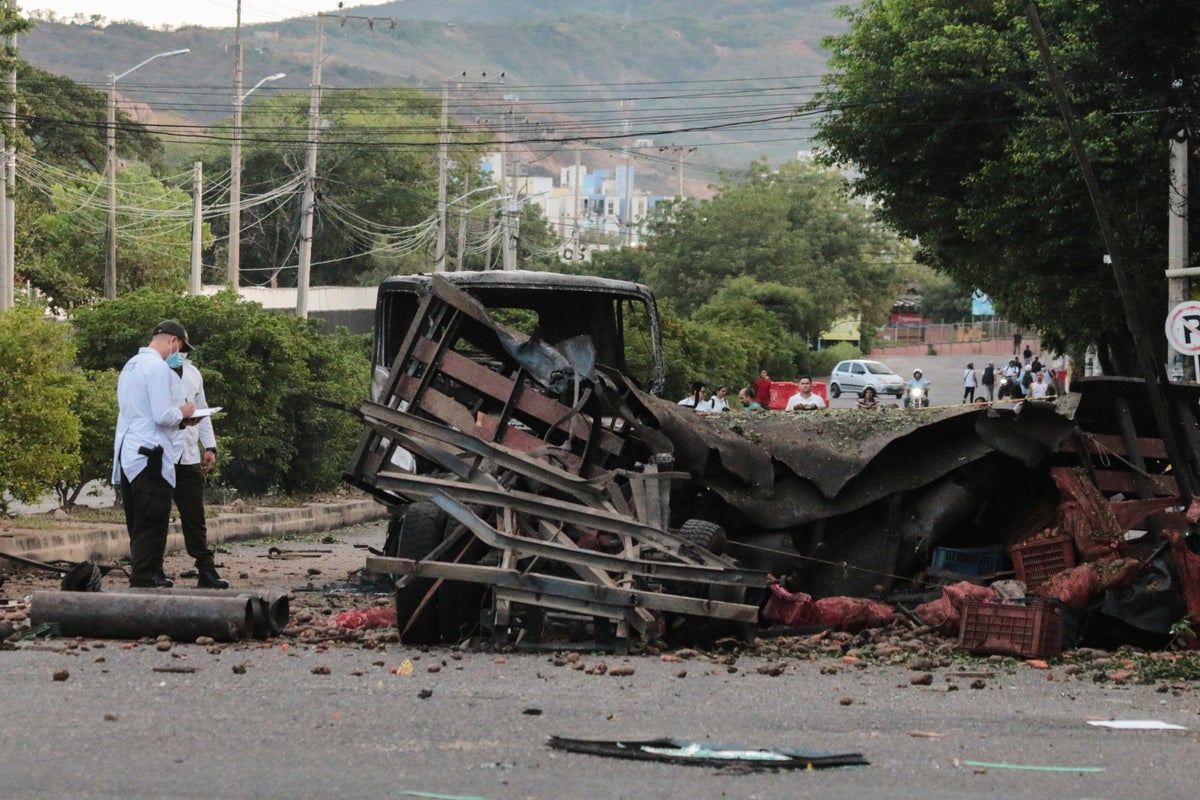
A devastating car bomb explosion detonated outside a police base in Colombia, injuring 11 people and killing a service dog, laying bare the persistent security vulnerabilities that continue to plague the nation's regional law enforcement installations despite years of counter-insurgency campaigns.
The blast tore through the perimeter of the facility, sending shockwaves through the surrounding neighborhood and instantly transforming a routine morning into a scene of chaotic urban warfare. Local authorities labeled the attack a vile terrorist act, pointing fingers at entrenched armed factions operating within the region. But beyond the immediate political condemnation lies a starker operational reality. How did a vehicle laden with explosives breach the immediate security perimeter of a heavily fortified police station? This incident is not merely an isolated act of desperation by remnant guerrilla groups or criminal syndicates. It serves as a diagnostic indicator of systemic surveillance failures, compromised intelligence networks, and the enduring difficulty of securing sprawling regional outposts against asymmetric threats.
Anatomy of a Regional Security Failure
Security at Colombian provincial police bases relies on a layered defense model. Concrete barriers, armed checkpoints, and intelligence-gathering units theoretically form an impenetrable shield. Yet, theory frequently collapses when confronted with the realities of asymmetric rural and semi-urban policing.
When a vehicle bomb successfully approaches a police installation, the failure begins long before the ignition is triggered. It points to a breakdown in tactical intelligence. Effective counter-terrorism in Colombia historically depends on human intelligence networks planted deep within suspicious communities. If a car can be acquired, modified to conceal heavy explosives, and maneuvered directly into the target zone without raising local red flags, the informational pipeline has failed.
Furthermore, physical hardening measures often lag behind evolving threat vectors. While major urban headquarters boast sophisticated electronic countermeasures and strict vehicular exclusion zones, smaller regional bases frequently operate with compromised infrastructure. Budget constraints, geographic isolation, and stretched manpower force commanders to make dangerous compromises. They trade deep-perimeter security for daily operational mobility.
The presence of explosive devices targeting these specific installations underscores a strategic calculation by the perpetrators. They seek to erode public confidence in state authority. By striking a police base, the attackers send a chilling message to the local populace. If the police cannot protect their own barracks, they cannot protect the citizenry.
The Broader Insurgent and Criminal Landscape
To understand why a police base in Colombia remains a primary target, one must examine the shifting dynamics of armed groups in the country. The landscape has mutated significantly since the historic peace accords with the Revolutionary Armed Forces of Colombia. The monolithic threat of the past has fractured into a decentralized network of dissident factions, criminal cartels, and transnational drug trafficking syndicates.
These groups often share a symbiotic relationship with local illicit economies. Cocaine production routes, illegal mining operations, and extortion rings generate the capital required to finance high-grade explosives and sophisticated operational planning. When state forces apply pressure on these economic lifelines, the armed actors retaliate symmetrically. They target the visible symbols of state presence.
- Dissident Factions: Groups that rejected the peace process retain ideological motivations combined with modern criminal pragmatism.
- Cartel Proxies: Purely criminal enterprises that utilize terror tactics exclusively to protect smuggling corridors from police interdiction.
- Urban Militias: Clandestine cells capable of blending into civilian populations to conduct reconnaissance and execute coordinated strikes.
The convergence of these entities creates a fluid threat environment. Intelligence analysts struggle to distinguish between a localized gang dispute and a planned insurgent campaign. This ambiguity hampers the ability of the national police to deploy preventative countermeasures before a bomb vehicle reaches its destination.
The Human and Operational Toll
Eleven people sustained injuries in the blast, ranging from shrapnel trauma to severe acoustic shockwaves. Among the casualties were both uniformed officers and civilians unfortunate enough to be transiting the area during the detonation. The psychological impact on the surviving personnel is immediate and enduring. Policing under the constant threat of sudden, catastrophic violence breeds hyper-vigilance, fatigue, and operational burnout.
The death of the service dog highlights another dimension of modern asymmetric warfare. K-9 units are indispensable assets for explosive detection, tracking, and perimeter security. The loss of a trained service animal is not just an emotional blow to the handler. It represents a direct degradation of the base's active defense capabilities.
When a base loses its detection animals and suffers structural damage to its communications and armory hubs, its operational radius shrinks. Officers become confined to defensive postures, hunkering down behind sandbags rather than conducting active patrols in the surrounding community. This defensive retreat creates a security vacuum. Armed groups eagerly exploit that vacuum to expand their territorial control, intimidate local merchants, and consolidate their illicit supply chains.
Re-Evaluating Counter-Terrorism Paradigms
For decades, the state's response to such attacks has followed a predictable script. Condemnation, deployment of high-level investigative committees, temporary reinforcement of the affected zone, and promises of enhanced security funding. Yet, cycle after cycle, the underlying vulnerabilities persist.
True security reform requires moving beyond reactive fortification. It demands a fundamental overhaul of how intelligence is gathered, analyzed, and shared between military and police commands. Bureaucratic friction between different branches of the security apparatus often creates blind spots that opportunistic attackers exploit. If intelligence regarding a vehicle movement is trapped in a regional headquarters database instead of reaching the patrol officers on the ground in real time, the technology is useless.
Additionally, the reliance on static infrastructure must be re-examined. Fixed police bases make attractive, stationary targets for actors who dictate the timing and terms of engagement. Shifting toward more mobile, decentralized operational footprints can drastically reduce the utility of pre-positioned car bombs. When targets move unpredictably, the calculus of planning a localized mass-casualty attack becomes exponentially more difficult for the perpetrators.
The car bomb outside the Colombian police base was designed to kill, maim, and terrorize. It achieved those grim objectives on a localized scale. However, its true significance lies in what it reveals about the long, difficult road ahead for a nation still struggling to translate peace agreements into ground-level security. Until the structural flaws in intelligence sharing, perimeter defense, and regional deployment are brutally confronted and systematically dismantled, these explosions will remain a recurring tragedy in the ongoing struggle for control over Colombia's contested territories.