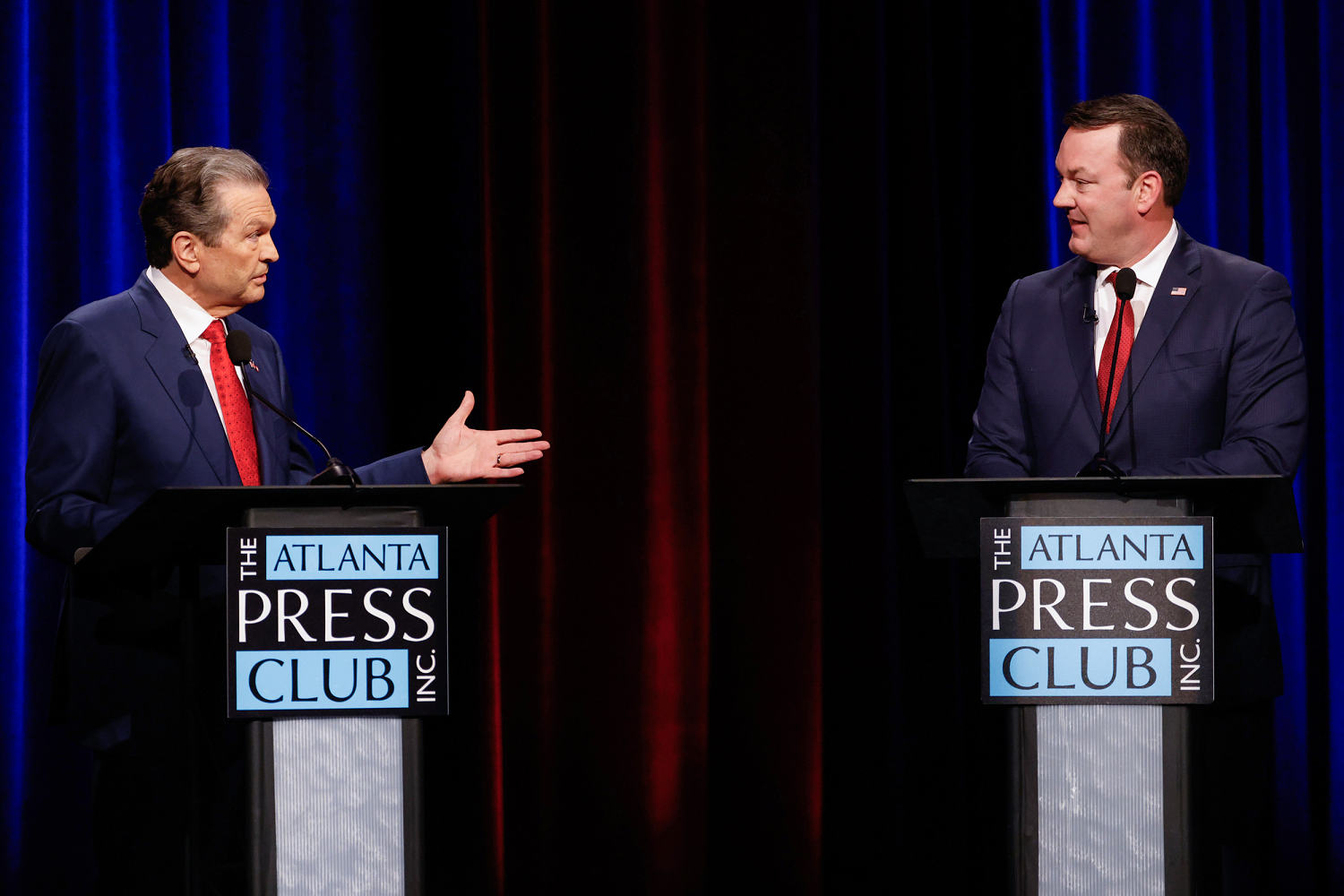
The outcome of the Georgia Republican gubernatorial primary establishes a fundamental structural shift in modern electoral politics: the complete institutionalization of populist rhetoric across competing intra-party factions. When Lieutenant Governor Burt Jones (37.2% of the vote) and healthcare billionaire Rick Jackson (34.5% of the vote) advanced to the June 16 runoff, the result did not represent a standard ideological split between a moderate establishment and a populist fringe. Instead, the primary eliminated the state's traditional constitutional institutionalists—Secretary of State Brad Raffensperger (14.9%) and Attorney General Chris Carr (11.3%)—redefining the runoff as an optimization problem between two distinct vectors of populist influence: institutional capture versus sheer capital deployment.
To evaluate this transition, political analysts must abandon binary metrics of "establishment versus outsider" and instead apply a rigorous framework analyzing how political capital, executive branding, and structural gatekeeping intersect within a shifting regulatory ecosystem.
The Strategic Matrix of the Multi-Candidate Field
The preliminary round of voting reveals a structural sorting of the electorate into three clear, mutually exclusive strategies. The distribution of the 553,971 total votes cast maps precisely onto these distinct strategic models.
1. The Institutional Purity Vector
Represented by Raffensperger and Carr, this model relied on the incumbent performance of the existing state executive branch. By capturing a combined 26.2% of the electorate, this faction demonstrated a hard ceiling for non-aligned, post-2020 institutional conservatism in Georgia. This segment of the electorate rewards administrative continuity but lacks the mobilizing velocity required to cross the 50% threshold in modern closed-loop primaries.
2. The Institutional Capture Vector
Executed by Burt Jones, this strategy leverages existing state authority to signal ideological alignment. Jones utilized his position as Lieutenant Governor to direct legislative mechanisms against his opponents, anchoring his campaign around an official endorsement from Donald Trump. This approach yielded 210,574 votes, establishing the structural baseline for dedicated partisan loyalists within the state.
3. The Uncapped Capital Vector
Deployed by Rick Jackson, this strategy treats the primary as an open market efficiency problem. Entering the race late in February, Jackson bypassed traditional grassroots infrastructure entirely, substituting it with unprecedented self-funding. Jackson captured 187,783 votes, demonstrating that absolute saturation of communication channels can rapidly manufacture a competitive electoral base from a position of zero initial name recognition.
The Expenditure Function and Airwave Saturation
The primary set a historical precedent as the most expensive gubernatorial primary in Georgia history, with aggregate spending exceeding $100 million. Analyzing the efficiency of this capital deployment reveals a stark divergence in the cost-per-vote (CPV) metrics between the two advancing candidates.
Candidate      Total Spent       Votes Received    Cost Per Vote (CPV)
----------------------------------------------------------------------
Burt Jones     $18,035,637       210,574           $85.65
Rick Jackson   $65,672,560       187,783           $349.73
Jackson’s expenditure profile demonstrates a severe diminishing marginal return on asset deployment. By spending $65.6 million to secure roughly 187,000 votes, Jackson ran an exceptionally inefficient acquisition strategy, operating at a CPV of $349.73.
By contrast, Jones's campaign combined $18 million in direct spending with the unmonetized equity of a Trump endorsement and statewide office holding. This execution yielded a CPV of $85.65. The $264.08 efficiency differential demonstrates that while raw capital can force a runoff, institutional posture and external endorsements function as massive force multipliers, dramatically lower the cost of voter acquisition.
This saturation created an inventory bottleneck in local media markets. Total advertising tracking from AdImpact indicated that the Republican primary consumed nearly all available linear television inventory in Georgia, crowding out down-ballot contests and leaving the parallel Democratic primary—where Keisha Lance Bottoms won outright with a total expenditure of roughly $3 million—virtually unadvertised.
Structural Asymmetry in Campaign Finance Regulation
The legal friction preceding the primary highlights a profound structural vulnerability in Georgia’s campaign finance architecture. Carr, Jackson, and Raffensperger filed concurrent lawsuits challenging a specific statutory loophole that permits incumbent state officeholders to utilize leadership committees. These committees can collect unlimited contributions, entirely bypassing standard individual donor caps, even during active legislative sessions.
As an active statewide official, Jones could leverage this mechanism to maintain a continuous fundraising apparatus. This institutional advantage created a severe regulatory asymmetry for non-incumbent challengers like Jackson, who, despite vast personal wealth, had to rely entirely on self-financing to match the velocity of an uncapped leadership committee. This structural variance explains Jackson’s choice to self-finance $83.5 million; it was the only mechanism available to overcome the structural asymmetry built into the state's incumbent-favoring regulatory framework.
The Policy Battleground and Risk Allocation
As the race narrows to a binary runoff, the policy debate has shifted from broad ideological declarations to precise, highly transactional vulnerabilities. Each candidate faces a distinct operational risk that the opposing campaign will seek to exploit to shift the remaining unaligned voters.
The Cartel versus Insourcing Dilemma
Jackson’s runoff strategy focuses heavily on framing Jones as the coordinator of a political "cartel" that uses state power for private enrichment. This attack is grounded in an objective legislative reality: Jones used his position as presiding officer of the state Senate to advance legislation designed to restrict Jackson’s healthcare firms from bidding on lucrative state-funded contracts.
While Jones frames this as protective oversight of taxpayer capital, Jackson has successfully leveraged the intervention to win endorsements from key legislative figures, such as House Speaker Pro Tem Jan Jones, who publicly criticized the lieutenant governor's use of institutional power.
The Outsider Out-Sourcing Vulnerability
Conversely, Jones has focused his attacks on Jackson’s operational core, targeting an admission made during the primary's sole televised debate. When questioned directly regarding the immigration status of domestic staff employed at his personal residence, Jackson responded, "I don't know."
This admission creates an acute narrative misalignment with his central policy platform, which advocates for the immediate deportation of undocumented immigrants convicted of crimes. In a Republican runoff where base turnout is highly dependent on immigration orthodoxy, this vulnerability introduces an operational bottleneck for Jackson’s messaging.
Runoff Optimization and Strategic Imperatives
To secure the nomination on June 16, both campaigns must shift from broad market saturation to highly targeted resource optimization. Runoff elections are characterized by a sharp drop in overall voter turnout, meaning the race will not be decided by converting independents, but by maximizing base retention and capturing the orphaned electorates of eliminated candidates.
The Jones Execution Vector
Jones must defend his 2.7 percentage point lead by converting the institutionalist voters who backed Chris Carr and Brad Raffensperger. To do this, he must pivot from pure anti-establishment rhetoric toward a message of stability and administrative competence, framing himself as a predictable executive who will protect the party's 24-year hold on the governor's mansion. Simultaneously, he must activate low-propensity voters by deploying Donald Trump for high-visibility rallies, using the endorsement to offset Jackson’s financial advantage in major media markets.
The Jackson Execution Vector
Jackson's path to victory requires sustaining his massive capital advantage while fundamentally altering his deployment strategy. Continuous, broad broadcast television advertising has reached saturation point and yielded diminishing returns. His campaign must reallocate capital toward highly sophisticated, micro-targeted ground operations and direct-to-voter digital campaigns.
His messaging must aggressively exploit the division between the state House and Senate leadership, positioning himself as a disruption agent who will dismantle insider privileges. He must capture at least two-thirds of the voters who backed Raffensperger and Carr by convincing them that an independent billionaire is less dangerous to the state’s economic climate than a politician who uses legislative power to target private enterprises.
