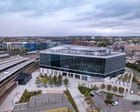
The commissioning of a half-billion-pound institutional asset represents a structural shift in how universities attempt to capture economic value from urban redevelopment. The launch of the Temple Quarter Enterprise Campus by the University of Bristol, anchored by the 38,000-square-meter Sloane Robinson building, is frequently framed through the lens of aesthetic novelty and regional regeneration. Beneath the architectural discourse lies a distinct exercise in balance sheet expansion, spatial optimization, and risk mitigation. Higher education institutions face compressed margins, volatile international student yields, and shifting delivery models. Constructing a heavy capital asset immediately adjacent to a major transit hub is an intentional mechanism designed to alter the fixed-cost equation of student acquisition and institutional retention.
The Spatial Arbitrage of Urban Megaprojects
Traditional campus layouts rely on suburban land banks acquired during periods of low capital costs. These legacy footprints incur high logistical friction, isolating academic departments from industrial application and forcing students into expensive residential submarkets. The location choice for this new site—the former Royal Mail sorting office adjacent to Bristol Temple Meads station—eliminates transit overhead and inserts academic infrastructure directly into a commercial transport node. In related developments, we also covered: The Structural Failure Points of Air Cargo Logistics: Deconstructing the Miami Prime Air Incident.
This placement exploits a specific economic variable: accessibility premium. By positioning the facility directly above and beside primary rail corridors, the institution widens its addressable market for commuter students. As private rental inflation outpaces disposable student income allowances, the total cost of attendance shifts heavily toward housing. Providing a high-density, transit-proximate campus creates an alternative economic model where students can bypass local residential leases entirely, preserving institutional enrollment volumes that might otherwise erode under cost-of-living pressures.
The Industrial Integration Matrix
Modern higher education infrastructure must justify its capital expenditure through direct economic feedback loops. Traditional academic silos fail to generate the commercialization revenue necessary to sustain advanced research in capital-intensive fields like quantum technologies, digital engineering, and artificial intelligence. The operating model deployed here relies on co-locating academic staff with over 300 enterprise partners inside a single physical envelope. The Wall Street Journal has analyzed this fascinating issue in extensive detail.
This proximity reduces transaction costs for collaborative research and development. When corporate entities embed teams within an academic facility, the friction of intellectual property negotiation and cross-organizational bureaucracy drops. The facility functions as a commercial incubator disguised as a lecture hall. Shared spaces like the Bristol Rooms and specialized zones designed for public-private friction operate as conversion funnels, turning raw academic research into market-ready applications while securing alternative funding streams outside of standard tuition revenue.
The Capital Expenditure Risk Profile
Deploying five hundred million pounds into a single physical asset introduces severe balance sheet exposure. Real estate projects of this scale are susceptible to timeline slippage, interest rate fluctuations, and post-occupancy structural maintenance burdens. To evaluate the viability of such investments, institutional leadership must balance physical asset depreciation against the velocity of technological obsolescence. Specialized laboratories for cybersecurity, advanced telecommunications, and quantum systems demand constant capital reinvestment to remain competitive.
If the revenue generated by industry partnerships fails to scale alongside the depreciation schedule of the hardware and real estate, the institution absorbs a structural deficit. Consequently, the success of the asset depends on maintaining high asset utilization rates across a twelve-month operating cycle rather than the traditional academic calendar. Shared circular lecture spaces and flexible collaboration hubs are designed to maximize utilization density, ensuring that square-footage output ratios remain high during non-teaching periods.
The Regional Economic Feedback Loop
Large-scale educational investments alter the surrounding real estate and labor dynamics. The Temple Quarter regeneration zone relies on the anchor institution to catalyze secondary commercial development, transforming a historically deprived neighborhood into a high-value knowledge cluster. For the university, this creates a localized talent pipeline. Graduates exit the facility directly into co-located enterprises, improving post-graduation employment metrics which subsequently feed back into institutional rankings and student recruitment metrics.
The operational dependencies of the campus require an integrated supply chain of local service providers, technology vendors, and municipal partners. Urban integration strategies that feature public pathways, civic engagement zones, and transit connections reduce political friction with local government bodies, securing zoning approvals and regional funding support that insulate the institution from regulatory shocks.
Execute the primary strategic play: Reallocate institutional capital expenditure models away from legacy residential expansion and toward high-density, transit-integrated mixed-use hubs that force immediate industrial co-location, thereby neutralizing commuter friction and capturing commercial R&D revenue streams.