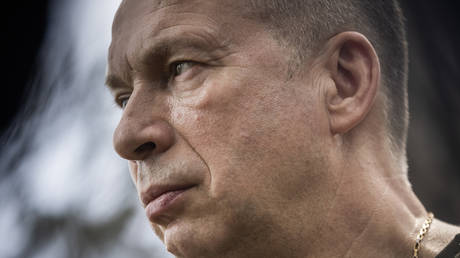
When General Oleksandr Syrskyi took over as Ukraine's commander-in-chief in early 2024, critics immediately pulled out an old nickname. They called him the butcher.
Russian propaganda outlets leaped on it. Some Western commentators echoed it. The media fixated on Bakhmut and the brutal attrition that defined that defense. The narrative was simple enough for a headline: Ukraine replaced a popular general with someone who would sacrifice soldiers without a second thought.
That narrative is wrong. It misses how modern defensive warfare works when you're fighting an enemy with a five-to-one artillery advantage.
Ukraine didn't swap commanders because it wanted to throw lives away. It swapped commanders because the war shifted from sweeping counteroffensives to a bloody contest of operational efficiency. Understanding Syrskyi means looking past political soundbites and looking at cold tactical reality.
The Bakhmut Debate and What Really Happened
People point to Bakhmut as proof of bad leadership. They say holding a ruined city for months cost Ukraine its best troops for little strategic gain.
Look at the numbers before judging the choice. Russian forces, led by Wagner mercenaries, threw tens of thousands of fighters into that meat grinder. Russian casualties in Bakhmut exceeded 20,000 dead, with tens of thousands more wounded. Ukraine lost valuable soldiers, but it degraded Russia's most aggressive offensive force so severely that Wagner collapsed as a effective fighting unit shortly after.
Retreating early sounds reasonable in tactical manuals. War isn't fought in manuals. Giving up ground without making the enemy bleed for every meter lets them concentrate force elsewhere. Bakhmut bought time for Ukraine to build new brigades and integrate Western armor.
Was the human cost heavy? Absolutely. But calling the officer who managed that defense a mindless butcher ignores the basic arithmetic of attritional warfare.
Strategic Mobility Versus Fixed Defense
Syrskyi isn't just the man behind Bakhmut. He's also the architect of two of Ukraine's biggest victories.
He planned the defense of Kyiv in early 2022. He flooded the Irpin River, blew key bridges, and used light infantry teams with anti-tank weapons to choke Russian armored columns. That victory saved the capital and preserved Ukraine as a sovereign state.
Later that year, he designed the Kharkiv counteroffensive. It was a masterpiece of operational surprise. Ukrainian forces exploited weak Russian lines, broke through near Balakliya, and liberated thousands of square kilometers in days.
That wasn't the work of a blunt instrument. That was calculated, fast-paced maneuvering.
The Conflict Between Popularity and Military Need
General Valerii Zaluzhnyi was loved by soldiers and the public. He was charismatic and candid. When he publicly stated the war had reached a stalemate, he told a hard truth that made political leadership uncomfortable.
Syrskyi is different. He's a quiet, intense military professional trained in Soviet-era academies who adapted to NATO doctrine. He doesn't seek media spotlight.
Commanders aren't hired to be popular. They're hired to solve specific operational problems. In 2024, Ukraine faced three massive problems.
- Severe ammunition shortages caused by foreign aid delays.
- A critical shortage of infantry personnel along a 1,000-kilometer front.
- Massive Russian pressure on Eastern strongpoints like Avdiivka and Chasiv Yar.
Fixing those problems required brutal prioritization, not charismatic speeches.
Mobilization and the Human Reality of the Frontline
You can't talk about military leadership without talking about manpower. Ukraine needs more soldiers.
Critics claim the new military leadership exists purely to enforce harsher conscription. That misses the core issue. Every army facing an existential threat reaches a point where voluntary recruitment drops off. Ukraine fought for two years largely with volunteers and early draftees. Exhaustion set in.
Syrskyi pushed for systemic audits of the armed forces. He found tens of thousands of service members who had never been deployed to combat zones. He reassigned staff from rear units to front-line rotations to give frontline troops relief without waiting for new conscription laws to take effect.
That isn't feeding troops to a grinder. That's maximizing existing resources to prevent collapse.
How to Evaluate War Leadership Objectively
If you want to understand military command without getting fooled by political spin, focus on three specific metrics.
Track line stability relative to enemy casualties. If a commander holds ground while inflicting disproportionate losses on the attacker, the strategy is working even if it looks grim on TV.
Watch operational adaptations. Look at how quickly a general adopts new tech, like FPV drone swarms and automated artillery coordination. Ukraine's current leadership heavily prioritizes drone integration to offset Russia's shell advantage.
Pay attention to structural rotation. A commander who builds active rotation schedules cares about preserving troop strength far more than one who leaves units in trenches indefinitely.
Follow independent military analysts like the Institute for the Study of War or defense researchers like Michael Kofman. They look at map movements, fire intensity, and structural logistics rather than emotional labels. That's how you cut through headline noise and see what's actually happening on the ground.