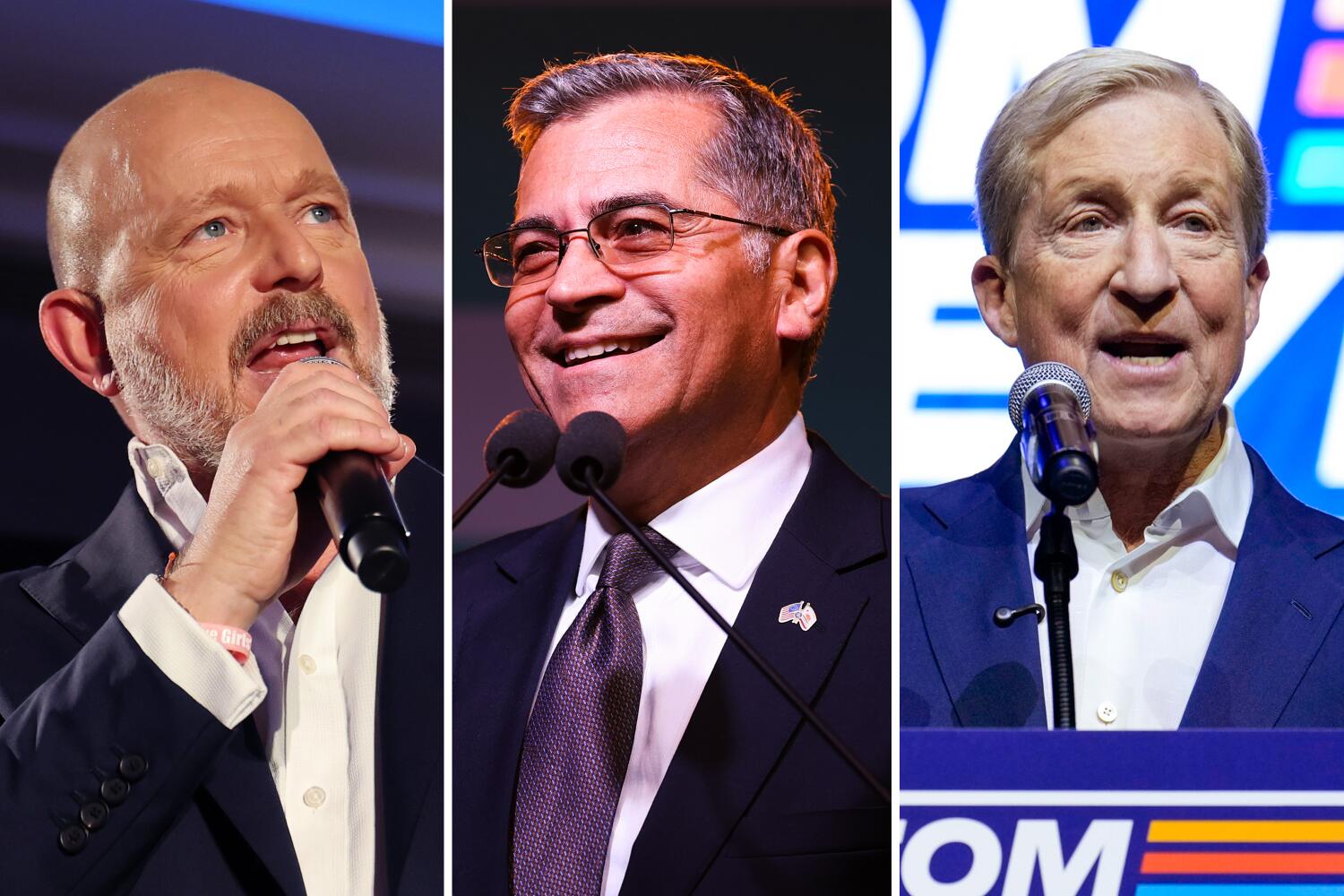
The media consensus on the California gubernatorial primary is out, and it is completely blind. Pundits are frantically analyzing the horse race between Republican Steve Hilton, Democrat Xavier Becerra, and the bleeding balance sheet of billionaire Tom Steyer. They call it an "unsettled" and "chaotic" contest. They point to Eric Swalwell’s sudden scandal-driven exit as the tectonic shift that reshaped the field.
They are wrong. They are reporting on the theater while missing the math.
This primary was never volatile. It was entirely predictable. The early returns showing Hilton and Becerra in the top two spots do not reveal a changing electorate or a chaotic race. They reveal a state executing the same, rigid tribal script it has followed for decades. The media is shocked that a quarter-billion dollars of self-funding could not buy Tom Steyer a ticket to November. Anyone who understands the basic mechanics of California political infrastructure knew he was lighting that cash on fire from day one.
The Myth of the $200 Million Kingmaker
Let’s dismantle the biggest narrative first: that Tom Steyer’s imminent elimination is a stunning upset or a rejection of "big money".
I have watched political consultants and wealthy vanity candidates burn fortunes in this state for twenty years. Steyer spent upwards of $215 million of his own net worth on television, radio, and digital ads. The pundit class treated this spending as a gravitational force that would inevitably pull him into the top two.
It was a liability, not an asset.
California’s jungle primary system rewards tribal consolidation, not saturation bombing. Steyer’s campaign lacked structural roots. Airwaves do not vote; organized networks do. In a state with 22 million registered voters spread across distinct, hyper-expensive media markets, television ads only buy name recognition, not loyalty. Steyer attempted a populist corporate-takeover strategy, but he forgot that the real shareholders of the California Democratic Party are public sector unions and entrenched regional machines.
When Eric Swalwell collapsed, those machines did not look for a billionaire outsider talking about seizing utilities. They looked for a predictable insider. They looked for Xavier Becerra.
Xavier Becerra and the Illusion of the Underdog
The media is pushing a classic narrative: Becerra the gritty underdog, mounting a late-stage surge after being counted out.
It is a total fabrication. Xavier Becerra was never an underdog. He is the ultimate institutional default asset.
| Candidate | Strategy | Real Status |
|---|---|---|
| Steve Hilton | Populist anti-tax rhetoric | Institutional floor for CA Republicans |
| Xavier Becerra | Institutional, steady hand | Default vehicle for Democratic machinery |
| Tom Steyer | Ad-driven progressive populism | Structural outsider with zero ground game |
Becerra did not surge because of brilliant campaigning or a sudden burst of momentum. He moved up because he was the only empty vessel available for institutional alignment once Swalwell vacated the lane. He carries the endorsements of organized labor and Hispanic legislative leaders. In California politics, that is not an underdog profile; that is the balance sheet of the incumbent machine.
Becerra’s entire pitch is that he knows how government works. He is campaigning as the continuation of the status quo. The mainstream press frames his rise as a sign that voters want a "steady hand" to fight the federal administration. The colder truth is that Democratic primary voters simply collapsed into the safest, most familiar brand name on the ballot because the alternative was a billionaire hedge-fund manager telling them to blow up the system.
Steve Hilton’s Ceiling is Made of Concrete
On the other side of the ledger, we have Steve Hilton celebrating outside the Capitol, claiming that "change is coming to California".
It isn't. Hilton is experiencing a mirage.
Hilton’s lead in the early returns—sitting around 26 to 28 percent—is nothing more than the baseline reality of the California Republican voter turnout. In a state where registered Democrats outnumber Republicans by nearly two-to-one, any viable, well-known Republican candidate who consolidates the conservative base will automatically advance to November under the top-two system.
The competitor articles suggest that Hilton’s message on the cost of living, gas prices, and tax cuts is generating a cross-partisan groundswell. This is lazy analysis. Hilton is an immigrant former Fox News host who carries a direct endorsement from Donald Trump.
Imagine a scenario where a Republican tries to win a general election in California while carrying the Trump banner. It is a mathematical impossibility.
The moment this primary transitions into a head-to-head general election, the race nationalizes instantly. The policy debates over gas taxes, electricity rates, and housing costs will disappear. They will be replaced by a massive, institutional Democratic messaging operation designed to turn the election into a referendum on the national GOP.
Hilton has hit his ceiling in June. He has nowhere to grow in November.
PAA: The Flawed Premise of California Politics
When people look at the data, they inevitably ask the same questions. The problem is they are asking the wrong ones.
Can a Republican actually win the California governorship?
The premise assumes that a compelling message on affordability can break through partisan registration advantages. It cannot. A Republican cannot win statewide office in California without a total fracture in the Democratic coalition or a candidate who actively rejects the national party platform. Hilton cannot and will not do that. His primary victory is an artifact of the top-two system, not an indicator of a shifting electorate.
Why did Tom Steyer's record-breaking spending fail?
Because money can only buy inputs (ads, mailers, staff), not outputs (votes). Steyer tried to run a top-down campaign based on ideological purity and high-production media. In doing so, he alienated the existing corporate interests without locking down the grassroots organizing power of the labor unions. He became a candidate without a country: too radical for the establishment, too wealthy for the populist left.
The Real Crisis Everyone is Ignoring
The true story of this primary isn't who won or who lost. It is the absolute disconnect between the state’s actual crises and the solutions being offered by the two men heading to November.
California is facing an existential affordability crisis. Average gas prices are floating above six dollars a gallon. The median home price is an astronomical $775,000. Electricity rates are the second highest in the nation. The "California Dream" is actively being choked out by structural, legislative failure.
What are the solutions being offered?
Hilton claims he will make the first $100,000 of income tax-free and simply "slash regulations". It is a standard, supply-side boilerplate that has zero chance of passing a supermajority Democratic legislature. It is a fantasy script written for a cable news audience.
Becerra offers nothing but steady stewardship of the exact machine that created these conditions. He is pitching himself as a defensive shield against Washington, completely ignoring that the economic pressures driving working families out of the state are entirely home-grown.
The media calls this race "unsettled" because the vote counting takes time. But politically, the outcome was settled before the first ballot was cast. The institutional machine chose its protector, the conservative minority chose its avatar, and the billionaire learned that even in a capitalist society, you cannot buy your way past an entrenched political monopoly.
Stop looking at the shifting percentages in the late-night tallies. The script is written. The general election will be a predictable, high-spending exercise in partisan polarization, and the structural failures tearing at the fabric of the state will remain entirely untouched.


