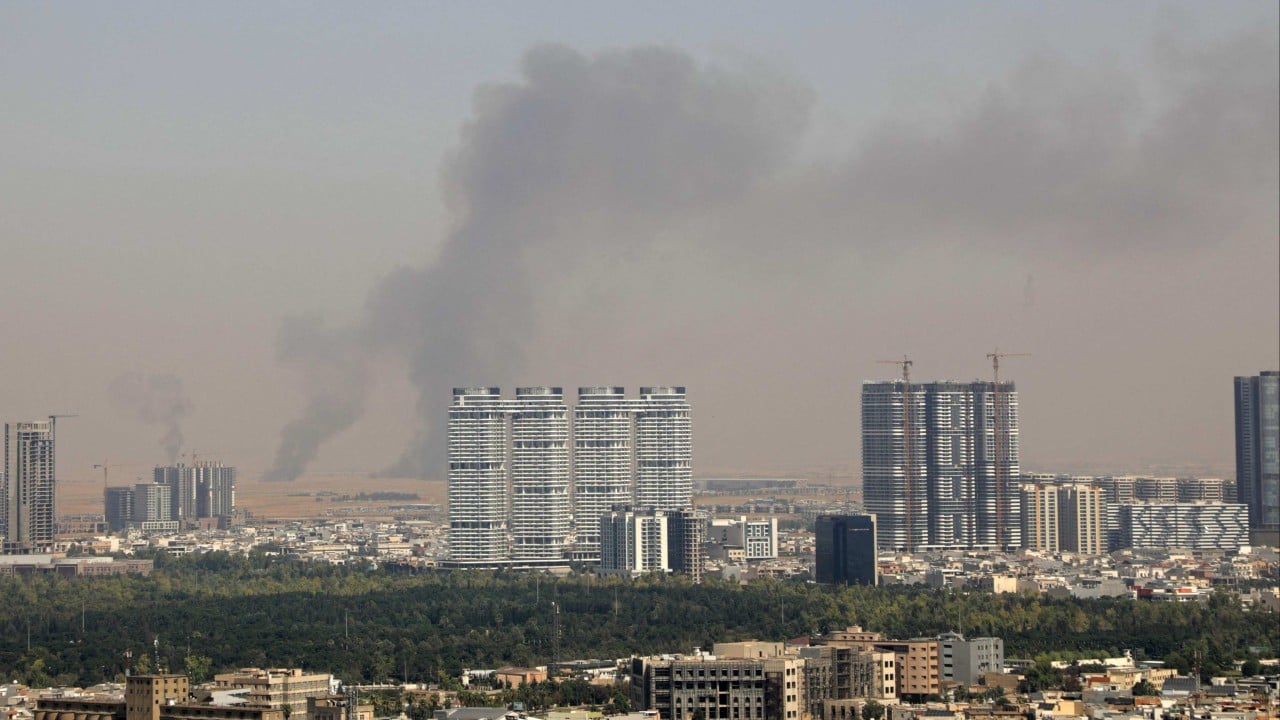
Sirens Are Cheap, Doctrine Is Expensive
Media outlets run the same script every time a siren wails in Manama or a controlled explosion rattles the perimeter of an airbase near Erbil. Red banner breaking news text flashes across the screen. Pundits adjust their mics and immediately invoke words like "unprecedented," "spiral," and "full-scale regional war."
It is high-drama television. It is exceptionally poor geopolitical analysis.
What the mainstream coverage treats as an alarming leap up the escalation ladder is, in reality, the precise opposite: a carefully calibrated, ritualized exchange designed to satisfy domestic audiences while explicitly avoiding systemic conflict. The headlines report noise as signal. They treat predictable, low-margin kinetic grandstanding as a sudden breakdown in regional stability.
If you want to understand what is actually happening between Washington, Tehran, and proxy networks across Iraq and the Gulf, you have to look past the siren footage and start counting the actual strategic trade-offs.
The Myth of the Uncontrollable Kinetic Spiral
The standard media narrative relies on a fundamental misconception about how asymmetric conflict works. The narrative assumes that every rocket launch or counter-strike inherently risks "pushing" both sides over an invisible threshold into outright warfare, as if state actors are blindfolded drivers coasting toward a cliff.
They are not coasting. They are navigating with millimeter precision.
Consider the mechanics of these flare-ups. A militia fires short-range artillery or low-cost kamikaze drones toward an isolated sector of a base housing US personnel. Sirens blare across neighboring Gulf capitals out of standardized, automated protocol—not because a carpet-bombing campaign has commenced. Air defense systems like C-RAM or Patriot batteries intercept the incoming ordinance, or the projectiles land in open scrubland.
Within two hours, news networks declare a historic escalation. Within four hours, military command releases a statement confirming minimal structural damage and zero fatal casualties.
This is not the breakdown of deterrence. This is deterrence operating as a managed utility.
+-----------------------------------------------------------------------+
|                       THE ESCALATION ILLUSION                         |
+-----------------------------------------------------------------------+
| MAINSTREAM PERCEPTION                  STRATEGIC REALITY              |
|                                                                       |
| Explosions heard near base  ---------> Uncontrolled regional spiral    |
| Sirens activated in Gulf    ---------> Imminent multi-state invasion   |
| Kinetic response issued     ---------> Deterrence failure             |
|                                                                       |
| CORRECTION: These actions are low-cost, calculated posture signaling. |
+-----------------------------------------------------------------------+
I have spent years watching defense analysts and intelligence practitioners break down satellite imagery and communications telemetry following these events. The pattern rarely shifts. Both sides operate under strict, unspoken rules of engagement that prioritize telegraphing intent over maximizing casualties.
When an adversary actually intends to alter the regional balance of power, they do not fire two unguided rockets at a fortified garrison with thirty minutes of pre-launch radar signatures. They launch saturated, multi-axis strikes targeting critical infrastructure without warning. Everything else is theater with live ammunition.
Why the Media Misses the Real Conflict
Why does mainstream reporting consistently misread these events? Because panic sells subscriptions, while structural analysis requires actual effort.
The press treats every incident as an isolated crisis rather than a routine line item in a decades-long war of attrition. By focusing exclusively on the immediate geography—Erbil, Manama, Baghdad—reporters miss the real battlespace, which has almost nothing to do with low-yield explosions in Iraq and everything to do with economic insulation, maritime shipping insurance, and domestic political preservation.
1. The Domestic Audience Trap
Every projectile launched in Iraq or Syria is aimed primarily at political factions in Tehran and Washington, not the soldiers on the ground. For regional state actors and their network of regional partners, firing a barrage allows them to project resistance without triggering a sovereign response that would obliterate their economic posture. For Washington, localized counter-strikes demonstrate "resolve" without requiring a Congressional war authorization that would paralyze an administration’s domestic agenda.
2. The Asymmetry of Cost
Reporters highlight the financial value of the targeted installations, but they overlook the attrition math. A drone costing $20,000 forces the deployment of a $2 million interceptor missile. The objective of the strike was never to destroy the base; it was to bleed the logistics tail of the defensive network while forcing Gulf states to absorb the political friction of hosting those defense assets. The explosion isn't the story. The burn rate of high-end air defense interceptors is.
3. The Protocol Fallacy
When sirens sound in Bahrain, newsrooms treat it as proof of direct target selection. In reality, modern integrated air and missile defense frameworks trigger wide-area alerts automatically whenever a vector trajectory crosses designated radar sectors. The siren is a risk-averse algorithm doing its job, not confirmation that a hotel or naval headquarters is under direct bombardment.
People Also Ask: The Real Questions Answered
Understanding this conflict requires shedding the naive assumptions that populate standard search engine queries.
"Is this the start of a regional war in the Middle East?"
No. A regional war requires a fundamental shift in state objectives, including the deployment of maneuver forces, sustained strategic bombing of deep-tier infrastructure, and the willingness of major powers to sustain catastrophic economic disruption. None of the actors involved currently possess the fiscal reserve or domestic mandate to survive an unconstrained war. What you are witnessing is a contained, persistent conflict that has existed in various intensities for over twenty years.
"Why do US bases in Iraq keep getting attacked?"
Because they exist in a strategic vacuum. US forces remain in Iraq primarily for counter-ISIS stability operations and to signal a footprint. However, their physical presence provides a fixed, geographic target for local militias seeking to exert political leverage over the central government in Baghdad. The bases are hit precisely because they are static, reachable, and politically sensitive enough to guarantee a news cycle.
"Are Gulf nations like Bahrain directly targeted?"
Rarely in a direct, counter-force capacity during these specific engagements. Host nations in the Gulf accommodate vital naval and air assets. When alerts trigger in these countries, it is almost exclusively due to atmospheric intercept debris or early-warning tracking of long-range vectors heading elsewhere. Highlighting "sirens in Bahrain" creates the illusion that the entire Arabian Peninsula is under siege, which conflates routine defensive readiness with active bombardment.
The Risk Nobody Is Discussing
Does this mean the situation is entirely without danger? Absolutely not. But the danger is not the cinematic, overnight regional war that cable television promises every time a siren blares.
The actual risk is miscalculation through operational friction.
When both sides rely on highly calibrated, low-yield exchanges to maintain their political standing, they rely on perfect intelligence and flawless hardware performance. If an unguided rocket strays off its intended trajectory due to a guidance system failure and impacts a high-density living quarter instead of an empty parade ground, the diplomatic maneuvering room vanishes instantly.
+--------------------------------------------------------------------+
|                      THE TRUE CATALYST PATH                        |
+--------------------------------------------------------------------+
| Intentional Escalation Strategy  ---> (LOW RISK)                   |
|   - Both parties calculate costs; keep strikes below lethal threshold|
|                                                                    |
| Hardware/Guidance Failure        ---> (HIGH RISK)                  |
|   - Stray projectile hits high-density personnel quarters         |
|   - Political insulation disappears; retaliatory cycle forced      |
+--------------------------------------------------------------------+
The danger isn't that political leaders suddenly decide to burn down the international system. The danger is that their cheap, theater-state strikes run into a mechanical error, leaving leaders trapped by their own public rhetoric.
The contrarian truth is simple: the loud explosions reported on the evening news are the safest part of this dynamic. They represent the established, predictable language of managed tension. The real structural shifts happen quietly—in energy market insurance adjustments, covert maritime interdictions, and weapons stockpile accounting—far away from the breaking news chyrons and the automated sirens.
Stop evaluating geopolitical risk by the volume of the siren. Start evaluating it by the economic capacity and strategic constraints of the actors pulling the triggers.


