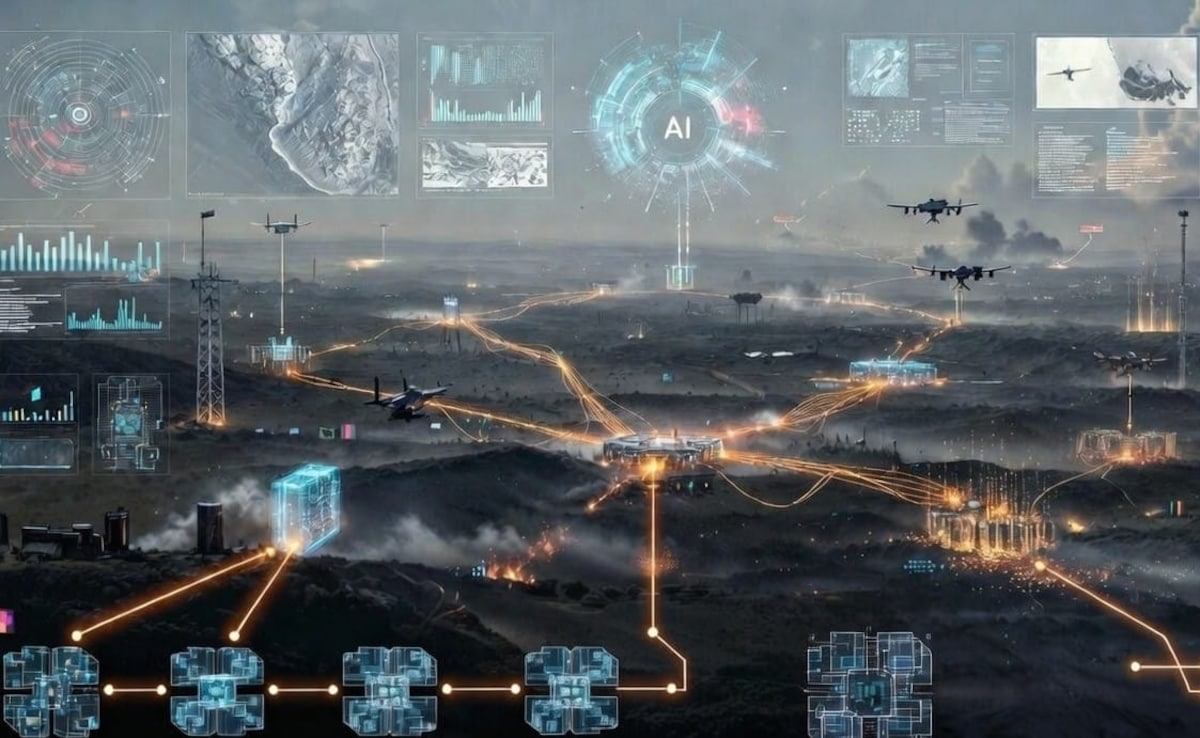
Ukraine is no longer just fighting a war of maneuvers; it is conducting a mass-scale laboratory experiment in algorithmic attrition. By the spring of 2026, the pretense of "human-in-the-loop" warfare is dissolving under the pressure of a 1,200-mile front where electronic jamming makes traditional remote piloting impossible. The primary goal is now the systematic replacement of human decision-making with fully autonomous kill chains to offset Russia’s massive personnel advantage.
The numbers reveal the sheer scale of this transition. In March 2026, drones were responsible for 96% of Russia's 35,551 battlefield casualties. Throughout 2025, Ukrainian automated systems killed or seriously wounded more than 240,000 Russian soldiers. Kyiv is no longer satisfied with sporadic strikes. The operational mandate is now to target 50,000 soldiers per month using AI-driven systems that do not require a steady radio link to a human operator. For another look, consider: this related article.
The End of the Remote Pilot
For the first two years of the conflict, the FPV (First Person View) pilot was the undisputed king of the battlefield. That era is over. Russian electronic warfare (EW) has become so dense that the electromagnetic spectrum is essentially a "no-go zone" for standard radio-controlled aircraft. High-power jamming systems now create "black holes" where signals from a pilot’s goggles to the drone are instantly severed.
To survive, the drones have evolved. Ukraine has moved from simple flight stabilization to terminal autonomous guidance. When a drone enters a jammed zone and loses its connection to the pilot, an onboard computer vision system takes over. Similar reporting on the subject has been shared by The Next Web.
It does not "wait" for a signal. It identifies the shape of a T-72 tank or a BMP infantry vehicle from a pre-loaded library of thermal and visual silhouettes. Once a match is confirmed, the drone locks on and strikes without a single bit of data crossing the airwaves. This is not a future concept. It is a daily reality handled by platforms like the Saker Scout and various locally produced "dark" drones that operate in total radio silence.
The Brave1 Data Factory
The secret to this autonomy isn’t a single "genius" chip, but a massive industrial pipeline of data. Ukraine has established the Brave1 Dataroom in partnership with Western firms like Palantir. This is a secure, centralized vault where thousands of hours of real battlefield footage—including successful strikes, near misses, and failed target identifications—are fed into machine learning models.
The Feedback Loop
- Collection: Frontline units upload raw data from drone cameras and thermal sensors daily.
- Annotation: Human "labelers" identify targets in the footage to teach the AI what a camouflaged Russian soldier looks like compared to a civilian or a tree.
- Deployment: Refined algorithms are pushed back to the front via satellite links, updating the "brains" of thousands of drones simultaneously.
This creates a software-driven arms race where a Russian countermeasure developed on Monday can be analyzed on Wednesday, with a software patch deployed across the entire Ukrainian drone fleet by Friday.
The Illusion of Meaningful Control
As the tempo of combat increases, the role of the human has shifted from "pilot" to "notary." In modern command centers, AI platforms like Gotham correlate data from satellites, intercepted radio signals, and reconnaissance drones to suggest hundreds of targets per hour.
A human officer might have only 20 seconds to review each recommendation. In many cases, the "review" consists merely of confirming the target is male and wearing a hostile uniform. This "nominal input" satisfies the legal requirement for human oversight, but it is functionally irrelevant to the speed of the machine. The sheer volume of data makes it impossible for a human brain to provide a qualitative analysis of proportionality or necessity for every strike.
The machine suggests. The human signs. The drone kills.
The Economics of Autonomy
The financial disparity is the most staggering aspect of this shift. A traditional 155mm artillery shell now costs approximately $4,000 to $8,000, and a single M1 Abrams tank costs over $10 million.
In contrast, a basic Ukrainian suicide drone costs roughly $400. Even with an added AI "brain" for autonomous terminal guidance, the price rarely exceeds $1,200. By utilizing commercial off-the-shelf parts and open-source firmware, Ukraine has achieved a cost-to-kill ratio that traditional Western defense contractors cannot match.
| Weapon System | Estimated Cost | Primary Weakness |
|---|---|---|
| Abrams Tank | $10,000,000+ | Vulnerable to $500 top-down strikes |
| 155mm Shell | $5,000 | Limited supply, requires heavy logistics |
| AI FPV Drone | $1,200 | Limited range, small payload |
Russia’s Pragmatic Pivot
Russia is not standing still. While Western analysts often focus on Ukraine's tech ecosystem, the Russian military has prioritized tactical automation. Rather than building broad, experimental AI frameworks, Moscow has focused on "hard" TRL 6–9 levels of technology: computer vision, sensor fusion, and signal analysis.
By early 2026, roughly 80% of Russian fire missions are conducted by unmanned systems. They have moved away from centralized jamming toward "intelligent EW" that sends corrupted data packets to overload drone receivers. The conflict has become a struggle between two competing software stacks, each trying to find a bug in the other’s targeting logic.
The Problem With the "Kill Switch"
The push for full autonomy is driven by necessity, but it introduces a permanent instability into modern warfare. If a drone is programmed to strike anything that matches a specific thermal signature, it cannot distinguish between a disabled vehicle being salvaged and one preparing for an attack. It cannot recognize a surrender.
Furthermore, as these systems become more autonomous, the "kill chain" becomes a "kill web." Responsibility for a strike is no longer tied to one pilot, but is distributed among data engineers, software developers, and the commanders who authorized the algorithm's deployment. When an autonomous system makes a mistake, there is no single individual to hold accountable.
The battlefield is no longer a place of human courage or tactical brilliance alone. It is an optimization problem. Ukraine is betting that by saturating the front with low-cost, high-autonomy machines, they can make the cost of Russian occupation—both in blood and in rubles—mathematically unsustainable. The transition to algorithmic warfare is not a choice; it is the only way to survive a war of attrition against a larger neighbor.
The "human-in-the-loop" is becoming a ghost in the machine, a legal placeholder in a process that now moves too fast for human thought.