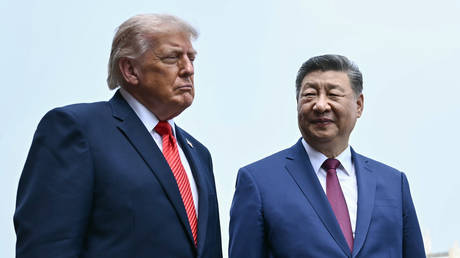
While the cameras in Beijing captured the carefully choreographed walk through the Temple of Heaven on May 14, 2026, the real story wasn't in the handshakes between Donald Trump and Xi Jinping. It was in the silence from Tokyo, the frantic hedging in Seoul, and the cold calculations being made in the boardrooms of Southeast Asia.
The core premise of this summit—a "stability" mission to manage a rivalry that has already spiraled into triple-digit tariffs and a naval blockade in the Middle East—is a convenient fiction. The primary goal for Washington is to secure "deliverables": Chinese purchases of Boeing aircraft, soybeans, and LNG to patch a politically bruised administration. But for the rest of Asia, this isn't a diplomatic reset. It is a moment of profound realization that the old security architecture is dead, and the new one is being traded for purchase commitments.
The Transactional Trap and the Taiwan Question
The most jarring shift in this summit is the sudden, terrifying fluidity of Taiwan’s status. For decades, the "One China" policy was a bedrock of strategic ambiguity. Now, it has become a bargaining chip.
By indicating he would discuss the $11 billion arms package for Taiwan with Xi, Trump has signaled to the region that security guarantees are no longer ironclad; they are line items. This creates a massive credibility gap. If the U.S. is willing to negotiate away a primary security partner for a few million tons of soybeans and a "Board of Trade" mechanism, what does that mean for Japan or South Korea?
The reaction from Taipei and Tokyo is a mixture of quiet fury and accelerated self-reliance. They are watching a president who views geopolitics through the lens of a balance sheet. To Trump, a stable relationship with Xi is more valuable than the ideological defense of a democracy. To Xi, this is the ultimate validation of his "patience" strategy. He is waiting for the U.S. to price itself out of its own alliances.
Why the Tariffs Actually Strengthened China
There is a persistent myth in Washington that the 2025 trade war weakened China. The data suggests the opposite. While Chinese exports to the U.S. fell by nearly 20% in 2025, their global exports surged by 21% in the first months of 2026.
China didn't just survive the tariffs; it repositioned itself inside the global system.
- The ASEAN Proxy: Chinese firms moved manufacturing to Southeast Asia at a pace Western analysts missed. They didn't leave; they rebranded.
- Market Diversification: Beijing aggressively pivoted to the Global South, building a trade network that bypasses U.S.-led financial structures.
- Resource Leverage: By curbing rare earth exports, China proved it can choke the global tech supply chain whenever it feels squeezed.
The new 10% global tariff implemented in February 2026 under Section 122 was meant to be a hammer. Instead, it has acted as a catalyst for "de-dollarization" and regional integration that excludes the U.S. completely.
The Hormuz Factor and the Energy Dilemma
We cannot look at the Beijing summit without looking at the Persian Gulf. The ongoing war in Iran and the closure of the Strait of Hormuz have made energy security the silent third party in the room.
China depends on Gulf oil. The U.S. wants China to use its influence over Tehran to reopen the shipping lanes. This gives Xi a lever he hasn't had in previous summits. He can trade "stability" in the Middle East for "flexibility" in the South China Sea. It is a classic geopolitical swap, but the cost is borne by the smaller Asian nations that rely on U.S. naval supremacy to keep those same lanes open.
The Silicon Wall and the AI Arms Race
The technology war remains the only area where the two powers are not even pretending to cooperate. While the summit agenda mentioned "AI safety," it is a smokescreen. The U.S. is still tightening the screws on advanced lithography, trying to prevent China from producing sub-5nm chips.
However, the "Silicon Wall" is leaking. Despite export controls, China has made significant leaps in indigenization. By giving the green light for Nvidia H200 sales earlier this year, Washington essentially admitted that total containment is impossible. The industry is now split into two distinct ecosystems: one centered on American standards and another on Chinese-integrated supply chains. For companies in Singapore or Vietnam, this means they have to build two versions of every product—an expensive, redundant, and ultimately unsustainable reality.
The End of the Goldilocks Era
For years, Asian governments thrived in a "Goldilocks" zone: they relied on the U.S. for security and China for prosperity. That era ended in Beijing this week.
The summit has proven that the U.S. is moving toward a "Fortress America" model of transactional isolationism, while China is building a "Sino-centric" order that rewards those who play by its rules. There is no middle ground left.
Countries like Malaysia and Indonesia are already voting with their feet, seeking membership in expanded trade blocs that don't come with the baggage of U.S. domestic politics. They are tired of being the grass that gets trampled when the elephants fight, and they are even more tired of being the grass that gets ignored when the elephants decide to dance.
The Beijing summit won't end the rivalry. It will simply codify the terms of a long, grinding stalemate where the U.S. gets its purchase orders, China gets its regional sphere of influence, and the rest of Asia is left to fend for itself in a fractured world.
The age of the superpower protector is over. The age of the regional mercenary has begun.