Singapore achieves water security by converting treated sewage into ultra-clean, drinkable water known as NEWater through a rigorous three-stage process of microfiltration, reverse osmosis, and ultraviolet disinfection. This recycled wastewater meets up to 40 percent of the island nation's daily water demands, exceeding World Health Organisation standards for purity. By capturing every drop of runoff and recycling its effluent, Singapore has transformed an existential vulnerability into a highly controlled, closed-loop technical triumph.
Yet, behind the gleaming visitor centers and the sterile bottles of recycled water distributed at national parades lies a far more complex reality. It is a story of geopolitical desperation, punishing energy bills, and a masterfully executed psychological operation that changed the mind of an entire population.
The Geopolitical Gun to the Head
To understand how Singapore treats its sewage, you must first understand why it had no choice. Water in Singapore was never just a utility. It was a matter of national sovereignty.
In 1942, British forces surrendered the island to the invading Japanese army. The decisive blow was not struck on the battlefield, but at the pipelines. The Japanese captured the Johor reservoirs in neighboring Malaya and severed the water supply. That lesson burned itself into the collective memory of the nation's founding leadership. When Singapore became an independent state in 1965, it remained bound to Malaysia by two water agreements signed in 1961 and 1962. These agreements allowed Singapore to draw up to 250 million gallons of raw water daily from the Johor River.
The arrangement was inherently unstable. For decades, Malaysian politicians threatened to shut off the valves whenever bilateral tensions flared. Water was a diplomatic weapon.
Singapore's Historical Water Dependency:
[Local Catchments] + [Imported Water from Malaysia]
                       |
                       v (The Threat of Supply Disruption)
[Existential Sovereign Risk]
The 1961 agreement expired in 2011. The 1962 agreement is set to expire in 2061. Long before these deadlines, Singapore’s Public Utilities Board (PUB) realized that relying on a neighbor for survival was a losing strategy. The state needed to decouple its survival from foreign geography.
Inside the Reclamation Infrastructure
The technology behind NEWater is often described in promotional brochures as a simple, elegant sequence. The engineering on the ground is brutally industrial and unrelenting.
Raw Sewage -> Secondary Treatment -> Microfiltration -> Reverse Osmosis -> UV Disinfection -> NEWater
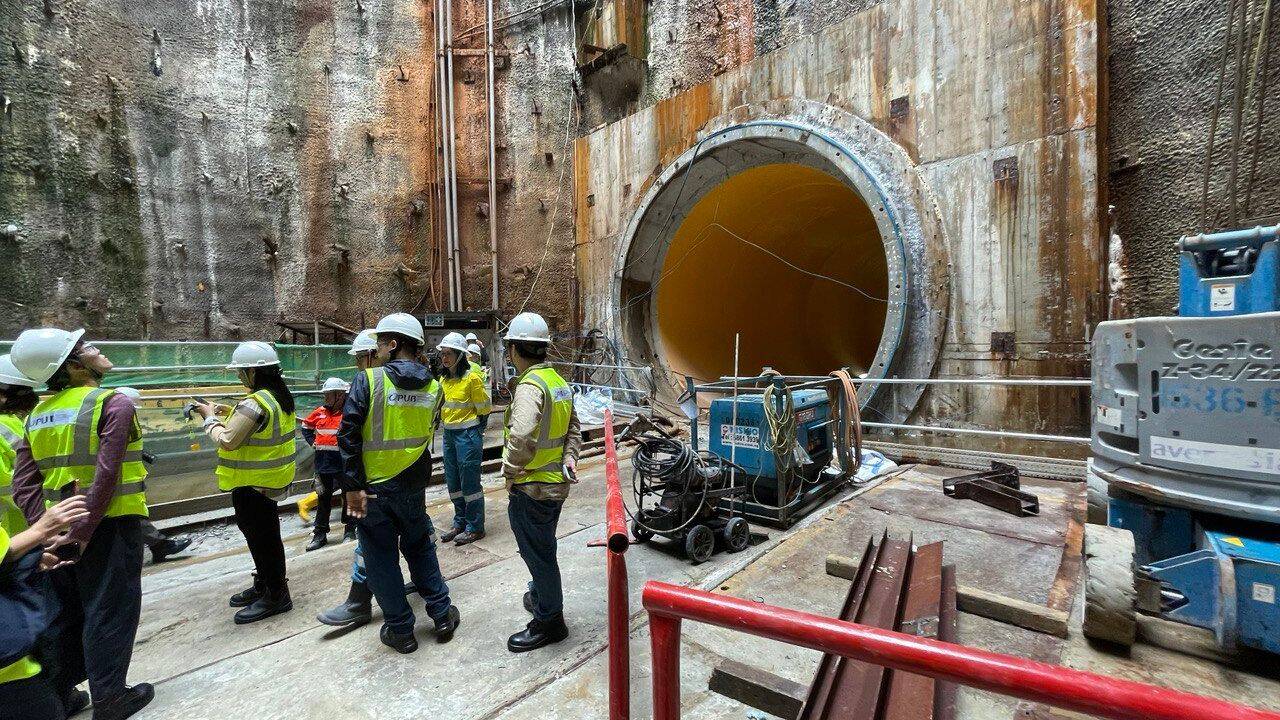
The process begins long before water reaches the reclamation plants. Singapore built the Deep Tunnel Sewerage System, a massive underground superhighway. This network uses gravity to channel used water from homes and industries down to centralized water reclamation plants located on the coastal fringes of the island.
Once the sewage arrives, it undergoes conventional secondary treatment to settle out solids and break down organic sludge. The real purification work begins after this stage.
The First Barrier: Microfiltration
The treated effluent is pumped through thousands of hollow-fiber membranes. These fibers are punctured with microscopic pores measuring just 0.04 microns in diameter.
To put that in perspective, a human hair is roughly 70 microns wide. The pores are small enough to physical trap suspended solids, colloidal particles, and virtually all bacteria.
As water is forced through these fibers under pressure, the physical debris is left behind. What emerges is a clear liquid, but it is still far from drinkable. It still contains dissolved salts, viruses, and complex chemical compounds.
The Second Barrier: Reverse Osmosis
This is the expensive, high-pressure core of the system. The water is forced through a semi-permeable membrane with pores so unimaginably small that they are measured at the molecular level.
Only water molecules can pass through. Dissolved mineral salts, heavy metals, pharmaceuticals, nitrates, and viruses are blocked and discarded in a concentrated waste stream.
The engineering challenge here is immense. The membranes easily foul. Organic matter and mineral scales build up on the surfaces, requiring frequent, aggressive chemical cleanings that degrade the membranes over time. The plant operators must constantly balance pressure, flow rate, and chemical dosages to prevent the system from grinding to a halt.
The Third Barrier: Ultraviolet Disinfection
As a final safety net, the water passes through an ultraviolet disinfection chamber. This step serves as an insurance policy.
The intense UV light destroys any residual trace of organic materials and neutralizes any viruses that might have survived a microscopic defect in the reverse osmosis membranes.
The result is water of shocking purity. It is actually too pure. Because it lacks the natural minerals found in groundwater, it is highly corrosive to metal pipes. To prevent the water from eating away at the distribution network, the PUB must add trace minerals back into the water, or blend it with raw reservoir water before it enters the domestic supply.
The Deepening Energy Dilemma
Every drop of recycled water carries an energy tax. This is the quiet trade-off of the closed-loop system.
Pushing millions of gallons of water through reverse osmosis membranes requires enormous mechanical force. This force is generated by high-pressure pumps driven by electricity. While recycling wastewater is significantly more energy-efficient than seawater desalination, it still consumes vastly more energy than treating traditional rainwater.
- Rainwater Treatment: Consumes roughly 0.2 kilowatt-hours of electricity per cubic meter.
- Wastewater Recycling (NEWater): Consumes approximately 1.0 kilowatt-hours per cubic meter.
- Seawater Desalination: Consumes upwards of 3.5 kilowatt-hours per cubic meter.
Singapore has negligible domestic fossil fuel reserves. It generates the vast majority of its electricity by burning imported liquefied natural gas.
This creates a tense, inescapable vulnerability. By solving its water crisis through technology, Singapore traded a direct water dependency for an indirect energy dependency. If global energy markets spike, the cost of keeping the taps running rises along with them.
To mitigate this, researchers are desperate to find ways to lower the energy threshold of reverse osmosis. They are experimenting with biomimetic membranes that mimic the aquaporin proteins found in human kidneys, which transport water molecules naturally with minimal pressure. But translating these lab-scale discoveries into industrial-scale realities is proving slow and incredibly expensive.
Winning the Psychological Warfare
The greatest hurdle to recycling wastewater was never the science. It was the human stomach.
The "yuck factor" has killed water reclamation projects across the globe. In the 1990s, San Diego tried to implement a similar reclamation system, only for critics to brand it "toilet-to-tap," successfully killing the initiative for years. Southern Downs in Australia faced similar public outrage. Humans have an evolutionary aversion to consuming anything associated with bodily waste, regardless of what the laboratory analysis says.
Singapore’s leadership approached this not as a technical problem, but as a marketing campaign.
"Wastewater" / "Sewage" ---------> Rebranded to ---------> "Used Water"
"Recycled Effluent" -------------> Rebranded to ---------> "NEWater"
The government banned the word "sewage" from the official vocabulary, replacing it with the sanitized term "used water." The reclamation facilities were not sewage plants; they were "Water Reclamation Plants."
They built the NEWater Visitor Centre, an interactive museum where school children and tourists could see the purification process firsthand. Visitors were handed sleek, clear plastic bottles of NEWater. Prime Minister Goh Chok Tong drank it on national television.
By framing the issue as an act of patriotic duty and sovereign survival, the state transformed a distasteful medical concept into a symbol of national pride. Today, Singaporeans do not think twice about drinking recycled water. They have been conditioned to see it as a triumph of intellect over geography.
The Limits of Replication
Many water-scarce cities look to Singapore as a blueprint. They miss the unique political conditions that made the triumph possible.
Singapore operates under a highly centralized, technocratic government with a single, unified water authority. There are no competing municipal districts, no historical water rights disputes between states, and no deep-seated partisan gridlock to stall infrastructure investments. When the state decides to build a multi-billion-dollar subterranean sewer network, it simply builds it.
In contrast, a city like Los Angeles or London must navigate a labyrinth of overlapping jurisdictions, private water companies, environmental impact lawsuits, and shifting political administrations. These external hurdles often make the implementation of large-scale reclamation networks politically impossible.
The Singapore model proves that solving a resource crisis requires more than just deploying membranes and pumps. It requires absolute political alignment and a population willing to trust the state with its most intimate biological needs. Without that social contract, the technology is just an expensive collection of pipes.