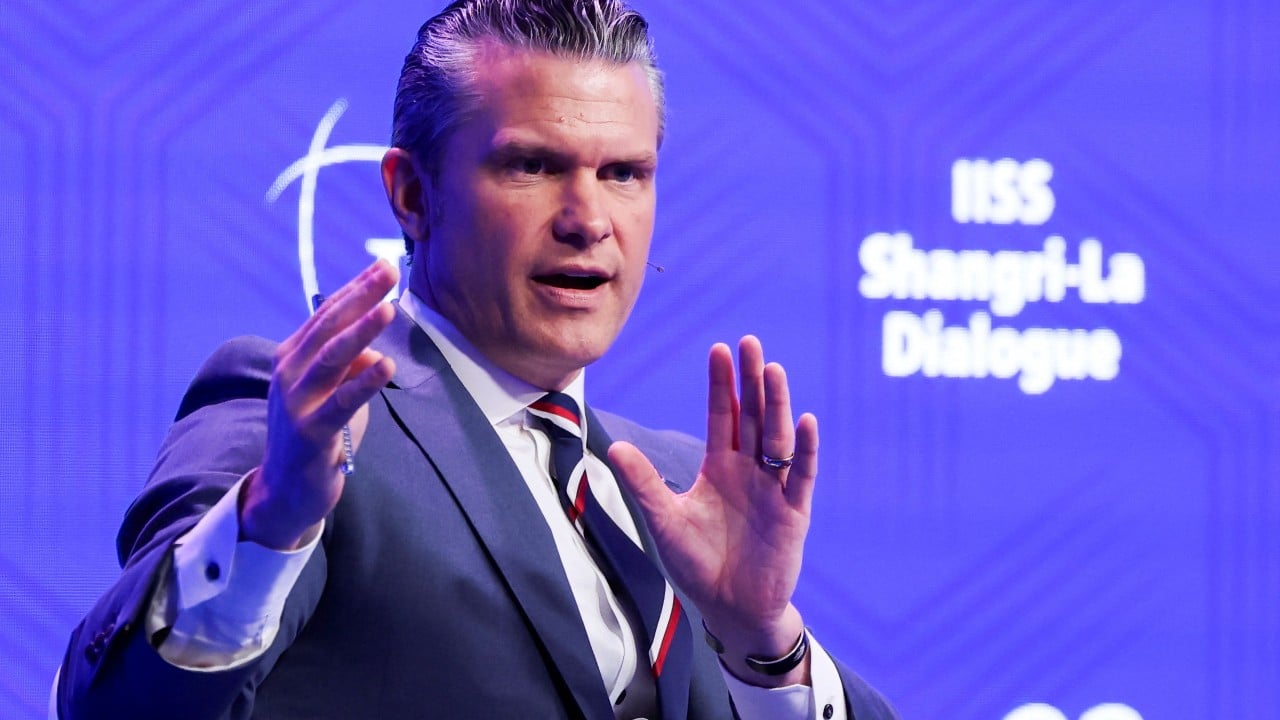
The traditional security umbrella protecting America's wealthiest Asian allies is being dismantled. Speaking at the IISS Shangri-La Dialogue in Singapore, US Secretary of War Pete Hegseth delivered a blunt message that upends decades of transpacific diplomacy. Washington is no longer willing to fund the defense of affluent nations.
While the official narrative frames this as a maturation of alliances, the reality is far more transactional. Hegseth explicitly demanded that regional partners hike their military spending to a minimum of 3.5 percent of gross domestic product or risk a fundamental shift in how the United States operates. This hardline stance marks a pivot toward a cold, interest-based realism that treats foreign governments as defense partners rather than dependencies. If you found value in this post, you might want to check out: this related article.
The End of the Free Ride
For half a century, American strategic planning in the Indo-Pacific operated under a predictable framework. The United States provided the ultimate military guarantee, and in return, regional allies offered hosting rights for forward-deployed American troops. Hegseth shattered that framework in a single 25-minute address.
"The era of the United States subsidizing the defense of wealthy nations is over," Hegseth stated. "We need partners, not protectorates." For another perspective on this event, check out the latest coverage from USA Today.
The financial implications are staggering. For an economy like Japan, moving toward a 3.5 percent threshold would require a massive domestic reallocation of capital. Hegseth praised Tokyo and Seoul for recent steps to increase military readiness, specifically highlighting South Korean President Lee Jae Myung's commitment to the new spending benchmark.
The strategy divides American allies into two distinct categories. Those who pay, and those who do not.
| Country | Status under New US Doctrine | Spending Policy |
|---|---|---|
| South Korea | Preferred Partner | Committed to 3.5% GDP benchmark |
| Japan | Rising Partner | Accelerating defense transformation |
| Delinquent Allies | Deprioritized | Faced with expedited cuts and reduced backing |
Nations that hit the 3.5 percent mark are promised the inner ring of American defense cooperation. This includes expedited advanced arms sales, deep industrial integration, and expanded intelligence sharing. Those who refuse will be pushed to the back of the line. Hegseth warned that Washington will prioritize lethal capabilities and businesslike cooperation over empty rhetoric, signaling that the Pentagon will judge its relationships by hard power and collective readiness rather than historical sentiment.
The Strategic Silence on Taiwan
The most striking aspect of the address was not what was said, but what was omitted. One year ago, Hegseth used the same Singapore forum to warn that a Chinese military campaign against Taiwan could be imminent. This year, the word "Taiwan" did not appear once in his prepared remarks.
The omission triggered immediate anxiety among regional diplomats. It follows a high-stakes summit in Beijing between President Donald Trump and Chinese President Xi Jinping. During those talks, both leaders chose to focus on stabilizing bilateral relations over solving deep-seated geopolitical disputes. By dialing down the public rhetoric on Taiwan, the Pentagon appears to be creating diplomatic space for the White House to manage its broader relationship with Beijing.
The closest Hegseth came to addressing the flashpoint was a pledge to defend the first island chain. This geographic network encompasses Japan, the Philippines, and Taiwan. Yet avoiding direct mention of Taipei suggests a calculated recalibration. While the administration maintains that there is no link between US arms deliveries to Taiwan and the ongoing war involving Iran, the maritime security crisis in the Gulf has clearly strained American logistical bandwidth.
Interest Over Ideology
European observers attending the summit received a sharp rebuke. Hegseth contrasted what he described as the realistic mindset of Asian nations with the moralizing tendencies of Western Europe.
He argued that a durable partnership cannot be built on idealistic values. It requires a concrete alignment of national interests.
"Alliances should happen without the drama and the moralizing," Hegseth remarked.
This ideological purge is a defining characteristic of the current administration's foreign policy. By removing human rights and democratic solidarity from the transactional calculus, the Pentagon aims to streamline operations. The focus is exclusively on building regional counterweights capable of checking Chinese expansion.
This approach offers clear benefits for countries like Vietnam and Singapore, which prefer a pragmatic security partner that does not interfere in domestic governance. However, it also introduces profound instability. If American security guarantees are strictly tied to a fluctuating GDP percentage, the deterrent value of those alliances becomes unpredictable.
The Empty Seat in Beijing
While the American delegation arrived in Singapore with a massive entourage, China opted for low-profile representation. For the second consecutive year, Chinese Defense Minister Dong Jun skipped the conference entirely. Beijing sent a lower-level panel of military experts and scholars from the People's Liberation Army instead.
This deliberate snub reflects Beijing's disdain for the multilateral format of the Shangri-La Dialogue, which Chinese officials view as an American-dominated venue designed to build coalitions against them. By sending academics rather than commanders, China controlled the temperature of the room. They avoided direct public confrontations while letting Hegseth's ultimatum to American allies do the work of sowing division for them.
The underlying tension remains intense despite the absence of top Chinese brass. Hegseth noted that there is rightful alarm throughout the Pacific regarding China's historic military buildup and the expansion of its maritime operations. The American strategy relies on maintaining open military-to-military lines of communication to avoid a catastrophic miscalculation.
A stable balance of power is the goal, but achieving it will require America's partners to shoulder a financial burden many are completely unprepared to bear. The line has been drawn in Singapore. Washington has made it clear that those who want American protection must first prove they can pay for it.