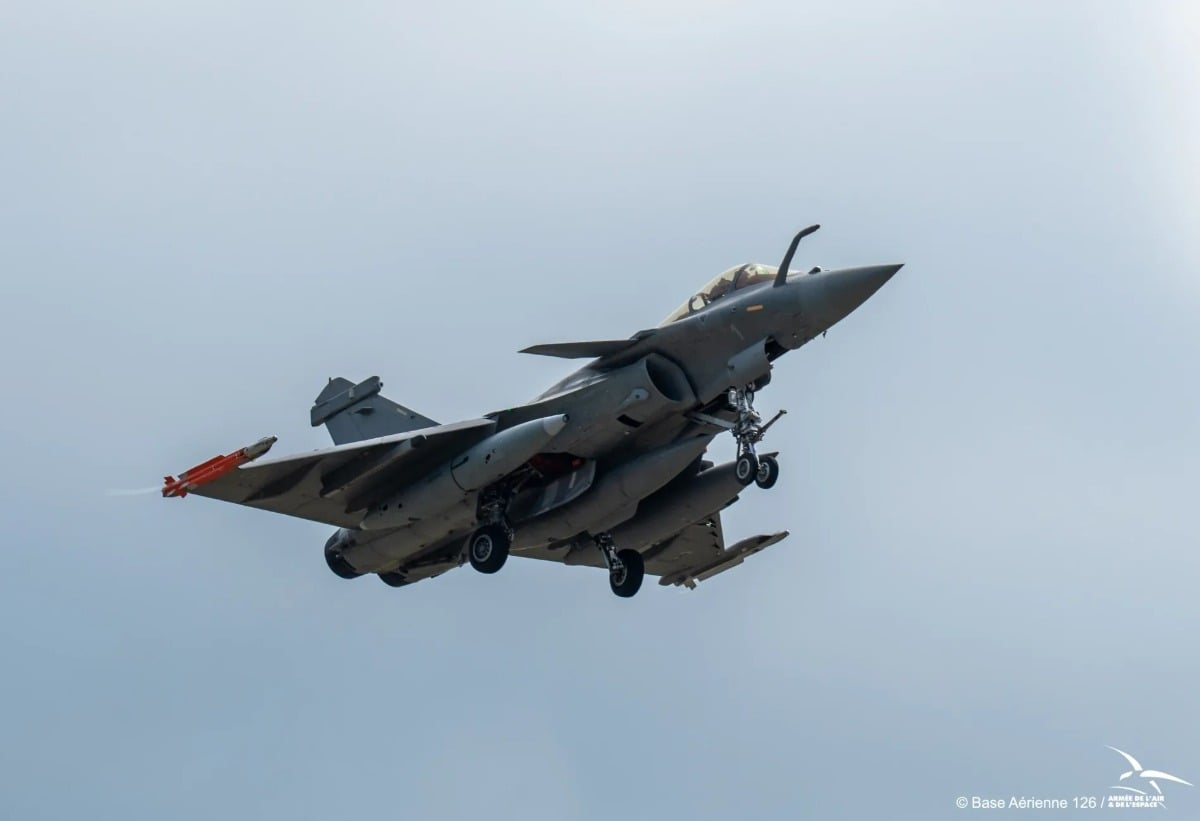
France just pushed its air defense strategy into supersonic territory, clearing a severe technical hurdle that most observers missed entirely. On June 1, 2026, the French defense procurement agency (DGA), alongside manufacturer MBDA and Dassault Aviation, executed the first supersonic test firing of the MICA NG (Missile d’Interception, de Combat et d’Auto-défense Nouvelle Génération) from a Rafale fighter jet. The public saw a successful missile launch. The defense establishment saw something far more pressing: an aggressive race against the clock to counter a massive proliferation of low-observable threats, from Chinese-made stealth fighters to high-speed cruise missiles and compact attack drones.
This second development firing, announced publicly on June 5, 2026, was not a routine exercise. It targeted the single greatest vulnerability of high-speed infrared targeting systems: friction-induced thermal blindness. By validating the MICA NG infrared seeker under the extreme aerodynamic heating of supersonic flight, Paris has demonstrated a crucial sovereign capability. It proves France can hunt down stealth platforms that try to avoid traditional radar tracking.
The Physics of Thermal Blindness
To understand why this test mattered, you have to look at the brutal physics of supersonic air combat. Standard aircraft tracking relies heavily on Active Electronically Scanned Array (AESA) radar. However, modern stealth airframes are explicitly shaped to deflect radar waves away from the source, rendering traditional radar-guided missiles far less reliable at distance.
The primary alternative is infrared tracking. An infrared seeker hunts the heat signature of an enemy aircraft’s engines or the atmospheric friction on its nose cone. But there is a major catch. When a Rafale fires a missile at supersonic speeds, the air friction against the missile’s own optical dome generates massive thermal energy.
- The Contrast Problem: As the missile dome heats up, the temperature difference between the target and the background drops sharply.
- The Blindness Effect: If not properly managed, the missile’s own sensor becomes blinded by its own heat, losing the enemy target completely.
The DGA test at the Mediterranean missile testing site focused entirely on proving that the MICA NG infrared seeker could filter out this self-generated heat wall. MBDA's engineering fix involves sophisticated sensor cooling and advanced image processing algorithms designed to maintain a high-contrast track even when the missile nose is cooking at supersonic velocities.
Redesigning Inside the Old Shell
The MICA NG program began in 2018 under a strict engineering constraint: it had to fit into the exact same external dimensions as the legacy MICA family. This choice was driven entirely by economics. By keeping the outer shell identical, the French military avoids the astronomical costs of redesigning the physical launcher mechanisms, internal wiring, and aerodynamics of the Rafale fighter jet.
Yet, everything under the hood is entirely new. The weapon represents a massive shift in how mid-range air combat is fought.
The Dual-Pulse Innovation
Legacy air-to-air missiles burn their rocket motor in a single, continuous burst at launch. They accelerate rapidly, but by the time they reach their maximum range, the fuel is spent. The missile coasting on momentum becomes slow and sluggish, making it relatively easy for an agile enemy fighter to out-maneuver.
The MICA NG implements a dual-pulse rocket motor. The first pulse ignites at launch to get the missile up to speed. The missile then coasts toward the target area. Just as it approaches the enemy, the second fuel pulse ignites, giving the missile a massive burst of acceleration in the final seconds of flight. This drastically expands the no-escape zone, the geographical area where a target can no longer turn or dive fast enough to evade the incoming weapon.
The Sovereign Architecture
Unlike most Western defense initiatives that rely on highly distributed multinational supply chains, the MICA NG is explicitly built to be a sovereign French product. The missile retains a dual-seeker architecture, meaning MBDA builds two completely interchangeable versions: one with the infrared seeker tested this week, and another equipped with an active radar seeker.
[Target Detection] ---> [Passive IR Seeker / Active Radar]
                             |
                             v
               [First Rocket Motor Pulse] -> High-speed cruise
                             |
                             v
               [Second Rocket Motor Pulse] -> Maximum terminal agility
This flexibility lets a Rafale squadron mix and match weapons depending on the electronic warfare environment they encounter. If an adversary uses heavy radar jamming, the pilot fires the infrared version. If the target is a stealth drone with a minimal heat signature, the radar variant takes over.
The True Geopolitical Customer
While the French Air and Space Force and the French Navy are the immediate beneficiaries, the timing of this successful supersonic test carries immense geopolitical weight on the export market.
Just days ago, on June 1, 2026, New Delhi officially issued a massive Letter of Request to France for a government-to-government deal to procure 114 Rafale fighter jets for the Indian Air Force. The proposed deal is staggering, valued at roughly Rs 3.25 lakh crore. Under the terms of the proposal, 94 of those 114 jets would be built directly in India through a deep partnership with Dassault Aviation.
====================================================================
               PROJECTED INDIAN RAFALE FLEET STRENGTH
====================================================================
Current IAF / Navy Commitments:       62 Jets
Pending Multi-Role Fighter Request:  114 Jets
Additional Naval Intentions:          31 Jets
--------------------------------------------------------------------
Potential Total Indian Fleet:        207 Jets
====================================================================
India’s primary strategic anxieties stem from its borders with Pakistan and China. China's rapid deployment of Chengdu J-20 stealth fighters has completely changed the aerial balance of power in the region.
The successful validation of a European air-to-air missile designed specifically to kill low-observable targets at supersonic speeds offers New Delhi exactly what it wants: an immediate counter-stealth capability that does not depend on American approval or Russian hardware. With Indian Prime Minister Narendra Modi scheduled to visit France in mid-June 2026, this test provides the French delegation with immense leverage to finalize the export agreement, offering a fully certified weapon system capable of challenging China's newest air assets.
Flaws in the Omni-role Defense Strategy
Despite the technical triumphs of the DGA test, the reliance on a single platform like the Rafale to carry the entire weight of France's aerial and nuclear deterrence framework introduces distinct vulnerabilities.
The Rafale is an "omni-role" aircraft, carrying out everything from close air support to nuclear strike missions with the ASMPA missile. But a platform cannot be everywhere at once. The integration of the MICA NG is a cornerstone of the upcoming F4 standard upgrade for the Rafale, an expensive modernization program aimed at keeping a 20-year-old airframe viable in highly contested airspace.
As high-intensity warfare returns to the European periphery, air forces are learning that sophisticated, ultra-expensive missiles like the MICA NG are finite resources. A dual-pulse, highly sensitive infrared missile is incredibly complex to manufacture. In a prolonged conflict against a peer adversary, high production costs and slow manufacturing turnarounds could deplete stockpiles far quicker than defense industrial bases can replenish them. Paris can design the most advanced counter-stealth missile in the world, but if industrial capacity limits the inventory to small operational batches, the strategic advantage narrows significantly.
The supersonic test over the Mediterranean proves that the engineering behind France's defense apparatus remains elite. Yet, the real test of the MICA NG won't just take place in the high altitudes of a supersonic flight envelope. It will play out on the factory floors of MBDA and in the high-stakes negotiation rooms of New Delhi, where industrial capacity and raw production numbers ultimately dictate military supremacy.