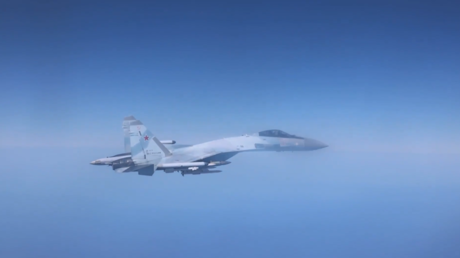
The British Ministry of Defence just released a chilling 12-second video confirming that two Russian fighter jets dangerously intercepted an unarmed Royal Air Force RC-135W Rivet Joint spy plane over the Black Sea. This was not a standard Cold War-style escort. A Russian Su-35 flew close enough to trigger the British aircraft's emergency systems, instantly disabling its autopilot and forcing the crew into manual control, while an Su-27 made six aggressive passes coming within just six meters of its nose.
The immediate question is why Moscow is risking a catastrophic mid-air collision now. The answer lies far beyond simple territorial posturing. This escalation represents a desperate attempt by Russia to blind NATO’s electronic eyes as Western-supplied long-range missiles and Ukrainian drone networks increasingly devastate Russian infrastructure. For a different view, check out: this related article.
The Invisible Battle for the Electromagnetic Spectrum
To understand why a Russian pilot would fly nineteen feet from a massive, Boeing-derived spy plane, you have to understand what the RC-135W Rivet Joint actually does. It does not take pictures. It vacuums up the electromagnetic spectrum.
Operated by the RAF’s 51 Squadron out of Lincolnshire, the Rivet Joint is a strategic electronic surveillance asset. It intercepts, tracks, and analyzes signals from enemy air defense radars, communication networks, and command nodes. In the context of the Black Sea theater, a single British Rivet Joint flying in international airspace can map the entire radar footprint of occupied Crimea and southwestern Russia in real-time. Related reporting on this trend has been published by The Washington Post.
That data is vital. When Western-supplied cruise missiles or Ukrainian strike drones successfully penetrate Russian air defense networks, they often rely on the electronic blind spots mapped out by these exact surveillance missions. By forcing the RAF crew to battle for control of a disabled autopilot, Moscow is trying to establish an invisible no-fly zone through sheer intimidation.
The Autopilot Disconnect and the Risk of Kinetic Escalation
The revelation that the Su-35's wake turbulence or electronic warfare suite triggered an automatic autopilot disconnect is the most alarming detail of the encounter. The Ministry of Defence confirmed the crew had to manually stabilize the aircraft amid chaotic conditions while traveling at high tactical speeds.
When a multi-engine surveillance platform loses autopilot due to an aggressive aerodynamic or electronic disturbance, the physical workload on the pilots skyrockets instantly. A minor miscalculation by either the Russian fighter pilot or the British crew at a distance of six meters leaves zero margin for recovery.
This is the most severe encounter over the Black Sea since September 2022, when a Russian pilot misconstrued an ambiguous command from a ground station and fired two missiles at a British Rivet Joint. While London publicly accepted Moscow's excuse of a "technical malfunction" at the time to prevent a wider war, intelligence officials knew the truth. The latest incident proves that Russian rules of engagement in international airspace remain volatile and poorly disciplined.
A Multi-Front Underwater and Airborne Pressure Campaign
This airborne chicken game did not happen in a vacuum. It follows a series of aggressive maneuvers across multiple geographic theaters designed to test Western resolve and stretch military resources thin.
- Undersea Confrontations: Days before releasing this flight footage, Defence Secretary John Healey revealed that the Royal Navy had tracked three Russian submarines operating near critical British undersea data cables and pipelines in the North Atlantic.
- Electronic Harassment: In late 2025, British officials formally protested a separate incident where a Russian intelligence vessel pointed blinding lasers at RAF pilots tracking its movements near UK waters.
- Arctic Expansion: Increased Russian bomber activity in the High North and the Baltic Sea has forced frequent, coordinated scrambles by NATO air policing units.
The strategy is clear. By simultaneously threatening underwater data infrastructure, blinding pilots with lasers, and aggressively buzzing strategic aircraft, Moscow is trying to see exactly where NATO's red lines are drawn.
The Policy Dilemma Facing London and NATO
Defence Secretary John Healey was quick to declare that this incident would not deter the UK's commitment to securing NATO’s eastern flank. The reality on the ground, however, is far more complex than political rhetoric suggests.
The UK has already summoned the Russian embassy to formally condemn the actions of the pilots, but diplomatic protests carry little weight in a hot combat zone. If the RAF continues these flights without protection, they risk losing an asset and a crew to an aggressive pilot error. Conversely, if the UK begins escorting the Rivet Joint flights with armed Typhoon fighter jets, it dramatically escalates the tactical environment, turning routine intelligence collection into an explosive military convoy.
For now, the flights continue. The RAF crews are relying entirely on cold professionalism and rigorous training to survive encounters where a single twitch of a Russian joystick could spark an international conflict. The video released by the MoD is a public warning that the air war above the Black Sea is rapidly approaching a breaking point.