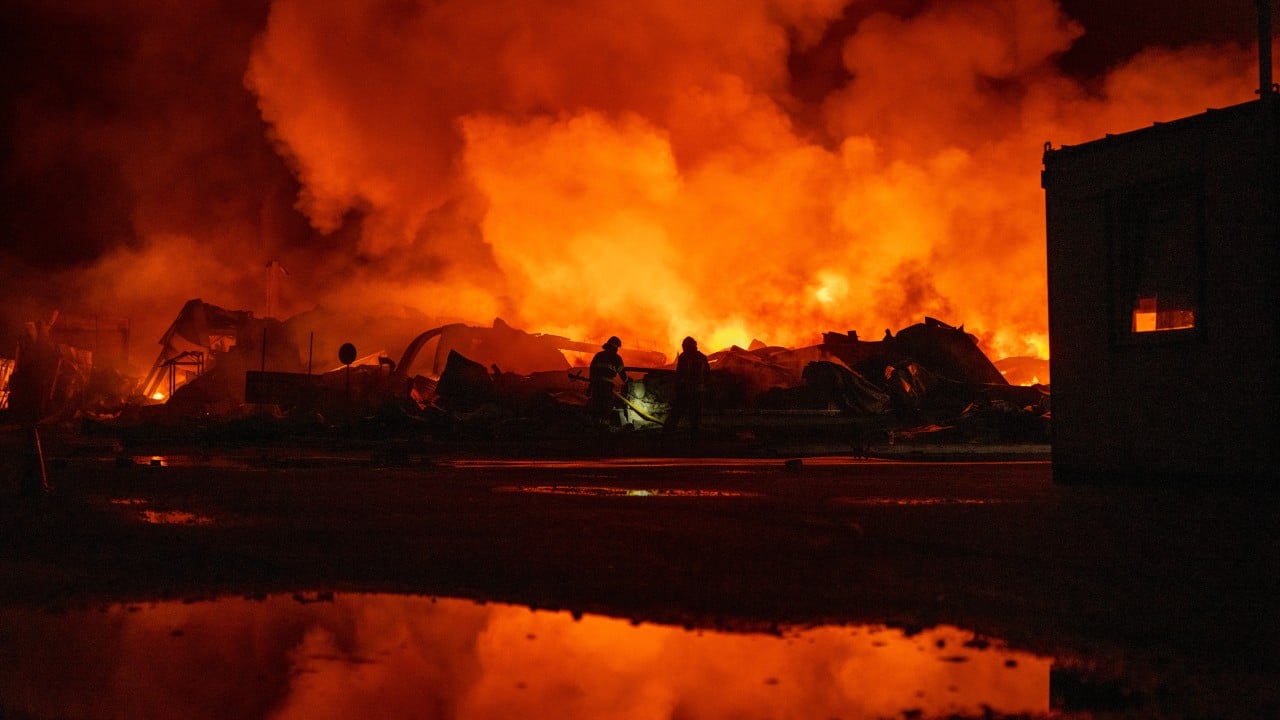
Russian ballistic missiles are breaking through Ukrainian air defenses due to a devastating convergence of strict interceptor shortages, unyielding terminal-phase speeds, and deliberate radar saturation tactics that exhaust Western-supplied systems like the Patriot. When the Kremlin launches an Iskander-M or an air-launched Kinzhal, the projectile enters its descent phase at multiple times the speed of sound, plunging downward at near-vertical angles. Air defense batteries are left with mere seconds to calculate a trajectory, launch a counter-projectile, and secure a kinetic intercept.
The math of modern air defense is unforgiving. For decades, military planners operated on the assumption that high-altitude, high-speed threats would be rare, expensive anomalies. Today, they are standard ordnance. Understanding why these weapons consistently find their targets requires looking past standard political talking points and examining the cold, mechanical reality of industrial production, radar horizons, and physics. Building on this theme, you can find more in: The End of the Mirage When Overseas Runaways Face the Music.
The Mathematics of the Drop
Unlike cruise missiles—which cruise horizontally through the troposphere much like jet-powered aircraft—ballistic missiles follow a parabolic arc dictated by gravity and rocket propulsion. Once the booster burns out, the warhead falls back into the atmosphere from the edge of space.
Gravity does the heavy lifting on the way down. An Iskander-M warhead does not merely fly; it plummets at terminal velocities exceeding Mach 5, executing sudden structural dives and releasing radar decoys designed to confuse tracking software. Analysts at Associated Press have shared their thoughts on this situation.
[Launch] ---> [Parabolic Arc / Space Edge] ---> [High-Speed Vertical Dive] ---> [Impact (Seconds to Intercept)]
For a defender, this creates an acute geometric crisis. A standard surface-to-air missile must climb upward against gravity, meet the incoming threat head-on, and execute a direct physical collision (hit-to-kill) using onboard guidance thrusters. The window for error is measured in milliseconds. If the radar loses track for even a fraction of a rotation due to ground clutter, electronic interference, or decoy saturation, the intercept fails completely.
The Interceptor Drought
Hardware without ammunition is scrap metal. The primary bottleneck facing Ukrainian skies is not an absence of launch platforms, but a severe scarcity of compatible interceptor missiles—specifically the PAC-3 variant required by Patriot batteries to engage high-speed ballistic threats.
Production lines in the United States and allied nations turn out a few hundred PAC-3 MSE (Missile Segment Enhancement) interceptors annually. Meanwhile, manufacturing facilities within the Russian defense sector output ballistic missiles at a rate that consistently outpaces Western inventory replenishment.
When state stockpiles dip below critical thresholds, air defense commanders face impossible triage decisions. Protecting a major urban center like Kyiv requires expending multiple interceptors per incoming threat to guarantee a hit. When supplies run dry, entire batteries sit dormant or are forced to watch incoming salvos land completely unopposed.
- The Production Mismatch: Lockheed Martin's primary assembly lines produce roughly 500 to 600 PAC-3 units per year.
- The Expenditure Rate: Sustained Russian saturation campaigns routinely expend dozens of ballistic weapons in a single week.
- The Financial Toll: Allied resupply models often require upfront financing and commercial markups, slowing down the velocity of aid when time is measured in casualties.
Evolving Tactics and Electronic Warfare
Russia has adapted its strike packages to exploit the operational limitations of Western defense architecture. Modern strikes rarely consist of a single ballistic missile. Instead, they are complex, synchronized choreography involving cheap long-range drones, radar-confusing decoys, and cruise missiles alongside ballistic assets.
Drones saturate the airspace first, forcing radar operators to keep tracking systems active and revealing their electronic signatures. When the main ballistic package arrives, the defending radars are already juggling hundreds of distinct radar contacts.
Furthermore, software updates applied to Russian guidance systems allow missiles to execute minor course corrections during their terminal dive. Even a slight, unpredictable shift in trajectory alters the intercept geometry enough to throw off a standard calculation, causing the defensive missile to pass harmlessly by.
Striking the Source
Recognizing the near-impossibility of catching every incoming arrow, military strategists in Kyiv have increasingly prioritized shooting the archer. Long-range drone strikes targeting Russian manufacturing plants, fuel depots, and launch pads deep within sovereign Russian territory represent an attempt to choke the supply chain at its origin.
Yet, this asymmetric counter-campaign faces its own severe restrictions. Communications limitations, regulatory hurdles regarding dual-use technology platforms, and the sheer vastness of strategic depth available to Moscow mean that industrial attrition takes months to manifest on the battlefield, while ballistic missile strikes arrive nightly.
The structural imbalance between offensive rocketry and defensive interception remains unresolved. Until industrial output matches the physical realities of high-speed interception, the advantage stays firmly with the descending warhead.


