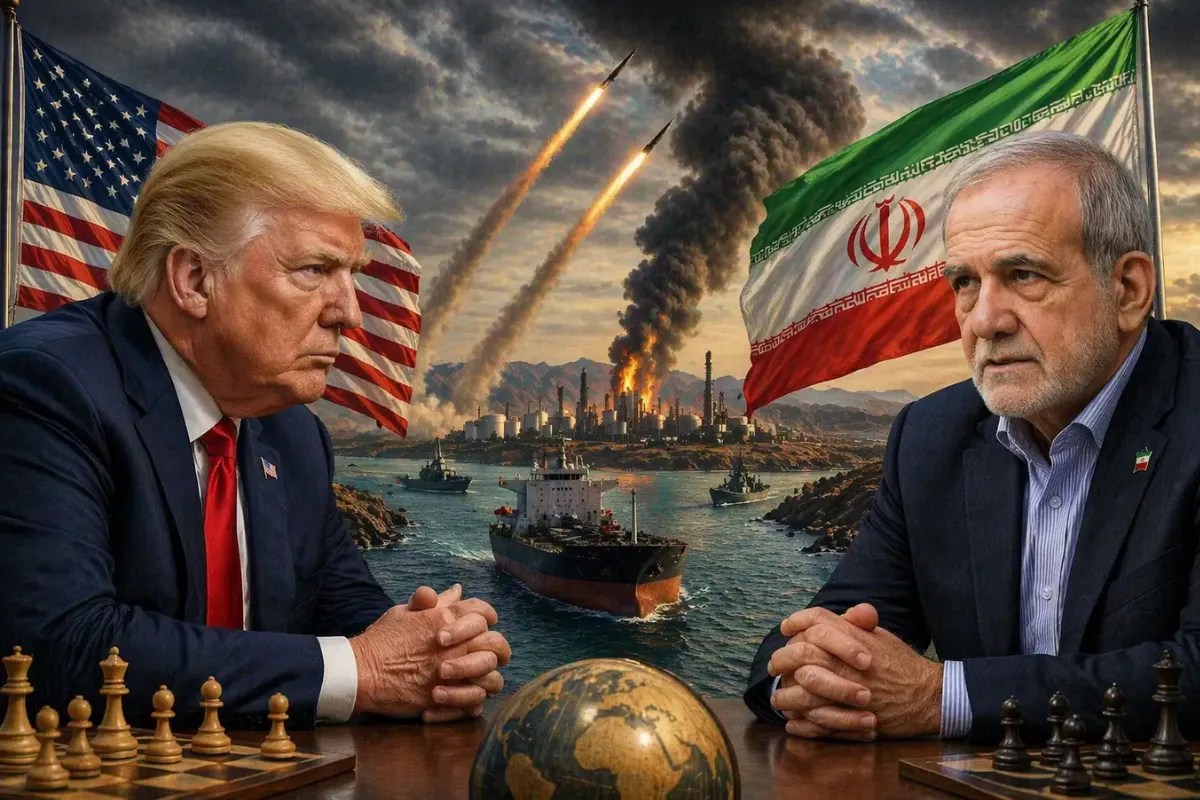
The rhetoric coming out of Mar-a-Lago isn't just campaign bluster. It is a calculated signals-intelligence operation designed to paralyze the Iranian leadership before a single piece of hardware moves. When Donald Trump warns of an approaching "storm" that "nobody can stop," he isn't speaking to the American voter alone. He is speaking directly to the nervous systems of the IRGC command structure in Tehran. This is psychological warfare being conducted in the open, shifting the geopolitical friction from diplomatic backchannels to the raw, unfiltered threat of total kinetic engagement.
For decades, the relationship between Washington and Tehran has followed a predictable, if violent, script. Sanctions are applied, proxies strike back, and both sides retreat to their respective corners to count the cost. That script is being shredded. The current escalation marks a departure from "maximum pressure" and a move toward what strategic analysts call "preemptive exhaustion." By signaling an unstoppable force, the Trump apparatus aims to force a domestic cardiac arrest within the Iranian regime—metaphorically and, if recent reports from Tehran are to be believed, perhaps physically. Discover more on a related subject: this related article.
The Anatomy of the Storm
When a politician uses weather metaphors like "the storm," they are usually hiding a lack of policy. With Trump, the metaphor is the policy. It implies a force of nature—something that cannot be negotiated with, paid off, or delayed. This removes the agency of the opponent. If you are facing a storm, you don't fight; you hide or you perish.
The Iranian response was telling. Senior officials in Tehran didn't just dismiss the threat; they reacted with a visceral intensity, claiming such threats would cause "heart attacks" among those who understand the stakes. This isn't just colorful language. It reflects a deep-seated anxiety about the vulnerability of the regime's aging leadership and its crumbling internal security. They know that the United States possesses the capability to decapitate their command structure without a full-scale invasion, a reality reinforced by the 2020 strike on Qasem Soleimani. Additional reporting by Associated Press explores related perspectives on the subject.
The "storm" refers to a multi-front assault that goes beyond missiles. We are looking at a synchronized rollout of:
- Total Financial Decoupling: Moving beyond basic oil sanctions to target the shadow banking systems in Turkey, the UAE, and China that keep the Rial on life support.
- Cyber-Kinetic Integration: The use of Stuxnet-style logic bombs to not just monitor, but physically destroy centrifuges and power grids.
- Proxy Neutralization: Hard-hitting strikes on Hezbollah and Houthi logistics hubs that provide Iran with its "forward defense" capability.
Tehran’s Calculated Panic
Why does Tehran react so strongly to what many see as mere rhetoric? Because the Iranian economy is a tinderbox. The regime survives on the perception of stability. When the specter of an "unstoppable storm" is raised by a man who has previously demonstrated a willingness to ignore the "rules" of engagement, the markets react instantly. The Rial plunges, capital flight accelerates, and the internal security forces—the Basij—start wondering where their next paycheck is coming from.
The "heart attack" comment from Iranian officials is a defense mechanism. They are trying to frame the American threat as so extreme it becomes absurd. But in the world of intelligence and power, if you have to tell people you aren't scared, you’ve already lost the psychological high ground. The Iranian leadership is currently trapped in a "trilemma": they cannot afford a war, they cannot survive a total blockade, and they cannot back down without losing the loyalty of their hardline base.
The Proxy Problem
Iran’s greatest strength has always been its ability to fight at a distance. By using the "Axis of Resistance," they keep the blood and fire away from their own borders. The "storm" threat suggests that this buffer is no longer recognized. The new doctrine implies that the principal will be held directly responsible for the actions of the agent. If a drone hits a US base in Jordan, the response might not land in the Syrian desert—it might land in a suburb of Tehran.
This shift in the rules of the game is what causes the genuine panic. For years, Tehran played a high-stakes game of "I’m not touching you" while their proxies wreaked havoc. The message from the Trump camp is that the game is over. The "storm" doesn't care about proxies; it hits the center of gravity.
The Economic Kill Chain
Military hardware is expensive and messy. Economic warfare is clean, efficient, and often more devastating. The "storm" involves a level of secondary sanctions that would essentially force the world to choose: trade with the $25 trillion US economy or trade with the $400 billion Iranian economy.
In the past, European and Asian powers tried to create "special purpose vehicles" to bypass US sanctions. They failed. The sheer dominance of the US dollar as a reserve currency means that any bank caught touching Iranian money is effectively disconnected from the global financial system. This is the "heart attack" that Tehran fears most. It isn’t a missile hitting a palace; it’s the sudden, silent death of the country’s ability to buy food, medicine, and loyalty.
The Role of Regional Players
Israel, Saudi Arabia, and the UAE are watching this play out with a mixture of hope and terror. For the Gulf states, a "storm" that successfully defangs Iran is the ultimate security guarantee. However, they are also the first targets for Iranian retaliation. If the IRGC feels the end is near, they may attempt to take the global oil market down with them by mining the Strait of Hormuz.
$Price \ of \ Oil \propto \frac{Geopolitical \ Risk}{Supply \ Stability}$
When the risk spikes, the price doesn't just rise; it gaps. The "storm" doctrine must account for the fact that a desperate regime is a dangerous one. Tehran knows that their only leverage is the threat of global economic chaos.
The Intelligence Gap
One of the most overlooked factors in this escalating tension is the current state of internal dissent within Iran. The "Woman, Life, Freedom" movement showed that the regime is deeply unpopular with its youth. Washington is betting that the "storm" will provide the external pressure necessary to cause internal fractures.
If the Iranian leadership is focused on an external existential threat, they have fewer resources to police their own streets. The goal is to create a feedback loop of pressure.
- External Threat: Constant psychological and military posturing.
- Economic Pain: Sanctions that target the elite and the security forces.
- Internal Unrest: A population that sees the regime as a magnet for disaster.
This is the "why" behind the aggressive language. It isn't just about winning an election; it's about setting the stage for a regime collapse that doesn't require a single American boot on the ground.
The Reality of Kinetic Options
Despite the talk of "heart attacks" and "storms," we must look at the physical reality of a conflict. Iran is not Iraq. It is a mountainous, vast country with a sophisticated (if aging) air defense system. A "storm" that involves a full-scale invasion is a fantasy that no serious military planner is considering.
Instead, the "storm" is likely a series of "Black Swan" events—unpredictable, high-impact strikes that target specific high-value assets.
- The Nuclear Program: Targeted strikes on Natanz and Fordow using GBU-57 Massive Ordnance Penetrators.
- The Navy: Sinking the Iranian navy in a matter of hours, a feat the US Navy already proved possible during Operation Praying Mantis in 1988.
- The Leadership: Using SIGINT to track and neutralize key decision-makers who direct external operations.
Tehran's response—claiming that these threats are enough to cause a heart attack—is an admission of vulnerability. They are acknowledging that the psychological pressure is reaching a breaking point. In the high-stakes poker game of Middle Eastern geopolitics, the player who shows a tremor in their hand is usually the one about to fold.
The American strategy has moved past the era of nation-building and "hearts and minds." The new approach is much colder. It is the application of overwhelming pressure until the structural integrity of the opponent fails. Whether this "storm" ever makes landfall is almost irrelevant; the damage is being done by the wind that precedes it.
The Iranian regime is currently operating in a state of high-cortisol survival. Every shadow is a drone; every bank transfer is a trap; every diplomatic overture is a trick. This is the "storm" in its most effective form. It is a war of nerves where the first side to blink loses everything. The "heart attack" Tehran mentions isn't a joke—it's a clinical diagnosis of their current political state.
When the rhetoric reaches this pitch, there is no easy way back to the status quo. You either deliver the storm or you lose the power of the threat forever. The Iranians know this. The Americans know this. The world is simply waiting to see if the clouds break or if the first lightning strike is already in the air.
Check the flight paths of the RC-135V/W Rivet Joint reconnaissance planes over the Persian Gulf. They tell a story that the press releases don't. While the politicians talk about "storms," the technicians are already mapping the targets. This isn't a drill, and it isn't a campaign stunt. It is the slow-motion start of a systematic dismantling. Every "heart attack" in Tehran is a data point for the analysts in Washington. The pressure will not decrease; it will only find new ways to squeeze.