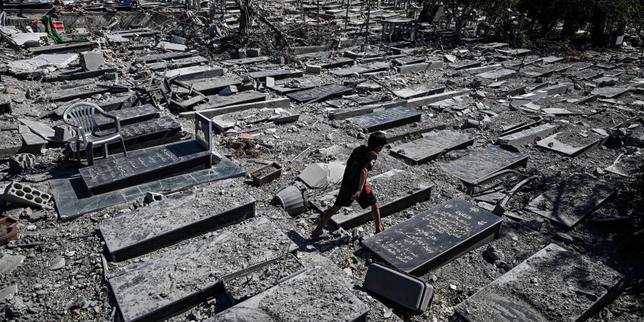
The scale of destruction in South Lebanon has crossed a threshold from which normal recovery is impossible. While previous conflicts left scars that could be patched over with Gulf aid and local resilience, the current reality in towns like Srifa reveals a total erasing of economic and civic infrastructure. This is no longer a crisis of rebuilding shattered homes. It is a permanent hollowing out of the region’s economic viability, driven by systematic structural leveling that far eclipses the damage of previous confrontations.
Local leadership and municipal tracking confirm that the physical ruin is not just widespread; it is absolute in core commercial zones. The financial mechanisms that allowed the south to bounce back after earlier wars have entirely evaporated.
The Total Collapse of the Reconstruction Model
Historically, the rebuilding of Southern Lebanon relied on a predictable flow of foreign capital. Following major conflicts, billions of dollars in rebuilding funds poured in from Gulf states, primarily Qatar and Saudi Arabia, alongside Iranian financing directed through political channels. This capital funded immediate cash payouts to displaced families and fueled a massive construction boom that temporarily masked the deeper wounds of war.
That pipeline is dead. Gulf nations have fundamentally shifted their foreign policy parameters. They no longer write blank checks to rebuild infrastructure in regions controlled by hostile political factions. Lebanon’s central government is bankrupt, suffering from a multi-year sovereign debt default that has paralyzed its banking sector. The average citizen cannot look to Beirut for a single dollar of compensation because the state treasury is empty.
Without external capital, the local economy faces an immediate dead end. A homeowner in Srifa whose property is reduced to gray dust cannot secure a bank loan, receive a state grant, or rely on international charities to rebuild a multi-story concrete structure. The financial vacuum means that visible destruction will translate directly into permanent displacement.
Erasing the Agrarian and Commercial Foundations
The economic survival of the south hinges on a delicate mix of small-scale agriculture and localized retail trade. The current conflict has systematically targeted both.
Fields of olive trees, some centuries old, have been scorched or rendered inaccessible by unexploded ordnance and white phosphorus contamination. Agriculture in this region is not an industrial enterprise that can absorb a multi-year loss; it is a subsistence-level operation run by families who depend on the annual harvest to pay off debts and secure winter supplies. The destruction of these groves eliminates the primary income source for thousands of households for a generation, as new olive trees take decades to mature and bear fruit.
The Retail Death Spiral
Small towns function on a network of family-owned storefronts, minimarkets, and repair shops. These businesses operate on thin margins, relying heavily on informal credit extended to neighbors.
- Supply Chain Rupture: Major distribution routes from Sidon and Beirut are highly volatile, driving the cost of moving goods to unsustainable levels.
- Credit Network Collapse: When a shopkeeper's inventory is destroyed, the loss ripples through the community. They cannot pay their suppliers, and their customers cannot pay their tabs.
- Capital Flight: Business owners who managed to salvage cash or portable assets are fleeing to safer areas northward, taking their entrepreneurial capacity with them permanently.
This creates a ghost-town effect long before the actual buildings are hit. An economy cannot function when the basic velocity of money drops to zero.
The Mirage of Humanitarian Aid
International non-governmental organizations and UN agencies are visible on the ground, but their presence creates a false impression of stability. Humanitarian aid is structured for survival, not revival.
Distributing food parcels, hygiene kits, and temporary water bladders keeps people alive in the short term. It does nothing to restore a functioning market. In fact, prolonged reliance on imported emergency aid often suppresses local production, making it even harder for remaining farmers and merchants to compete when they attempt to restart operations.
Furthermore, international donor fatigue is acute. With major global crises competing for limited humanitarian budgets, funding for Lebanon is consistently under-allocated. The aid visible on the streets of Srifa today is a shrinking safety net that will inevitably be pulled away, leaving a dependent population with no underlying economy to support them.
Demographic Shift and the Loss of Human Capital
The most severe consequence of this structural ruin is the permanent relocation of the middle class and youth. Those with professional skills, education, or family connections abroad are leaving the south entirely.
When a teacher, an engineer, or a skilled mechanic leaves a town like Srifa, the community loses more than just a resident. It loses the civic fabric required to operate schools, maintain water networks, and manage municipal governance. The population left behind skews heavily toward the elderly and the impoverished, who lack the physical and financial mobility to relocate.
This demographic drain transforms vibrant towns into stagnant, dependent settlements. A village composed entirely of destroyed property and an aging population cannot generate the tax base or the physical labor required to initiate a grassroots recovery. The physical architecture of the region is being altered alongside its human geography.
The Long-Term Geometry of Isolation
The geographic isolation of the south is hardening into a permanent feature. Roads cratered by repeated strikes are rarely repaired properly, often patched with loose gravel that washes away with the first winter rains.
Bridges connecting small agricultural hubs to major highways remain severed. This fragmentation turns a once-cohesive regional economy into an archipelago of isolated pockets, each struggling to survive on localized resources. The cost of transporting simple construction materials like cement and steel rebar into these remote areas has doubled, making any private effort to rebuild prohibitively expensive.
The structural damage observed today is fundamentally different from past conflicts because it occurs within a broader context of total national collapse. The resilience that Lebanese society prided itself on for decades has been thoroughly exhausted by years of hyperinflation, political paralysis, and the destruction of the domestic banking system. There are no reserves left to draw upon. The physical ruins of Srifa are not a temporary setback; they are the visible manifestation of a permanent contraction of habitable territory in the south.


