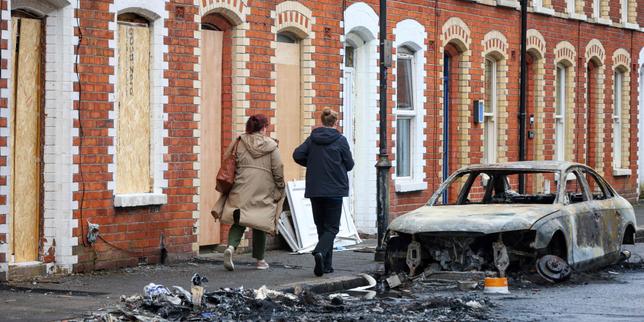
The smell of charred plastic hangs low over the damp tarmac of Sandy Row. It stays in the back of your throat, a bitter reminder of what happens when a city loses its grip on its own ghosts.
For two nights, Northern Ireland’s capital did not sleep. Windows shattered. Bricks flew through the air like heavy, jagged birds. Fireworks were weaponized, aimed directly at businesses owned by people who had arrived in Belfast seeking nothing more than safety and a fresh start. The Police Service of Northern Ireland (PSNI) watched the fires burn, ultimately branding the chaos exactly what it was: a targeted wave of racist violence.
Then came the third night.
On Monday evening, the streets did not explode. Instead, a heavy, suffocating quiet settled over the red-brick terraces. Hundreds of people gathered, standing shoulder to shoulder in the falling light. But this time, the tension didn’t break into a riot. The crowds dispersed into the damp Belfast evening without a single brick being thrown.
The immediate danger had passed. The silence that replaced it, however, is far from peaceful.
To understand what is happening in Belfast right now, you have to look past the dramatic headlines of burning cars and see the people standing in the shadows of the peace walls.
The Anatomy of an Explosion
Consider Mohammed, a hypothetical shopkeeper whose reality mirrors dozens of business owners in the city today. He arrived in Northern Ireland five years ago, leaving behind a conflict that had reduced his hometown to rubble. He chose Belfast because he believed a city that had crawled its way out of its own decades of violence would understand the value of peace.
On Saturday night, he stood behind his counter, listening to the rhythmic, terrifying thud of a crowd approaching his storefront. He didn’t know the people outside. They didn’t know him. Yet, to the angry mob fueled by viral social media misinformation, Mohammed wasn’t a neighbor, a taxpayer, or a father. He was an abstract target. A symbol of an imagined threat.
When the brick finally smashed through his display window, showering his floor with glittering shards of glass, it didn’t just damage property. It shattered a fragile sense of belonging that had taken half a decade to build.
The numbers tell a stark story. Northern Ireland, historically defined by its binary green-and-orange, Catholic-and-Protestant divide, has seen a rapid shift in its demographic landscape over the last two decades. According to recent census data, the percentage of the population born outside the UK and Ireland has steadily risen, bringing new languages, cuisines, and cultures to neighborhoods that were previously monolithic.
But beneath that growing diversity lies a complex socioeconomic reality. Decades of political stagnation have left working-class areas struggling with underfunded schools, a severe housing shortage, and a healthcare system stretched to its absolute breaking point.
When a society feels abandoned by its institutions, anger searches for a lightning rod. It rarely strikes upward at the lawmakers or the economic structures responsible for the rot. Instead, it strikes sideways. It finds the most vulnerable, the newest arrivals, and turns them into scapegoats.
The Invisible Borders
Living in Belfast means navigating a geography of memory. Even today, decades after the Good Friday Agreement of 1998, physical barriers—massive structures of concrete, iron, and steel known as peace lines—still slice through the city, separating communities that once fought each other.
These walls are a visual manifestation of a deeper, psychological trauma. For generations, survival in certain quarters of Belfast depended on knowing exactly who lived on which street, which flag hung from the lampposts, and which color the curbs were painted. Fear was an asset. Distrust was a survival mechanism.
When the recent anti-immigration riots flared across parts of the United Kingdom, sparked by the horrific stabbing of three young girls in Southport, England, the ripples traveled across the Irish Sea. The internet did what it always does: it weaponized grief and injected false rumors into communities already primed for suspicion.
In Belfast, this toxic digital cocktail mixed with old, unresolved territorial anxieties. The very tactics once used during the Troubles—barricades, petrol bombs, masked men patrolling street corners—were repurposed. This time, the enemy wasn’t the neighborhood across the peace wall. The enemy was anyone who looked different.
The irony is thick enough to choke on. Communities that spent decades fighting for recognition and civil rights are now seeing elements within their own ranks deny those same basic rights to others.
The Gathering and the Dispersion
By the time Monday night arrived, the city held its breath. The PSNI had reinforced its presence, deploying armored Land Rovers at key junctions. The air felt charged, the way it does right before a summer thunderstorm. Everyone expected a third night of ruin.
But the human spirit is unpredictable.
As the sun dipped below the horizon, hundreds of people began to assemble. They weren’t just the angry, masked youths who had dominated the previous forty-eight hours. There were older residents, community workers, and ordinary citizens who had looked at the smoke rising over their city on Sunday morning and decided they could no longer remain silent.
They stood in the streets, a human counterweight to the madness. On the other side, anti-immigration demonstrators gathered, their banners reflecting a deep-seated panic over changing demographics. The two factions faced each other, separated by a thin, taut line of riot police.
For hours, the standoff persisted. Words were traded. Ideologies clashed in the cold air. But as the clock ticked past midnight, something extraordinary happened. The anger ran out of oxygen.
The crowds did not clash. They did not burn down their own neighborhoods. Slowly, in small groups of twos and threes, people turned around and walked away. The gatherings dispersed in absolute, stunning calm.
Political leaders issued their standard statements of condemnation. They used words like "unacceptable" and "disgraceful." They promised justice. But those words feel hollow to the families currently packing their bags, wondering if it is time to leave Northern Ireland for good.
The real victory on Monday night didn't belong to the politicians. It belonged to the fragile, exhausted restraint of ordinary people who looked into the abyss of renewed sectarian and racial strife and chose to take a step back.
The Cost of the Morning After
The physical debris of a riot can be swept away in a few hours. Street sweepers can clear the glass, and council workers can scrub the scorch marks off the asphalt. The economic and emotional damage, however, stains the fabric of a community for years.
Northern Ireland has spent a quarter of a century trying to market itself to the world as a place of rebirth. It has courted international tech companies, film studios, and tourists eager to see the breathtaking coastlines and historic shipyards. A single weekend of violence threatens to dismantle that carefully constructed narrative, reminding global investors that under the shiny, modern veneer, the old fault lines remain dangerously active.
But the financial toll is secondary to the human cost.
Walk past the shattered front of a supermarket on a Tuesday morning and you see the true casualty: trust. You see it in the eyes of the delivery driver looking over his shoulder as he unloads crates. You see it in the hesitant steps of a mother walking her children past a wall covered in fresh, hateful graffiti.
It is easy to look at Belfast and see a city trapped in a loop, doomed to repeat the violence of its past under new pretexts. That is the cynical view. It ignores the profound exhaustion of a populace that simply wants to live without the constant shadow of conflict.
The quiet that followed Monday’s dispersion is not a resolution. It is a truce. It is a brief, breathless pause in a conversation that Northern Ireland has been avoiding for far too long—a conversation about who belongs, who gets to define the future of these streets, and how to heal communities that feel entirely left behind by progress.
As the morning light creeps over the Belfast Hills, illuminating the cranes of the shipyard and the quiet terraces below, a lone figure sweeps up the last fragments of glass outside a damaged shop. Each stroke of the broom ring out in the morning stillness. A small, solitary sound against a heavy silence.


