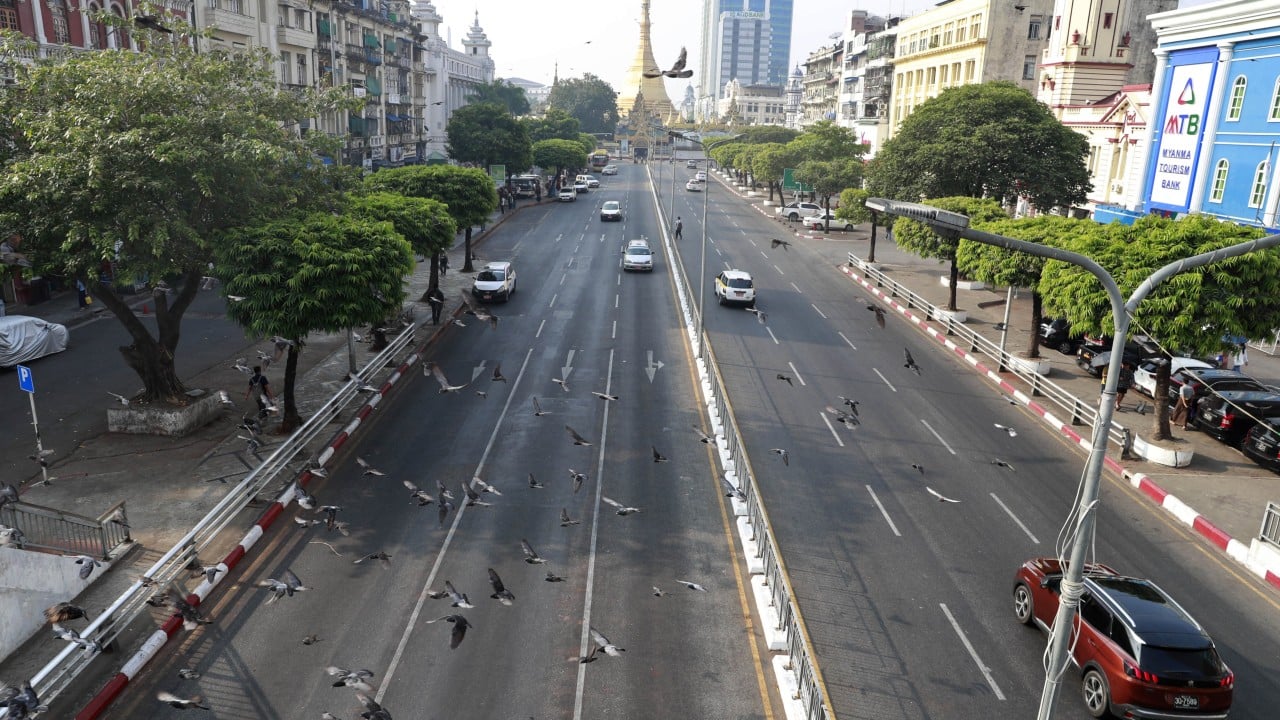
Smoke still clings to the morning air in parts of a country that rarely finds a quiet hour.
Consider a hypothetical merchant named Ko Tun. He wakes before the sun cuts through the humidity of Yangon. For thirty years, his family has traded in textiles, hauling bolts of cotton from riverside docks to cramped storefronts. Today, Ko Tun stares at a ledger that tells a strange, impossible story. On paper, officials in grand government halls speak of billions in projected growth, digital currencies, and foreign trade corridors. They point to charts climbing steeply toward the sky.
Yet, when Ko Tun steps outside, his delivery truck sits motionless. The fuel tank is empty, not because fuel does not exist, but because the price has doubled overnight, and the road north is blocked by a checkpoint controlled by armed factions who care nothing for gross domestic product.
This is the central contradiction of modern Myanmar.
Economic potential is touted with the confidence of a polished pitch deck. Every few months, optimistic reports circulate about strategic positioning, mineral wealth, and a young, eager workforce ready to build the factories of tomorrow. But ground truth is a stubborn thing. You cannot pave a highway with optimism. You cannot feed a family with a projection.
To understand why this nation remains trapped in an agonizing purgatory between grand ambition and grim reality, we have to look past the official press releases. We have to look at the wiring beneath the floorboards.
The Arithmetic of Isolation
Numbers tell a harsh tale when the guns refuse to fall silent.
Since the military takeover that upended the country, the economy has contracted sharply, shedding years of fragile post-transition progress. Factories that once hummed with the production of garments for European and American brands now sit dark or operate at a fraction of their capacity. International corporations pulled their stakes, leaving behind half-built offices and disillusioned local partners.
Money flows differently now. It moves through underground channels, shifting into stablecoins, smuggled gems, and cross-border barter deals that evade central bank tracking.
Imagine trying to build a modern house while the foundation is actively shifting during an earthquake. That is the daily task for the remaining business owners. Inflation has soared, eroding the purchasing power of ordinary citizens whose wages buy less rice and medicine with each passing week. When the currency loses its spine, trust evaporates alongside it.
Yet, the state apparatus insists on looking toward the horizon. Trade delegations meet. Agreements are signed with regional partners who find opportunity in isolation, buying resources at a steep discount while infrastructure crumbles at home.
The Human Cost Behind the Spreadsheets
Behind every macroeconomic indicator lies a person making an impossible choice.
A young software developer in Mandalay watches her internet connection crawl to a halt for the third time this afternoon due to rolling power cuts. She has freelance clients in Singapore who depend on her code, but code requires electricity and stability. She weighs her options: stay and fight for a future in a place she loves, or join the exodus of young professionals boarding flights to Thailand, Malaysia, or beyond, draining the nation of its intellectual capital.
Brain drain is not an abstract demographic shift. It is the empty seat at the dinner table. It is the brilliant engineer repairing generators instead of designing the networks of tomorrow.
When infrastructure fails, human ingenuity takes over, but at a punishing cost. Solar panels now dot rooftops across neighborhoods that used to rely entirely on the national grid. Small generators rattle incessantly on street corners, burning expensive diesel just to keep grocery store freezers running for a few hours. These are not signs of thriving enterprise; they are scars of survival.
People adapt. They always do. But adaptation is not the same as growth.
The Illusion of the Quick Fix
There is a dangerous temptation among outside observers to view conflict zones as blank slates waiting for a sudden turnaround. The narrative goes that once peace returns, foreign investment will flood in, construction will boom, and the lost decade will be erased overnight.
History disagrees.
Economic recovery after prolonged civil conflict is not a switch you flip. It is a slow, agonizing extraction of shrapnel from a deep wound. Even if a ceasefire were declared tomorrow, the institutional damage runs deep. Trust in banks is shattered. Courts are viewed with suspicion. Property rights are fluid and often determined by whoever holds a rifle rather than a deed.
Investors do not merely look for untapped markets; they look for predictability. They want to know that a contract signed today will be honored five years from now. They want to know that cargo can move from a factory to a port without passing through half a dozen extortion checkpoints.
Right now, predictability is the rarest commodity in the market.
The Quiet Resilience
And yet, walk through the markets of any township, and you will witness a startling refusal to quit.
Women sit behind low tables piled high with tomatoes, herbs, and betel nut, transacting in crumpled bank notes that tell stories of wear and tear. Micro-entrepreneurs find ways to ship goods across front lines using network apps and sheer daring. Families pool their meager savings to send their children to underground schools, determined that the next generation will not lose its literacy along with its liberty.
This resilience is often romanticized by outsiders as proof that the economy is holding strong. It is not. It is proof that human beings will bend infinitely before they break.
The gap between the official narrative of rising potential and the gritty reality of everyday survival remains wider than ever. Until that gap is bridged by genuine political resolution and a return to basic security, any talk of an economic boom remains what it has always been: a mirage shimmering over a dry road.
The dust settles on a market stall in downtown Yangon as evening approaches. Ko Tun counts his remaining cash by the pale, flickering light of a battery-powered bulb, listening to the distant rumble of a generator down the alley, wondering what tomorrow's ledger will bring.