The story of human evolution was never a clean, straight line, regardless of what the old textbooks claimed. For decades, the prevailing narrative suggested a neat succession of species, each one slightly more "advanced" than the last, marching toward the prize of modern humanity. New dental analysis from ancient South African cave sites has shattered that orderly progression. We now have proof that Australopithecus africanus and Paranthropus robustus—two lineages long thought to be distinct and separate—were not just sharing the same geography. They were sharing DNA.
This isn't a minor footnote in paleoanthropology. It is a fundamental shift in how we understand the "how" and "why" of our own survival. By examining the isotopic signatures and morphological anomalies in the enamel of teeth found in the "Cradle of Humankind," researchers have uncovered evidence of interbreeding that occurred millions of years ago. These early relatives were "canoodling" in a way that suggests our evolutionary history is less of a tree and more of a tangled, messy thicket.
The Dental Ledger of Ancient History
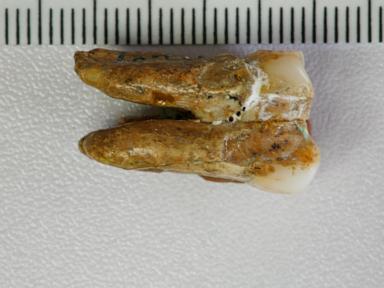
Teeth are the most durable records of life. Long after skin, muscle, and even most bones have crumbled into dust, enamel remains. It acts as a biological hard drive, recording the diet, environment, and even the migration patterns of the individual.
In this latest investigation, the focus shifted from the shape of the teeth to the micro-structures within them. Scientists used high-resolution imaging to look at dental "crowding" and trait inheritance that shouldn't exist if these species remained isolated. When you see specific mandibular traits traditionally assigned to the robust Paranthropus appearing in the more gracile Australopithecus fossils, the explanation is simple and visceral. They were mating.
This discovery challenges the "Competitive Exclusion Principle." That's the idea that two species competing for the same resources cannot coexist. If they are in the same place at the same time, one must outcompete the other. But if they are breeding, the lines of competition blur. They weren't just fighting for the same tubers or nuts; they were integrating.
Why the Traditional Model Failed
The old guard of paleoanthropology liked boxes. They liked to say, "This is Species A, and this is Species B." It made the world easy to map. However, the biological reality of the Pliocene and Pleistocene eras was far more fluid.
We see this same pattern in modern biology. When environments change rapidly—as they did in ancient Africa due to shifting climates and drying landscapes—the barriers between closely related species often break down. Hybridization becomes a survival strategy. It introduces new genetic variations into a population, potentially providing the tools needed to survive a drought or a change in food supply.
The "robust" lineages were known for their massive jaws and huge grinding teeth, built to eat tough, fibrous plants. The "gracile" lineages had smaller teeth and likely a more varied diet. By interbreeding, these groups were essentially hedging their bets.
The Isotopic Smoking Gun
To prove this wasn't just a coincidence of bone shape, researchers looked at strontium isotopes. These are absorbed from the water and soil through the food chain and deposited in the enamel.
- Local Signatures: If both species had identical isotopic signatures, they lived in the same valley.
- Migration Patterns: If a "robust" individual showed an isotopic signature from a "gracile" region, it suggests movement for mating.
- Juvenile Records: Because enamel forms in childhood, these teeth tell us where these individuals were born, not just where they died.
The data shows a crossover. We have individuals with the physical traits of one species but the chemical signature and dental "blueprints" of another. This isn't a guess. It is a biological fact written in calcium.
The Myth of the Lone Survivor
The public has a fascination with the "Missing Link." We want to find that one perfect ancestor that explains everything. But this research suggests there is no single link.
Instead, we are the product of a massive, multi-species merger. This has happened later in our history as well. We know modern humans carry Neanderthal and Denisovan DNA. We used to think that was an anomaly—a weird fluke that happened on the fringes of Europe and Asia.
The dental evidence from South Africa proves that this "hybridization" is actually the standard operating procedure for hominids. We are a "mutt" species. Our success didn't come from being the "purest" lineage; it came from being the most genetically opportunistic.
The Mechanics of Hominid Attraction
How did these groups interact? It is easy to look at a reconstructed skull of a Paranthropus with its massive sagittal crest and think it looked too different from an Australopithecus to be attractive. That is a human bias.
In the animal kingdom, closely related species cross paths all the time. If the pheromones align and the social structures allow it, mating happens. There was no "species consciousness" three million years ago. There were only small groups of primates trying to navigate a dangerous, changing world.
The Cost of Purity
Species that stay "pure" often go extinct. They become too specialized. If you only eat one type of bamboo and that bamboo dies, you die.
The robust lineages eventually disappeared from the fossil record. For a long time, we thought they were an evolutionary dead end. But if they were interbreeding with the lineages that led to Homo, then they didn't really disappear. Parts of them—their immune systems, their metabolic adaptations, their bone densities—were absorbed into the larger human story. They didn't lose the game of evolution; they just changed teams.
Implications for Modern Genetics
This isn't just about old rocks and broken teeth. It changes how we interpret the modern human genome. If we've been swapping DNA with "cousin" species for millions of years, the "African Out of Africa" model becomes much more complex.
It suggests that genetic diversity was being banked and traded across the continent long before Homo sapiens ever walked the earth. This deep-time mixing provided the raw material that eventually allowed our ancestors to develop larger brains and more flexible behaviors.
We often talk about "human nature" as if it were a singular thing. In reality, what we call human nature is a collection of traits harvested from a dozen different branches of the family tree.
The Industry of Ancestry
There is a massive industry built around "ancestry" and "purity." People pay hundreds of dollars to find out they are 12% of this or 15% of that. This dental research makes those distinctions look like a joke.
At our core, we are a composite. The very idea of a "pure" human line is a fantasy created by Victorian-era scientists who wanted to see a hierarchy in nature. The teeth don't lie. They show a history of cooperation, proximity, and sexual integration that defies easy categorization.
The Problem with the Fossil Record
We have to acknowledge the gaps. Fossils are rare. We are basing these massive conclusions on a few hundred specimens scattered across a continent.
Some critics argue that we are over-interpreting the data. They suggest that dental "anomalies" could just be natural variation within a single species that we've mistakenly split into two. But that argument actually supports the same conclusion: the boundaries we draw between "species" are largely arbitrary. Whether they were two species mating or one highly diverse species, the result is the same. The "neat" version of evolution is dead.
Mapping the Tangled Thicket
If we want to understand the future of human biology, we have to stop looking for a straight line back to a single point. We are the result of a million different encounters in the tall grass of the savannah.
The investigative reality is that we are still using 19th-century language to describe 21st-century genomic and isotopic findings. Terms like "species" and "sub-species" are failing us. They are too rigid for the fluid, messy reality of ancient life.
The teeth found in the South African caves are a warning against certainty. They tell us that even millions of years ago, the ancestors of humanity were breaking the rules, crossing the lines, and merging their fates. We didn't survive because we were the best at being one thing; we survived because we were willing to be everything.
Evolution is not a ladder. It is a sieve, and only the most adaptable, most integrated, and most genetically diverse fragments manage to slip through the holes of time. We are what’s left after three million years of mixing. Stop looking for a pure ancestor. It never existed.

,webp/026/870/222/v2/2560x1440.201.webp)