The human lung under pressure is a fragile thing. At a depth of seventy-three feet beneath the surface of the Andaman Sea, the ocean does not feel like water. It feels like a fist. The weight of the atmosphere above you triples, pressing against your chest with the blunt force of forty-four pounds per square inch. Your alveoli compress. Your heart rate slows to a rhythmic, primeval crawl.
In that twilight zone where the sunlight fades from brilliant turquoise to a bruised, heavy indigo, silence usually reigns. But on a recent morning off the coast of Havelock Island, the silence was replaced by something else. A collective, rhythmic thrumming of human hearts.
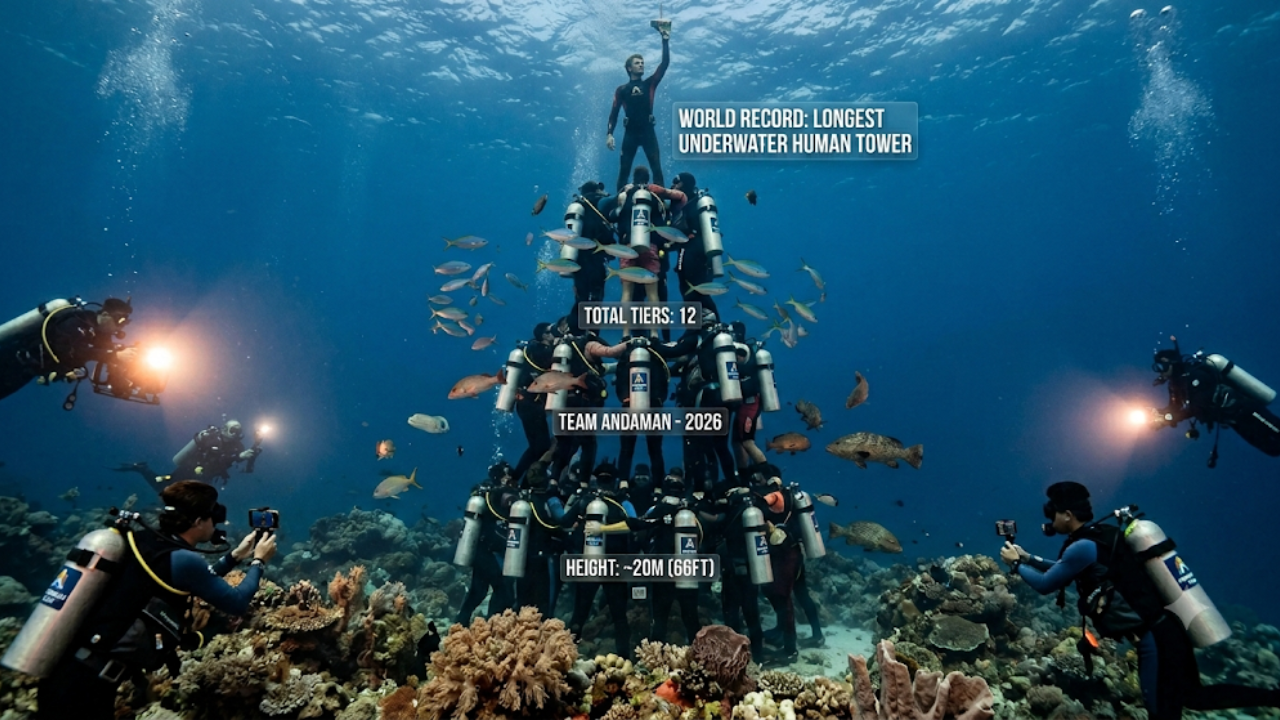
Seventy-five divers were suspended in the water column. They were not swimming. They were not exploring. They were holding onto each other, limb by limb, rib by rib, defying the crushing buoyancy of the ocean to build a tower of flesh and bone.
They stayed down there for nearly three hours. To understand why requires looking past the shiny plaque of a Guinness World Record. It requires looking at what happens when a community decides to turn a terrifying expanse of open water into a home.
The Chemistry of Trust
Human towers, or castells, are a deeply rooted tradition in Catalonia, Spain. For centuries, colles—teams of hundreds of people—have gathered in town squares to build human skyscrapers, sometimes nine or ten tiers high. It is a spectacle of pure physics, balance, and raw courage. A child, the enxaneta, scrambles to the very top, raises four fingers to symbolize the stripes of the Catalan flag, and the crowd roars.
Now, imagine stripping away the solid stone of a European plaza. Strip away the cheering crowds, the safety nets of the ground, and the very air required to breathe. Move that entire operation to the bottom of the Indian Ocean.
In a traditional land-based tower, gravity is the enemy. The people at the bottom, the pinya, bear thousands of pounds of crushing weight. Underwater, the physics invert. Buoyancy becomes the adversary. Human bodies want to float. The saltwater pushes you up, twists your torso, and drifts you away with the currents. To stand on a man’s shoulders seventy feet below the surface is not a matter of strength. It is a matter of absolute, terrifying stillness.
Consider a hypothetical diver named Vikram. He is positioned in the third tier of the tower. In the open air, Vikram can yell to his teammate if his footing slips. He can adjust his weight with a quick, reflexive step. Under the Andaman waves, Vikram is deaf and mute. His only language is the tightening of a hand around his ankle. If he panics and inhales too sharply, his buoyancy changes instantly, pulling the entire structure off-balance. If he exhales too deeply, he sinks, crushing the diver beneath him.
Every breath is a calculated risk. Every movement must be performed in slow motion, as if moving through wet cement.
The Logistics of the Impossible
The logistical nightmare of coordinating seventy-five divers in the open ocean cannot be overstated. A standard scuba tank lasts about forty-five to sixty minutes under normal conditions. At seventy-three feet down, that time shrinks drastically because the air you breathe is compressed.
The organizers could not simply drop seventy-five people into the water and hope for the best. The operation required the precision of a military invasion.
Divers were divided into specialized tiers. The heaviest, most experienced divers formed the foundation, anchoring themselves to a specially designed underwater platform to prevent the current from sweeping the entire human structure out into the deep blue. Then came the mid-level tiers, divers who had to maintain perfect neutral buoyancy—neither sinking nor floating—using only the air in their lungs and minor adjustments to their buoyancy compensators.
Then there was the visibility. The Andaman Sea is famous for its crystalline waters, but when seventy-five pairs of fins start kicking near the seabed, the ocean floor rebels. Silt rises. What was once clear water turns into a milky fog. Divers lost sight of their hands. They could no longer see the surface. They could only feel the grip of the person next to them.
It took weeks of grueling practice in swimming pools and shallow bays just to master the art of standing still together. They had to learn to synchronize their breathing. When the foundation breathed in, the middle tier had to breathe out. They became a single, undulating organism, a human reef responding to the pulse of the tide.
Why the Andaman Sea Cried Out
To the casual traveler, the Andaman and Nicobar Islands are a postcard paradise. White sand beaches, lush mangroves, and coral reefs teeming with clownfish and manta rays. But beneath the tourism brochures lies a deeper, more urgent story. These islands are isolated, fragile ecosystems facing the twin threats of climate change and over-tourism.
The people who live and work in these waters—the local dive instructors, the marine biologists, the fishermen—have watched the reefs change. They have seen the coral bleaching events caused by rising sea temperatures. They have watched the plastic drift in from distant shipping lanes.
The underwater human tower was not a stunt designed for social media clout. It was a manifesto written in flesh and seawater.
By building a structure that required absolute unity, the divers wanted to mirror the delicate interdependence of the marine ecosystem itself. If one organism fails, the entire reef collapses. If one diver loses focus, the tower falls. The record was a megaphone used to shout a message from the bottom of the sea: we are entirely dependent on one another, and we are entirely dependent on the ocean.
The Final Tier
As the clock ticked past the two-hour mark, the physical toll on the divers reached a critical point. Hypothermia is a silent predator in the deep. Even in the tropical waters of the Andamans, spending hours submerged saps the heat from a human body sixty times faster than air. Fingers turn blue. Muscles begin to shake uncontrollably.
A shivering diver cannot maintain balance. The tower was on the verge of fracturing.
The final tier, consisting of the youngest and lightest divers, began their descent from the surface line. They moved down through the water column like astronauts descending toward a space station. The silt was thick now. The currents were picking up, tugging at the tower, trying to bend it like a blade of grass.
The top diver reached the pinnacle. He placed his feet on the shoulders of the teammate below him. He did not have a crowd cheering him on. He had only the sound of his own regulator—the mechanical hiss-click of air—and the vast, empty blue stretching out into the abyss.
He raised his hands. He held the position.
The underwater cameras flashed, their artificial light cutting through the gloom to capture a image that defied belief. A seventy-three-foot monument of humanity, standing erect in the deep ocean, perfectly still against the current.
The Return to Air
When the signal was finally given to dissolve the tower, it did not collapse. It evaporated.
Divers let go of ankles and shoulders, slowly drifting backward into the water column. They began their agonizingly slow ascent toward the light. In diving, you cannot rush to the surface. Doing so causes the nitrogen dissolved in your blood to turn into bubbles, a agonizing and potentially fatal condition known as the bends.
They had to stop. Thirty feet. Twenty feet. Fifteen feet. They hung in the water for safety stops, watching the silver bubbles of their exhaust rise toward the sunlit ceiling above them.
When they finally broke the surface, coughing up saltwater and gasping for the warm, humid air of the Andaman tropical morning, there were no cheers at first. There was only the sound of seventy-five people breathing deeply, taking in the air they had rationed so carefully for hours.
They had broken a world record, yes. But as the dive boats began to pull them from the water, the look on their faces was not one of triumph. It was something closer to reverence. They had gone to a place where humans do not belong, and by holding onto each other, they had made it stand still.