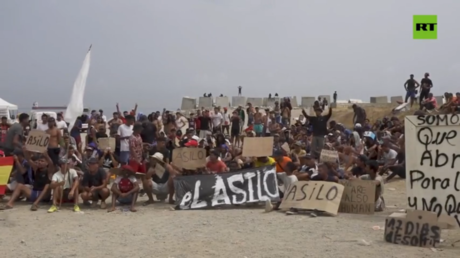
Every time a few hundred people rush a fence in Ceuta or Melilla, the panic machine whirs into motion. The footage loops on cable news. Pundits clutch their pearls. Politicians dust off their favorite crisis speeches about invasions and overwhelmed states.
It is theater. And everyone is playing their assigned role. Meanwhile, you can read related stories here: The Brutal Math Behind Sudan's Phantom Humanitarian Crisis.
The lazy consensus in mainstream media frames these flashpoints as sudden security emergencies, framing human desperation as a hostile military operation. This framing is not just intellectually lazy; it is deliberately misleading. It hides the structural mechanics of how borders actually function, why migration happens, and who benefits from keeping the border discourse permanently broken.
Let us dismantle the noise. To understand the bigger picture, check out the detailed article by Al Jazeera.
The Geography of the Spectacle
Spain's African enclaves are unique anomalies. They are tiny EU territories physically attached to the North African landmass. When people scale those fences, they are performing a high-risk physical protest against a wall of bureaucratic impossibility.
Mainstream coverage treats these events as spontaneous floods. They are not. They are the predictable pressure release valves of a continent that has outsourced its border enforcement to authoritarian transit states while demanding open-market trade and cheap labor behind closed doors.
Imagine a scenario where a municipality completely dismantles its public transit system, bans cars, and then acts shocked when crowds start sprinting down the highway. That is modern European migration policy. You create an environment where legal entry is a mathematical near-impossibility for anyone without a high-tier passport, and then you act outraged when desperate people try physics.
The Economics Nobody Wants to Talk About
I have spent years analyzing cross-border labor flows and state infrastructure. I have watched governments burn billions on razor wire, biometric tracking towers, and detention architecture, all while their domestic agricultural, construction, and care sectors quietly scream for workers.
The European economy runs on undocumented labor. It is the hidden subsidy keeping elder care affordable, harvests from rotting on the vine, and urban construction projects on schedule.
Governments know this. Employers know this. Even the politicians screaming into microphones about border security know this. The entire system relies on a dual-track reality: an official policy of zero tolerance paired with an unofficial wink-and-nod tolerance for the underground labor pool that keeps inflation down.
When hundreds of migrants demand asylum at a fence, they are breaking the script. They are forcing a bureaucratic system to acknowledge them out in the open, rather than quietly blending into the shadow economy where they can be exploited without labor rights or tax contributions.
That is why the reaction is so frantic. It is not about security. It is about exposure.
Dismantling the Asylum Myth
Let us address the common public question: Are these asylum claims legitimate, or are they just economic opportunism?
The question itself is a trap, designed to force a false binary. International law does not require you to choose between fleeing violence and seeking a better economic future; often, they are the exact same thing. Climate collapse, state failure, corruption, and systemic poverty are not separate from violence—they are slow-motion violence.
When a state apparatus collapses or an economy is structurally gutted by global trade imbalances, staying put is a death sentence of a different kind. Pretending that only individuals fleeing active civil war zones possess valid claims to human dignity is a convenient legal fiction invented by wealthy nations to keep numbers manageable.
The professional migration management industry—border agencies, detention contractors, deportation logistics firms—has a vested financial interest in maintaining this friction. Peace is bad for their procurement budgets. A calm, orderly, digitized visa framework that actually works would render half of these agencies redundant.
The Real Cost of Fortress Politics
Every euro spent on higher fences and militarized enclaves is a euro stolen from actual administrative capacity.
If European nations spent a fraction of their border security budgets on processing centers, streamlined work permits, and consular processing in countries of origin, the dramatic fence-scalings would vanish overnight. People do not risk falling off a twelve-foot razor-wire barrier because they enjoy the adrenaline; they do it because the alternative doors are welded shut.
Fortress mentalities do not stop movement. They just professionalize smuggling networks. They hand billions of euros to criminal cartels who charge extortionate rates precisely because the legal paths have been criminalized.
When you make survival illegal, you create a monopoly for outlaws.
The Uncomfortable Truth
The truth that neither the open-border idealists nor the nationalist hardliners want to admit is that migration is a symptom, not a disease. It is a lagging indicator of global inequality.
You cannot police your way out of a demographic winter at home while the global south has a youthful population desperate for opportunity. You cannot preach free markets while locking down the movement of the one commodity every economy actually needs: human capital.
The next time you see footage of crowds demanding entry at a European border, stop looking at the fence. Look at the policies that built it, the labor markets that secretly crave the people standing on the other side, and the political cowards who find it easier to manage a perpetual crisis than to fix a broken system.
Stop asking how to keep them out. Start asking why we keep pretending we can live without them.