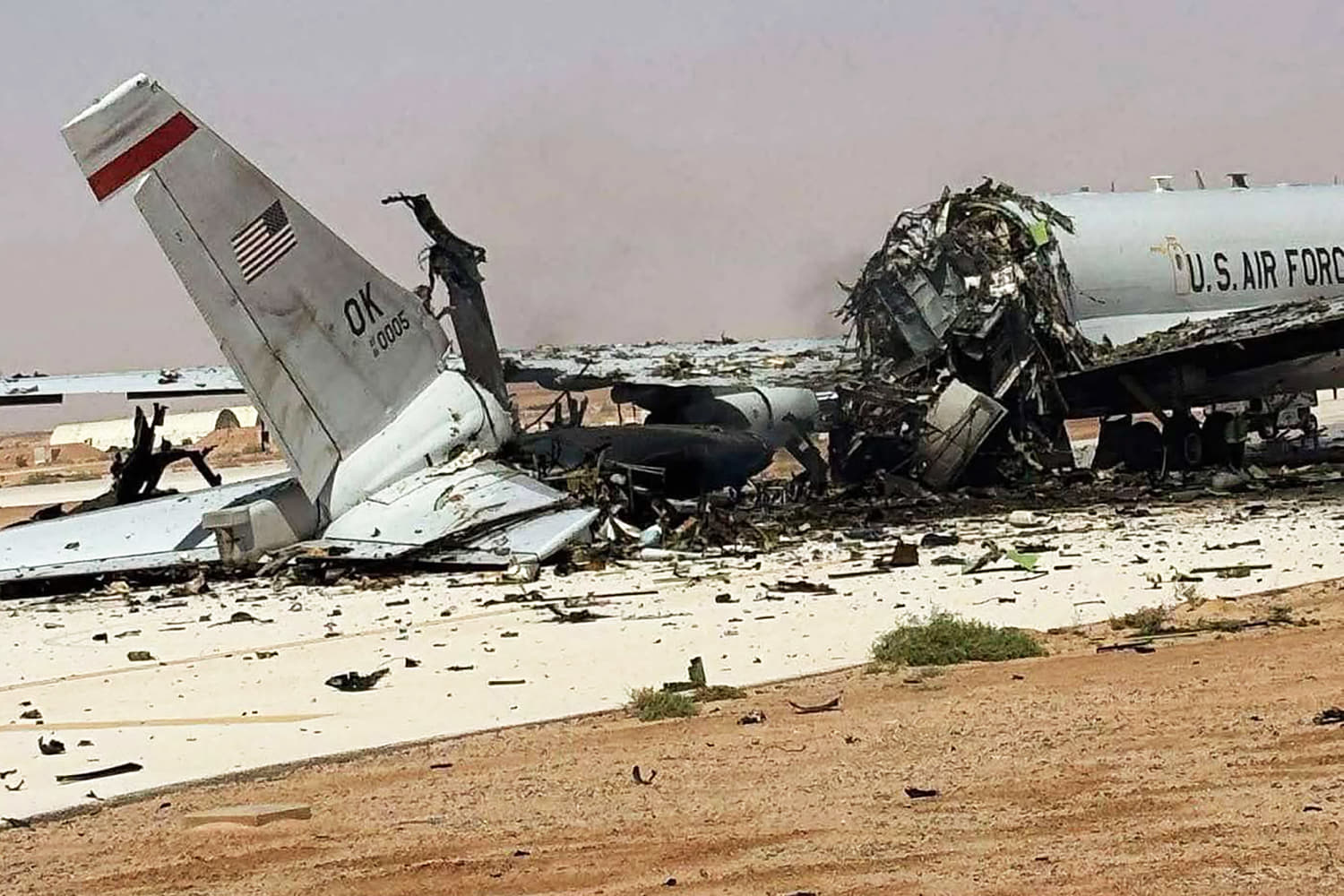
The recent strike on a joint military facility in Saudi Arabia has done more than just dent the metal of a high-value airframe. It has exposed a fundamental fracture in the doctrine of regional air defense. While early reports focused on the dramatic visuals of smoke plumes and twisted duralumin, the real story lies in the specific loss of an E-3 Sentry Airborne Warning and Control System (AWACS) aircraft. This isn't just a plane. It is a flying nerve center, and its removal from the chessboard creates a vacuum that ground-based radar simply cannot fill.
Satellite imagery confirms the destruction of the aircraft on the tarmac, a sitting duck during a refueling and maintenance cycle. For years, the assumption was that the sheer density of Patriot missile batteries and integrated defense layers made these high-value assets untouchable while on the ground. That assumption died this week. The strike used a sophisticated mix of low-slung cruise missiles and loitering munitions that exploited the "clutter" of the desert floor, slipping under the long-range eyes of the very systems the AWACS was meant to augment.
The Myth of Total Air Superiority
Modern warfare relies on the assumption that we can see everything, everywhere, all the time. The E-3 Sentry provides that "god’s eye view," using its massive rotating radar dome to track low-flying threats that are often invisible to ground stations due to the curvature of the earth and mountainous terrain. When an AWACS is taken out, the defensive perimeter doesn't just shrink; it becomes porous.
Ground-based radar is a fixed point. It can be mapped, jammed, or simply bypassed by a clever flight path. An AWACS is mobile, unpredictable, and capable of directing dozens of fighter jets to an intercept point before the enemy even knows they’ve been spotted. By successfully targeting this platform on the ground, the attackers didn't just destroy a $270 million piece of hardware. They blinded the local command structure.
This wasn't a lucky shot. The timing suggests a deep level of intelligence regarding the aircraft's "pit stop" duration. These planes are maintenance-heavy. For every hour they spend in the air, they require dozens of hours of work on the ground. This creates a predictable window of vulnerability that regional adversaries have clearly learned to exploit.
The Low Tech Loophole
There is a grim irony in a billion-dollar defense network being defeated by a drone that costs less than a luxury SUV. We are seeing a democratization of precision strikes. Ten years ago, hitting a specific hangar from five hundred miles away required a superpower’s budget. Today, it requires a garage, a commercially available GPS chip, and a fiberglass mold.
The strike profile indicates a "swarm" tactic designed to saturate defenses. By launching a wave of cheap, slow-moving drones, the attackers forced the base's automated systems to engage. While the interceptors were busy chasing plastic drones, the heavy-hitting cruise missiles—the ones actually carrying the kinetic punch—slipped through the gaps. It is a classic shell game played with high explosives.
- Saturation: Overloading the sensor's ability to prioritize targets.
- Decoupling: Using cheap assets to "strip" the defensive layers away from the target.
- Precision: Using terminal guidance to hit the most sensitive part of the aircraft, usually the cockpit or the radar rotodome.
Why Ground Defenses Failed
The Patriot and THAAD systems are masterpieces of engineering, but they were designed to hit fast-moving ballistic missiles coming from the stratosphere. They are less effective against a drone hugging the contours of a dry riverbed (wadi) at eighty miles per hour. This "nap-of-the-earth" flight path masks the attacker’s radar signature against the background noise of the terrain.
Furthermore, the political optics of air defense often outweigh the tactical reality. Placing a battery in a highly visible location provides a sense of security to the host nation, but it also provides a fixed target for an adversary’s surveillance. The attackers knew exactly where the "blind alleys" in the radar coverage were because those batteries haven't moved in months.
The Logistics of Vulnerability
We have become addicted to large, centralized "super-bases." These facilities are marvels of logistics, capable of launching hundreds of sorties a day, but they are also massive, stationary targets. In the Pacific or Eastern Europe, the talk is all about "Agile Combat Employment"—the idea of spreading planes across many small, hidden airfields. In the Middle East, we are still tethered to massive hubs like the one struck in Saudi Arabia.
When you park a vital asset like an E-3 Sentry at a known hub, you are betting that your shield is impenetrable. That bet failed. The loss of this single airframe ripples through the entire theater. Other AWACS crews must now fly longer hours to cover the gap, leading to "airframe fatigue" and increased maintenance needs for the remaining fleet. It is a death spiral of readiness.
The Saudi military, which operates its own fleet of these aircraft alongside U.S. assets, now faces a crisis of confidence. If their premier airbase cannot protect its most important planes, then the entire "Fortress Arabia" concept is under scrutiny.
The Intelligence Failure
Beyond the hardware, we must look at the human element. A strike this precise requires real-time data. Someone knew that the AWACS would be in that specific hangar at that specific time. This suggests a compromise in either signal intelligence (SIGINT) or, more likely, human intelligence (HUMINT) on the ground.
Base security isn't just about fences and cameras; it’s about the thousands of contractors, laborers, and support staff who move through these facilities every day. An adversary doesn't need to hack a satellite if they can pay a fuel truck driver to take a photo with a smartphone. The "digital exhaust" created by a modern military base is nearly impossible to scrub.
Hardening the Target vs. Hiding the Target
There is a heated debate in defense circles about whether to double down on "hardening"—building massive concrete "revetments" to protect planes—or to focus on "deception."
- Hardening: Building hangars that can withstand a direct hit from a 500-pound warhead. This is incredibly expensive and takes years.
- Deception: Using inflatable decoys and thermal heaters to trick an incoming missile’s seeker. This is cheap but relies on the enemy being easily fooled.
The Saudi strike proved that neither is currently sufficient. The missile didn't hit a decoy; it hit the real thing. This implies that the attackers had "all-weather" and "all-spectrum" confirmation of their target before they pulled the trigger.
Economic Warfare by Other Means
The cost-exchange ratio of this attack is staggering. The missiles and drones used likely cost less than $2 million in total. The damage is nearly 150 times that amount, not including the loss of specialized personnel and the years of training required to operate such a platform. This is the definition of asymmetric warfare.
Adversaries like Iran have realized they don't need to win a dogfight in the sky if they can win the battle on the tarmac. By forcing the U.S. and its allies to spend billions on defense against thousand-dollar drones, they are bleeding the treasury as much as the military capability.
Every time a Patriot missile (costing roughly $4 million) is fired at a drone made of plywood and lawnmower engines, the defender is losing the economic war. We are using silver bullets to shoot at flies, and eventually, we will run out of bullets.
The Ripple Effect on Regional Stability
This event changes the calculus for every neighbor in the region. If the "gold standard" of Western air defense can be punctured, then the deterrent power of that presence is diminished. We are likely to see an increase in "probing" attacks. These aren't necessarily meant to start a war, but to test where the next blind spot might be.
The Saudi response will likely be a massive purchase of more kinetic defense systems, but that is a reactive strategy. The real fix requires a total overhaul of how high-value assets are managed in high-threat environments. They can no longer be treated as "behind the lines" assets because, in the age of the long-range kamikaze drone, there are no lines.
We are entering an era where the airfield is the front line. The luxury of the "safe rear" has evaporated. Until air defense can catch up to the reality of low-cost, high-precision swarms, every radar plane, tanker, and transport aircraft sitting on a desert runway is a liability.
The smoke over the Saudi desert wasn't just a sign of a successful strike; it was a signal that the old rules of engagement are officially obsolete. We have been out-innovated by an enemy that isn't trying to match our technology, but is simply looking for the gaps we were too proud to see. The AWACS is gone, and for the moment, so is the clarity it provided.
The military must now decide if it will continue to park its most valuable eyes in plain sight or if it will finally admit that the desert is no longer a safe place to sleep.