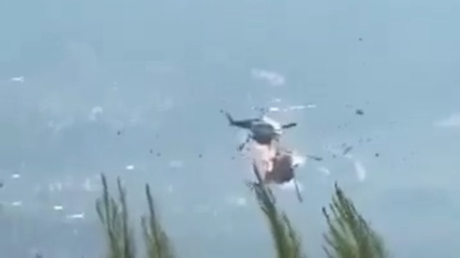
Every time two aerial firefighting aircraft clip rotors or wings in the smoke, the media machine grinds into motion with a predictable, lazy narrative. The talking heads nod solemnly. They blame pilot fatigue. They blame poor communication. They point fingers at human error in the cockpit like clockwork. It is the easiest, laziest possible diagnosis for a systemic failure. It requires zero technical literacy, zero understanding of operational dynamics, and zero accountability from the people running the show from the ground.
Stop blaming the stick-and-rudder jockeys. They are doing the impossible with antiquated tools while management watches from air-conditioned command centers.
The standard media coverage of helicopter collisions during wildfire suppression operates on a fundamentally flawed premise: that aerial firefighting is an orderly dance coordinated by calm voices over pristine radio frequencies. Anyone who has spent an hour inside a temporary flight restriction zone during a Class A wildfire knows that is a dangerous fantasy. It is an unregulated, high-stress brawl fought in zero-visibility conditions, where crews are set up to fail by a bureaucracy addicted to throwing low-margin aircraft at high-magnitude disasters.
The Myth of the Controlled Airspace
The mainstream public assumes that firefighting airspace resembles commercial aviation. Radar separation, strict vectoring, structured corridors.
The reality is closer to a demolition derby in a blinding fog bank.
When multiple agencies converge on a rapidly expanding fire, you get a chaotic soup of state contractors, federal resources, military units, and freelance operators. They are all crammed into a tight column of airspace, choking on particulate matter, blinded by thermal updrafts, and relying on visual flight rules in instrument meteorological conditions.
Expect pilot error when the operational envelope itself is an error.
If you pack a dozen aircraft into a cubic mile of choking smoke with shifting winds and zero horizontal visibility, collisions are not anomalies. They are statistical certainties over time. When an accident happens, the National Transportation Safety Board report will inevitably cite spatial disorientation or a breakdown in visual separation. That is technically true in the same way that drowning is technically the cause of death when you push someone off a boat into a hurricane. It describes the physical mechanism of failure while completely ignoring the structural architecture that put them there.
The Economics of Aerial Attrition
Let us talk about the equipment. I have watched government procurement officers pinch pennies on sensor suites while dropping millions on obsolete airframes that belong in a aviation museum.
Most firefighting helicopters operating on initial attack vectors are flying on tight margins. They are older military surplus or heavily aged commercial utility ships. They lack modern synthetic vision systems, multi-sensor collision avoidance integration, and real-time mesh networking that allows aircraft to see each other through smoke.
Instead, pilots rely on Mark One eyeball and a crackling Very High Frequency radio channel that is frequently jammed with chatter from ground crews, incident commanders, and passing aircraft.
Why? Because retrofitting a fleet of heavy-lift and utility helicopters with advanced avionics costs real capital, and the agencies funding these operations treat safety equipment as optional luxury add-ons rather than baseline survival requirements. We spend billions suppressing fires after they blow up, yet we starve the tactical air architecture of the tech stack required to keep pilots alive while they work blind.
Imagine a scenario where long-haul trucking companies forced drivers to navigate mountain passes at night with taped-up windshields and broken headlights, then fired the drivers for crashing. That is essentially our current aerial firefighting strategy.
The Radio Chaos Trap
Communication is supposed to be the safety net. In reality, it is often a hazard.
During a major fire, frequencies get overcrowded. Initial attack coordination requires split-second decisions, but pilots are frequently drowned out by administrative updates, overlapping tactical channels, and distant supervisors asking for status reports.
When smoke closes in and visibility drops to zero, a pilot does not need a committee meeting over an open mic. They need immediate tactical separation. But the organizational hierarchy of firefighting demands constant verbal check-ins, creating cognitive overload precisely when the human brain is already flooded with adrenaline and hypoxic stress from high-altitude flying in thick carbon monoxide.
We rely on voice protocols designed in the mid-20th century to manage 21st-century aerial densities. It is a recipe for disaster. Until we move away from voice-dependent coordination and toward automated, machine-to-machine spatial deconfliction, pilots will continue to pay the price for bureaucratic inertia.
The Wrong Questions Are Being Asked
Look at the standard post-incident inquiries. They always ask:
- Did the pilots follow protocol?
- Were the frequency assignments clear?
- Was fatigue a factor?
These questions accept the premise that the current operational model is fundamentally sound and only needs minor tweaks. That premise is false.
The right questions are uncomfortable:
- Why are we relying on visual flight rules in zero-visibility smoke environments?
- Why do contract operators have to fight for basic safety avionics upgrades while agencies hoard budgets for administrative bloat?
- Why is initial attack doctrine still anchored to the idea that throwing more aircraft at a disaster makes it safer, rather than more congested?
More aircraft do not equal better suppression. Often, they just equal a higher collision probability matrix. When the sky above a ridge is overcrowded with three different rotorcraft types dipping buckets from the same small water source, you do not have a coordinated strike force. You have a traffic jam at two hundred feet above the treetops.
The Unspoken Trade-off
Let us be brutally honest about why nothing changes.
Wildfire suppression is a massive industry. Contractors profit off flight-hour billings. Agencies justify annual budget increases based on the sheer volume of iron they put in the air. Safety upgrades reduce operational flexibility and increase downtime for maintenance.
The system prefers a tragic headline every few years over the massive structural overhaul required to make aerial firefighting genuinely safe. They pay lip service to safety culture while maintaining a logistical framework that treats pilots as replaceable parts in a high-stakes attrition game.
Until the contracting system penalizes congestion and rewards technological self-sufficiency, until synthetic vision and active proximity alerts are mandatory for every bird on the line, and until we stop treating midair collisions as tragic flukes instead of predictable systemic failures, the smoke will clear, the funerals will pass, and the exact same machinery will spin right back up to do it again.
Strip away the grief-stricken press conferences. Strip away the institutional hand-wringing. The math is brutal, cold, and entirely preventable.
Fix the airspace. Fix the tech. Stop blaming the pilots who fly into the fire because they are the only ones brave enough to do the job you designed to kill them.