The heavy oak doors of the school board meeting room usually muffled the sounds of the Texas evening. Not tonight. Tonight, the humidity outside matched the thick tension inside. A mother sat in the third row, her fingers white-knuckled around a worn plastic binder. Her son, a quiet eighth-grader who spent his weekends building robotics kits, was starting to ask questions she didn’t know how to answer. Not about geometry. Not about biology.
He wanted to know why his homeroom teacher was suddenly reading from the Book of Genesis.
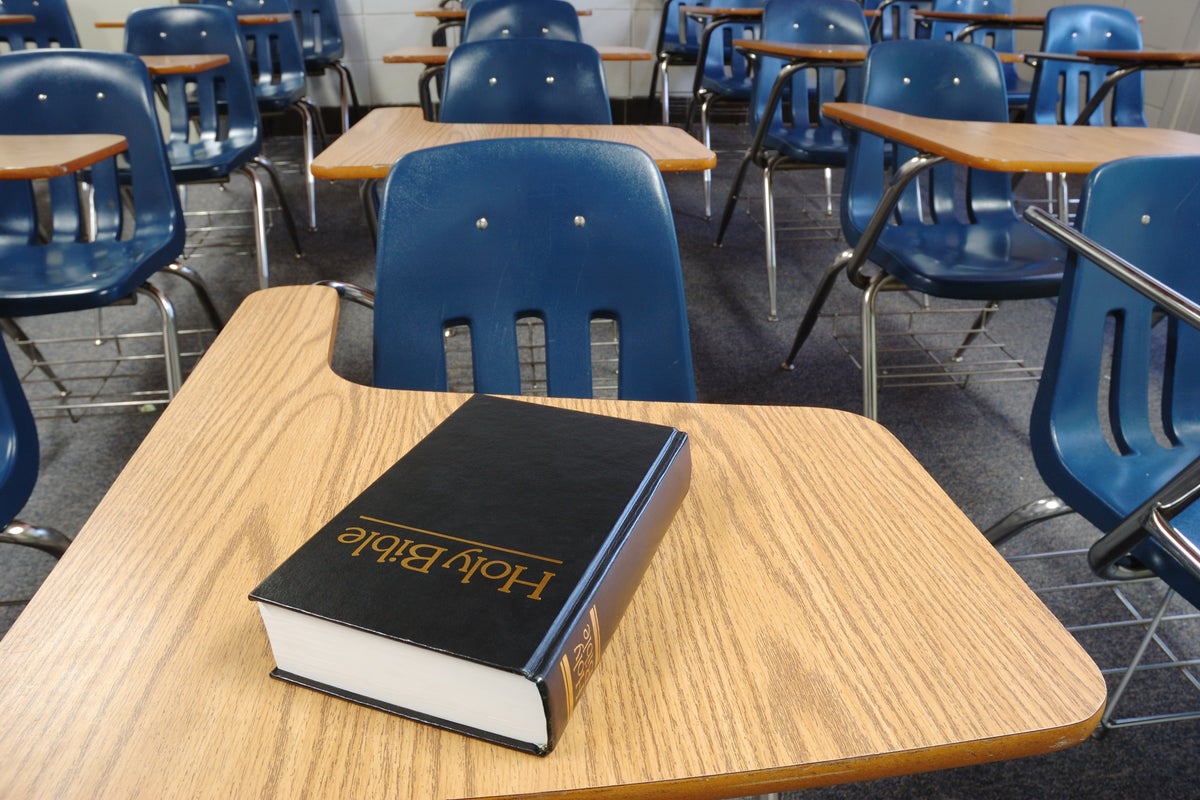
Texas recently shifted the landscape of American public education by passing a mandate. Every public school in the state must now incorporate the Bible into its elementary and middle school curriculum. It is not an elective. It is not an after-school club. It is a core requirement, woven directly into reading and language arts lessons.
To some, this is a long-overdue return to traditional values, a grounding mechanism for a generation cut adrift by technology and social isolation. To others, it feels like an architectural rewrite of the separation between church and state, a seismic tremor that started in Austin but is already sending shockwaves toward school districts across the country.
Your town might be next.
The New Lesson Plan
Consider a hypothetical third-grade classroom in a suburb just outside of Dallas. Let's call the teacher Ms. Alvarez. For a decade, her mornings followed a predictable rhythm. She taught vocabulary using fables, history through short biographies, and grammar with sentence diagrams.
Now, her curriculum guide includes a new anchor text.
When she teaches the concept of justice, she isn't just pointing to the legal system or the Civil Rights Movement. She is instructed to use the story of King Solomon. When she teaches literature, the poetic structures of the Psalms are placed on the same level as Robert Frost.
The policy operates under the premise that the Bible is a foundational text of Western civilization. Proponents argue that without understanding its narratives, a student cannot fully grasp English literature, historical legal frameworks, or art history. They claim it is a cultural tool, not a theological one.
But the reality on the ground looks vastly different from the theory debated in legislative halls.
Ms. Alvarez stands at the whiteboard, acutely aware of the faces looking back at her. In the front row sits a child whose family flees religious persecution in another country. In the back, a child whose parents are devoutly Baptist and expect their specific theological interpretations to be respected. Next to them, a child from a family of secular humanists.
One wrong word, one slight inflection of her voice, and she faces a parental complaint or a state violation. The classroom, once a sanctuary for shared curiosity, suddenly feels like a minefield wrapped in a textbook.
The Invisible Stakes
This is not just a Texas story. The strategy is part of a broader, highly coordinated national movement. Over the past few years, various state legislatures have introduced bills aimed at bringing religious texts and symbols back into the public square.
First came the laws requiring the prominent display of "In God We Trust" posters in school hallways. Then came the legislation allowing school districts to hire chaplains instead of licensed counselors. The mandatory integration of the Bible into daily curriculum is simply the next logical step in a carefully designed playbook.
Look at the funding structures and the political action committees backing these initiatives. They are highly organized, exceptionally well-funded, and they see public schools as the primary battleground for the cultural identity of America.
What happens when a state mandates a specific religious text? The legal precedents are being challenged in real-time. For decades, the Supreme Court upheld a relatively strict boundary line based on the Establishment Clause of the First Amendment. Public schools could teach about religion objectively, but they could not practice or promote it.
The new Texas curriculum attempts to walk a razor-thin tightrope by framing the Bible as an essential historical and literary artifact.
But can you truly separate the history from the faith?
Ask a ten-year-old child to analyze the story of Noah's Ark purely for its literary themes of renewal. To that child, the vivid imagery of a flooded world and a saving vessel is not an abstract metaphor. It imprints. It shapes their worldview. It introduces a specific moral framework into a space that by law is supposed to serve everyone equally.
The Human Cost of Alignment
The burden of this experiment does not fall on the lawmakers who signed the bill into law surrounded by flashing cameras. It falls on the people inside the schools.
Superintendents are staring at budget sheets, trying to figure out how to fund new instructional materials that comply with the state standards while facing threats of lawsuits from civil liberties groups. Principals are spending their evenings drafting guidelines to protect their staff from litigation.
Then there are the parents.
Imagine navigating a parent-teacher conference where the discussion isn't about your child's reading level, but about the specific translation of scripture being used in class. The trust that holds a school community together begins to fray. Parents who once happily volunteered for the bake sale or the book fair now look at the administration with suspicion.
The public school system has historically functioned as America's great equalizer. It is the one place where children from every imaginable background—regardless of wealth, race, or creed—sit side-by-side to learn a shared set of skills and civic values. It requires a delicate, unspoken agreement: we leave our deeply personal, private beliefs at the door so we can learn how to live together as citizens.
When the state breaches that door, the agreement shatters.
The curriculum shifts the focus of education. Time spent dissecting biblical narratives in a standard language arts block is time not spent on phonics, computational thinking, or scientific inquiry. In a country where reading proficiency scores have faced systemic declines, every instructional minute is precious. We are trading foundational skill-building for cultural debates.
The Ripple Effect
If you live in Ohio, Pennsylvania, Tennessee, or Iowa, you cannot afford to look at Texas as an isolated anomaly. The blueprint is already being studied by advocacy groups across the nation.
Modern politics scales incredibly fast. A policy tested in one state can be cloned, packaged, and introduced in dozens of other state houses within a single legislative session. School board elections, which used to be quiet affairs centered on bus routes and cafeteria menus, have become proxy wars for national ideological battles.
It starts with a proposal to introduce historical accuracy into the curriculum. It progresses to a mandate.
The question we must ask ourselves is not whether the Bible has historical value. It undeniably does. The real question is whether we trust the state to be the arbiter of spiritual and historical truth for a diverse populace.
If a school district can mandate the teaching of one specific holy book today, what prevents a different legislature with a different political alignment from mandating a completely different set of texts tomorrow? The precedent being set is one of government intrusion into the intellectual and spiritual development of children.
The school board meeting in that Texas town eventually adjourned. The crowd filed out into the humid night, their voices buzzing in the parking lot. The mother with the plastic binder walked slowly to her car. She looked back at the school building, its dark windows reflecting the streetlights.
Inside those classrooms, the desks were empty, waiting for the morning bell. Waiting for the children who would arrive with their backpacks, their pencils, and their impressionable minds, entirely unaware that their daily lessons had become the most volatile battleground in the country.
The chalkboard used to be a place for questions. Now, it is a place for decrees.