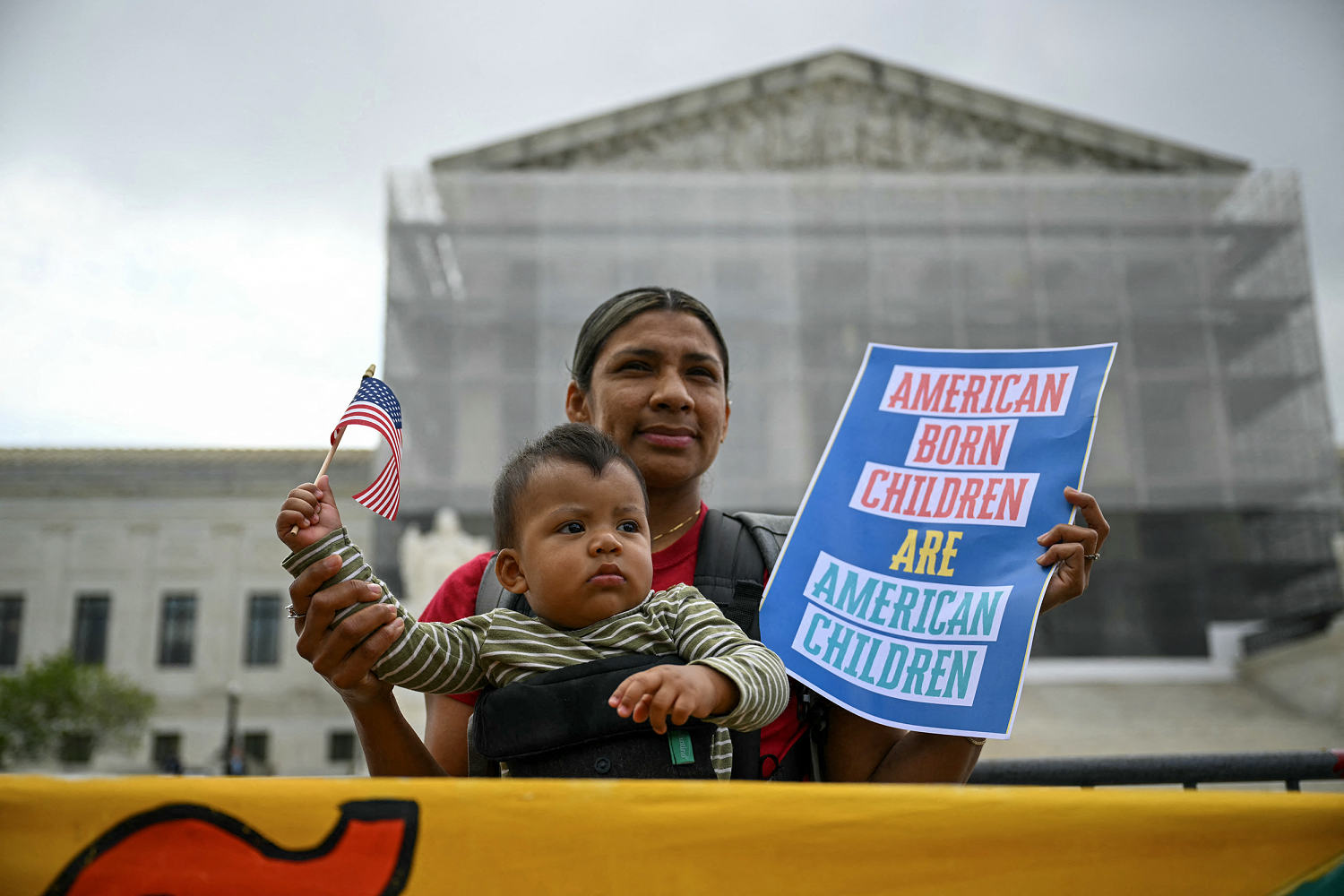
The legacy media is currently hyperventilating over a Supreme Court case they don’t actually understand. They’ve framed the debate as a binary clash: a xenophobic attack on a sacred American pillar versus a noble defense of equality. This narrative is comfortable, it’s easy to sell, and it’s fundamentally wrong. Most journalists are operating on a third-grade social studies version of the 14th Amendment. They treat the concept of jus soli—right of the soil—as an absolute, untouchable law of nature.
It isn’t.
I’ve spent years dissecting constitutional law and watching the administrative state find loopholes in "settled" law that would make a tax attorney blush. The "lazy consensus" suggests that the 14th Amendment was written to grant citizenship to anyone born within the geographic borders of the United States, period. If you believe that, you’ve been sold a simplified bill of goods. The real debate isn't about where you were born; it’s about what "subject to the jurisdiction thereof" actually meant in 1868 and what it means in a globalized 2026.
The Jurisdiction Trap Everyone Ignores
Most legal commentators treat the phrase "subject to the jurisdiction thereof" as a mere synonym for "being physically present." If you are standing on U.S. soil, you are under U.S. jurisdiction, right? Wrong.
If physical presence equaled jurisdiction in the constitutional sense, then foreign diplomats, invading armies, and Native American tribes (at the time) would have all produced citizen children by default. They didn’t. The framers of the 14th Amendment—specifically Senator Jacob Howard, who introduced the Citizenship Clause—explicitly stated that this language intended to exclude people who owed allegiance to another power.
We aren't talking about traffic laws. We are talking about political allegiance.
Imagine a scenario where a foreign nation sends thousands of citizens to live in a disputed territory specifically to birth a new generation of voters. Does the mere act of crossing a line on a map create a binding political contract between that infant and the state? The Supreme Court is finally wrestling with the difference between territorial jurisdiction and political jurisdiction.
Wong Kim Ark is Not the Shield You Think It Is
The go-to "gotcha" for every law professor on Twitter is United States v. Wong Kim Ark (1898). They claim this case settled the matter forever. It didn’t.
Wong Kim Ark was born to parents who were legal, permanent residents of the United States. They weren't tourists. They weren't here in violation of federal law. They were domiciled. The court’s ruling was specifically tailored to the children of legal residents. To extrapolate that ruling to include the children of people who have no legal right to be in the country is a massive logical leap that the 1898 court never actually made.
We’ve allowed a massive expansion of the "administrative state" to interpret this silence as an invitation. For decades, we’ve operated on a policy of "default citizenship" because it was easier than checking papers. Now, the bill is coming due. The Court isn't "reimagining" the law; they are finally reading the fine print that the executive branch has ignored for seventy years.
The Global Outlier Problem
Let’s talk data. The United States is one of the few developed nations that still clings to unrestricted jus soli. Most of Europe, including "progressive" bastions like France and the UK, moved to jus sanguinis (right of blood) or modified birthright systems decades ago.
- United Kingdom: Abolished pure birthright citizenship in 1983.
- France: Requires children of foreign parents to meet residency requirements and manifest a desire for citizenship upon reaching adulthood.
- India: Scrapped it in 2004 to curb illegal migration.
The "consensus" in the U.S. is actually a global anomaly. We are told that changing this would make us a "pariah" or an "outlier." The truth is we are already the outlier. The rest of the world realized long ago that citizenship is a mutual contract, not a prize for winning a race across a border.
The Economic Ghost in the Machine
Critics claim that limiting birthright citizenship would create a permanent underclass. This is a classic emotional appeal designed to bypass the brain’s logic centers.
The real economic question is about the sustainability of the social contract. A nation-state is essentially a massive insurance pool. To keep the pool solvent, you need a defined membership. If the criteria for entry is simply "being present at the moment of birth," the actuarial math starts to break.
I’ve seen how local municipalities struggle with the "anchor baby" phenomenon—not because of "racism," but because of infrastructure. Schools, hospitals, and social services are built for a projected population. When that population is artificially inflated by birth tourism and unauthorized entry, the systems buckle. The status quo isn't "compassionate"; it’s a recipe for systemic collapse.
The "People Also Ask" Fallacy
People often ask: "Doesn't the 14th Amendment protect all children?"
The answer is: Yes, under the Equal Protection and Due Process clauses. But "protection" is not the same as "citizenship." A tourist's child is protected from being murdered or robbed while on U.S. soil. That doesn't mean they get a U.S. passport.
Another common query: "Can the President end birthright citizenship with an Executive Order?"
Brutally honest answer: Probably not. But he can direct the State Department and the Social Security Administration to stop issuing documents to those who don't meet the "subject to the jurisdiction" criteria. This would force a constitutional showdown that the Supreme Court—not the President—would have to resolve. That is exactly what we are seeing now.
The Risks of My Argument
Let’s be clear: stripping away the "default" setting for citizenship is messy. It would create a massive bureaucratic nightmare. We would need a way to track the legal status of parents at the time of birth with 100% accuracy. The potential for errors is high. You could end up with "stateless" individuals—people who belong nowhere. This is a genuine humanitarian concern that the "limit birthright" crowd often hand-waves away.
However, a policy isn't "right" just because it’s easier to administer. We’ve chosen the path of least resistance for a century, and it has led to a border crisis that is currently tearing the country apart.
The Birth of the "Sovereign Individual" Myth
We’ve moved into an era where people believe they have a "right" to a country. They don't. A country is a voluntary association of people who agree to live under a specific set of rules and share a common destiny.
If you allow the definition of "citizen" to be diluted into "anyone who happens to be here," you lose the very concept of a nation. You become a shopping mall with a flag. The Supreme Court isn't attacking citizenship; they are trying to save it from becoming a meaningless participation trophy.
Stop listening to the pundits who tell you the sky is falling. The sky is exactly where it’s always been. We’re just finally looking at the map and realizing we’ve been driving in the wrong direction for fifty years.
The 14th Amendment was a tool for liberation, designed to ensure that former slaves were recognized as full political members of the union they helped build. Using it as a loophole for birth tourism is a historical insult. It’s time to stop pretending that every person on earth has a constitutional right to an American passport just because their mother had a good GPS and a plane ticket.
Citizenship is an inheritance, not a squatters’ right.