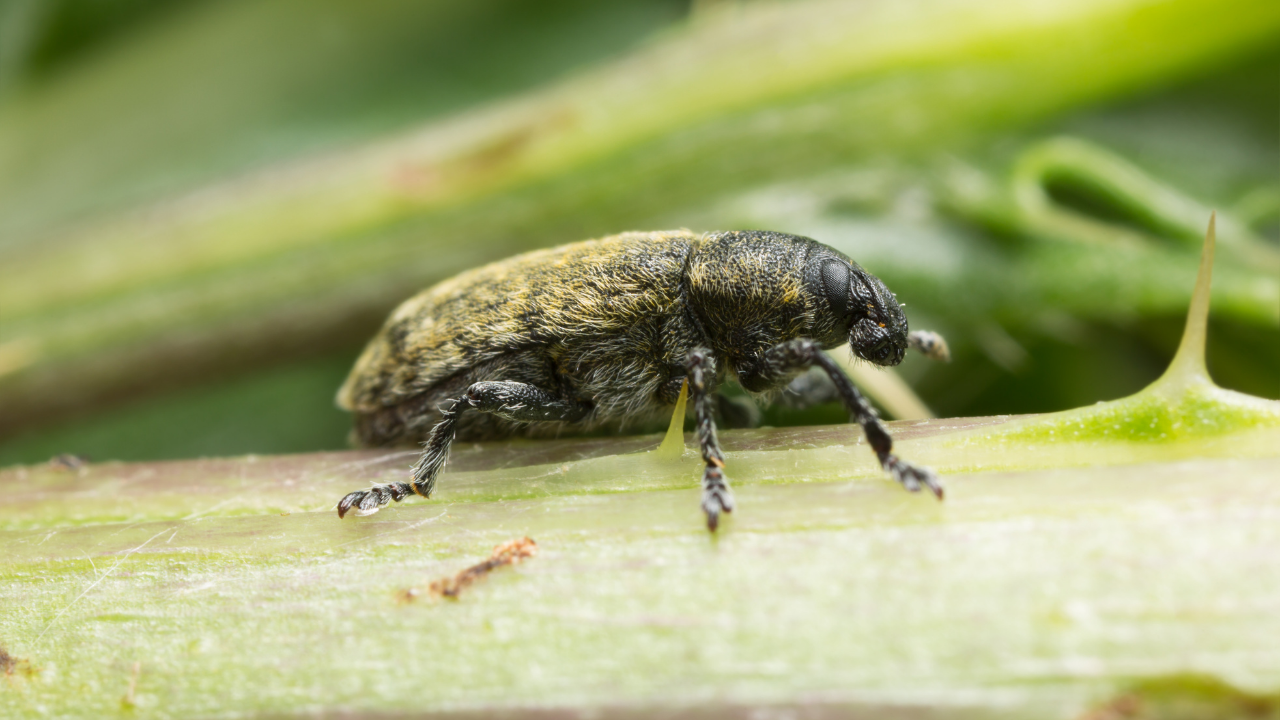
In 1969, federal authorities initiated a campaign to solve a persistent agrarian headache. Musk thistle, an invasive Eurasian weed, was choking out livestock rangelands across North America. To combat it, the United States turned to a foreign biological solution: Rhinocyllus conicus, a European seedhead weevil. Scientists expected this insect to behave as a surgical strike, suppressing the invasive plant by consuming its developing seeds. Instead, the move backfired with a grim irony. The weevil abandoned its intended target, spreading across the continent to feast upon at least 25 native thistle species, including several rare and endangered varieties.
The failure was not merely a lapse in judgment. It was a failure of the foundational assumptions behind classical biological control at the time. When officials imported the weevil from southern Europe, the prevailing sentiment was that the insect would remain loyal to the specific thistle species it occupied in its home range. They treated the environment as a closed system where control agents could be released and then forgotten. That perspective proved catastrophic for native flora.
By the mid-1980s, the weevil had become entrenched far beyond its original release zones. It did not restrict its appetite to the invasive musk thistle. It began colonizing native Cirsium thistles, drilling into their flower heads to devour reproductive tissue before seeds could mature. This damage is invisible to the casual observer but devastating to the plant. Because native thistles often produce fewer seeds than their aggressive, invasive counterparts, the cumulative impact of the weevil’s feeding significantly impairs the survival of native plant populations. In southern New Mexico, for example, researchers documented the insect attacking the endangered Sacramento Mountain thistle, further threatening a species already living on the knife-edge of extinction.
This episode serves as a cold reminder of the risks inherent in altering natural systems. Unlike a chemical herbicide that eventually dissipates or remains bound to a specific application site, an introduced insect possesses the agency to adapt. It moves, it breeds, and it evolves to exploit new opportunities. Once an organism is released, the clock cannot be reversed. Scientists cannot simply recall the weevil once it begins to deviate from its projected behavior.
The regulatory environment of the late 1960s and 1970s lacked the rigorous scrutiny now applied to biocontrol programs. Early laboratory tests, while conducted in good faith, were fundamentally limited by the scope of their observation. They focused on whether the weevil would attack economically significant crops. The potential impact on native biodiversity was an afterthought. Consequently, a program intended to restore ecological balance instead introduced a permanent, self-sustaining stressor into the American wilderness.
Modern field experts now view the Rhinocyllus conicus introduction as a classic cautionary tale regarding the hubris of environmental engineering. The decision to halt federal distribution in 2000 arrived decades too late. By that time, the beetle was already a permanent resident of the ecosystem, thriving in locations where it had never been invited.
We must also consider the ecological opportunity cost. Native thistles are not merely weeds; they function as vital resources for pollinators and local wildlife. By diminishing their reproductive capacity, the weevil has quietly shifted the composition of natural grasslands and meadows. This change is not restricted to a few counties or a single state. It is a continent-wide transformation of the biological record, one that highlights the danger of prioritize immediate, short-term economic relief over long-term environmental stability.
The strategy of fighting one invader with another creates a binary outcome. It either succeeds in isolation, or it births a secondary crisis that may prove more difficult to contain than the original problem. Today, the weevil remains a testament to the fact that when we attempt to manage the complexity of nature with simplistic, reductionist tools, the environment often has the final word. The beetle did not fail to reproduce. It succeeded too well, and in doing so, it effectively rewrote the survival prospects for a generation of native plants. The lessons from this era remain urgent. Future efforts to address invasive species must be viewed with a skeptical eye, prioritizing the protection of existing biodiversity over the seductive appeal of biological silver bullets. We must accept that when we deploy an uncontained, living agent into the wild, the potential for unforeseen consequences is not a possibility—it is an inevitability.