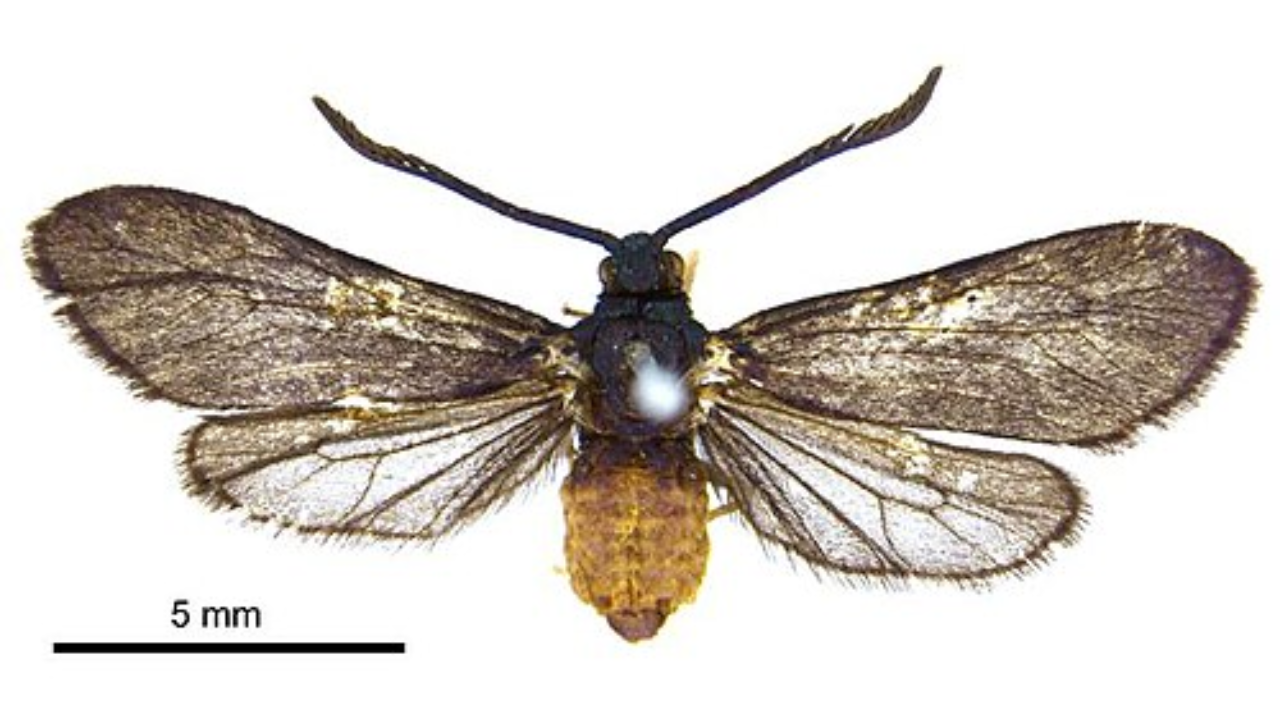
The levuana moth was once a vibrant, iridescent purple fixture of the Fijian islands. Today, it is gone. Its extinction did not come from urban sprawl, industrial pollution, or illegal poaching. Instead, it was systematically eradicated by an intentional, government-backed biological control program designed to save the colony’s lucrative coconut industry. In 1925, scientists introduced a parasitic fly, Bithia lucentina (historically known as Ptychomyia remota), to cull the moth population. The fly did its job too well. Within decades, it didn't just suppress the pest; it hunted the native levuana moth to absolute extinction, creating a permanent cautionary tale about human intervention in isolated ecosystems.
For generations, the levuana moth (Levuana irridescens) existed in a delicate balance within the South Pacific. But when European settlers established massive coconut plantations in the 19th and early 20th centuries, the moth’s caterpillars found an infinite buffet. Coconut palms were the economic backbone of Fiji, providing copra for export and a primary food source for locals. By the 1920s, the moth caterpillars were defoliating entire plantations, leaving skeletal fronds and ruined harvests. The colonial government panicked. Economic ruin loomed. For a deeper dive into similar topics, we suggest: this related article.
Enter the era of enthusiastic biological control.
In the early 20th century, entomologists viewed nature as a machine with interchangeable parts. If a pest population spiked, the solution was simple: find its natural enemy and drop it into the fray. A team of British and Canadian entomologists looked to Malaya, where a similar moth was kept in check by a parasitic tachinid fly. They captured the flies, bred them, and released them into the Fijian wild. For further background on the matter, in-depth analysis can be read at Associated Press.
The mechanism was brutally efficient. The female fly deposits her eggs directly onto the levuana caterpillar. Once the maggots hatch, they burrow into the living caterpillar, consuming it from the inside out. The fly maggots pupate within the cocoon of their dead host, emerging as adult flies ready to repeat the cycle.
The Myth of the Precision Strike
Early reports hailed the campaign as an unqualified triumph. Within a year of the fly’s release, levuana populations collapsed. Coconut yields skyrocketed back to normal. The agricultural complex patted itself on the back, publishing papers celebrating a cheap, permanent solution that required no ongoing chemical usage.
But ecology is rarely linear. The scientists of the 1920s operated under a dangerous assumption: that the parasitic fly would only target the levuana moth, or that once the pest vanished, the fly population would naturally starve down to a harmless baseline. They lacked the modern understanding of host-switching and island biogeography.
Island ecosystems are evolutionary crucibles. Because they are isolated, native species develop without the defenses needed to survive aggressive mainland predators. The tachinid fly was a generalist masquerading as a specialist. When the levuana moth population dwindled, the fly did not starve. It simply turned its attention to other native Fijian insects, using its highly effective reproductive strategy to decimate non-target species.
The levuana moth, possessing no evolutionary memory of such a relentless parasite, had no defense mechanisms. It could not hide, it could not develop resistance fast enough, and its localized habitat left it with nowhere to run. By the mid-20th century, sightings of the purple moth became exceedingly rare. By the late 1970s, despite desperate efforts by later conservationists to find surviving pockets, the species was declared extinct.
The Collateral Damage We Never Measured
The loss of a single moth species might seem trivial to a ledger-focused colonial administrator, but ecosystems do not work in isolation. The levuana moth was a critical component of the local food web. Its sudden removal created a vacuum.
Birds, bats, and predatory insects that relied on the moth caterpillars for sustenance had to alter their diets or face their own population declines. Furthermore, the tachinid fly’s tendency to host-switch meant that an untold number of other native Lepidoptera species—many of which were never formally cataloged by science—likely vanished alongside the levuana moth. We will never truly know the full scope of the biodiversity collapse triggered by the 1925 release.
This historical oversight highlights the fundamental flaw in early conservation and agricultural management. Decisions were driven entirely by immediate economic outcomes, with zero regard for long-term ecological stability. The focus was on protecting a monoculture plantation system, a highly artificial environment, at the expense of the diverse, natural ecosystem surrounding it.
Modern Biocontrol and the Illusion of Safety
Advocates for biological control argue that the Fiji disaster is a relic of a bygone era, an unfair critique of a discipline that has since matured. Today’s protocols are undeniably stricter. Before an organism is introduced to a new environment, it undergoes years of quarantine testing to ensure host specificity. Researchers expose the candidate predator to dozens of closely related native species to guarantee it will not switch targets.
Yet, nature routinely defies laboratory consensus. Environmental variables change. Climate shifts alter species ranges and behaviors. A parasite that appears strictly specific in a controlled cage in a laboratory can behave entirely differently when unleashed into a complex, wild ecosystem where its preferred host becomes scarce.
Consider the cane toad in Australia, introduced in 1935 to control the cane beetle. Not only did it ignore the beetles, which lived high on the stalks out of the toad's reach, but it multiplied exponentially, poisoning millions of native predators that attempted to eat it. Or look at the rosy wolfsnail, introduced to Hawaii in the 1950s to control an invasive African snail. Instead, the wolfsnail ignored the target and pushed dozens of unique, native Hawaiian tree snail species to extinction.
The underlying hubris remains unchanged. Humans continue to attempt to fix engineered ecological crises with further engineering, operating under the assumption that we can predict every interaction within a food web containing thousands of moving parts.
Rewriting the Rules of Intervention
The extinction of the levuana moth forces a uncomfortable realization: some interventions are irreversible. Extinction is absolute. Once a genetic lineage is wiped clean from the planet, no amount of technology or regret can bring it back.
Resource managers must shift from an ethos of eradication to one of management and tolerance. The goal of agriculture cannot purely be the total elimination of risk at the cost of native biodiversity. Integrated Pest Management (IPM) offers a more balanced path, utilizing a combination of physical barriers, crop rotation, localized biological interventions, and minimal chemical applications to keep pest populations below an economic threshold without aiming for total annihilation.
Had the colonial authorities in Fiji accepted a slightly lower profit margin or invested in manual containment strategies, the coconut industry still would have survived, and the levuana moth would still fly today. The true cost of saving the coconuts was the permanent mutilation of Fiji's natural heritage.
The lesson of the purple moth is not that biological control should be banned entirely, but that our ignorance of ecological systems will always outpace our confidence. When we play the role of evolutionary arbiter, we must accept that the consequences of our mistakes will outlive our short-term economic triumphs.