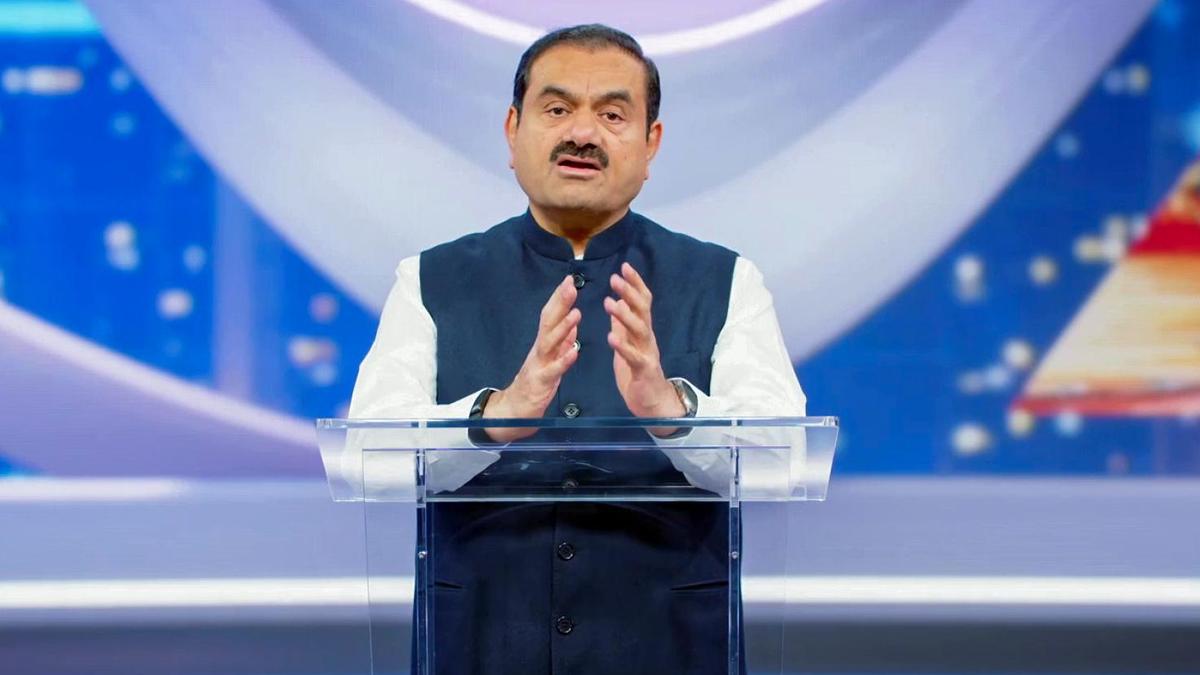
The air in Manhattan’s courtrooms often feels heavy with the scent of old paper and the quiet hum of high-stakes litigation. It is a world removed from the dust-choked construction sites of Gujarat or the sprawling solar parks of Rajasthan. Yet, the invisible threads connecting these two worlds have recently begun to vibrate with a frantic energy. For months, the name Gautam Adani has circulated through the corridors of U.S. justice like a ghost—a figure of immense power whose business empire became the focal point of a massive federal investigation into allegations of bribery and securities fraud.
Now, the silence is breaking.
New reports suggest that U.S. authorities are moving toward a resolution in the legal saga surrounding the Adani Group. This isn't just a corporate update or a dry filing in a dusty ledger. It is the climax of a drama that pitted a global titan against the relentless machinery of the American Department of Justice. At its heart, the story is about the price of ambition and the delicate, often dangerous dance between rapid industrial growth and the rigid boundaries of international law.
The Ghost in the Machine
To understand why a federal prosecutor in Brooklyn cares about a port in India, you have to look at the plumbing of global finance. Money is never local. When a massive conglomerate like Adani seeks to build the infrastructure of tomorrow, it drinks from a global well. It issues bonds. It courts American investors. It enters a contract not just with its partners, but with the regulatory systems that govern the flow of those billions.
The allegations were staggering. Federal investigators began peeling back the layers of a complex narrative involving hundreds of millions of dollars in alleged bribes intended to secure lucrative solar energy contracts. Imagine a hypothetical local official—let’s call him Raj—sitting in a small office, holding the power to green-light a project that would power millions of homes. The authorities alleged that the path to Raj's signature was paved with illicit payments, hidden from the eyes of the very American investors who were funding the dream.
The stakes were never just about one man’s net worth. They were about the integrity of the bridge that connects emerging economies to Western capital. If that bridge is built on a foundation of deception, the entire structure begins to sway.
The Weight of a Name
Gautam Adani’s rise was the stuff of legend. He built a kingdom out of coal, ports, and eventually, the green energy of the future. He became a symbol of a rising India, a man whose personal success was inextricably linked to his nation’s industrial might. But when the U.S. Department of Justice moves, symbols don't matter. Only evidence does.
The investigation centered on whether the Adani Group misled U.S. investors about its compliance with anti-bribery laws. For an investor in New York or Chicago, the "truth" is a legal requirement, not a suggestion. They need to know that the returns they see on their screens aren't being manufactured through backroom deals. When the short-seller Hindenburg Research released its explosive report in early 2023, it didn't just crash the stock price; it pulled the curtain back on a world of opaque offshore entities and shell companies. It turned a success story into a cautionary tale.
The recent movement toward a resolution indicates that a settlement or a formal conclusion may be on the horizon. In the world of high finance, a resolution often looks like a massive fine and a deferred prosecution agreement—a way for the company to keep breathing while acknowledging the wreckage left in its wake. It is a pragmatic, cold ending to a hot, emotional conflict.
The Invisible Victims of Corporate Warfare
We often talk about these cases in terms of "market capitalization" or "regulatory frameworks." Those words are shields. They hide the human reality.
Think about the pension funds. Consider a retired schoolteacher in Ohio whose retirement savings are tied to an index fund. That fund contains Adani bonds. When the news of an investigation hits, and the value of those bonds plummet, that teacher loses a week of groceries, or a month of medical bills. They have never heard of the Adani Group. They couldn't point to the Mundra Port on a map. But they are the ones who bear the weight of the "invisible stakes."
Then there are the workers in India. Thousands of families rely on the Adani Group for their livelihood. When a conglomerate of this size is threatened with legal collapse in the world's most powerful financial market, the anxiety ripples down to the man driving the crane and the woman managing the logistics. Their stability is tethered to the legal maneuvers happening thousands of miles away in a language they might not speak.
The resolution of these cases isn't just a win for the DOJ or a relief for the Adani board of directors. It is a moment of precarious stabilization for a global ecosystem that was beginning to fracture.
The Architecture of a Settlement
How do you resolve a scandal that spans continents? It isn't done with a handshake. It is done with thousands of pages of discovery, months of forensic accounting, and a series of "proffer" sessions where the truth is traded like currency.
U.S. authorities are likely weighing the "public interest" against the need for accountability. If they strike too hard, they risk destabilizing a critical player in the world's most populous nation, potentially chilling foreign investment in India for a decade. If they strike too softly, they signal to every other global conglomerate that the Foreign Corrupt Practices Act is merely a suggestion—a cost of doing business.
The "resolution" being reported is the sound of a middle ground being found. It is the sound of the Adani Group likely preparing to pay a steep price for the right to keep its name on the door. It is the sound of the U.S. government asserting that no matter how fast a company grows, it cannot outrun the reach of a dollar-denominated contract.
The Lessons Carved in Stone
The Adani saga is a mirror. It reflects our own desire for rapid progress and our simultaneous fear of the shortcuts taken to achieve it. We want the green energy revolution. We want the ports to open and the ships to move. But we also want to believe that the world is fair.
The reality is messier. The resolution of these fraud cases won't magically erase the questions raised over the last two years. It won't bring back the billions in market value that evaporated overnight. What it will do is provide a closing chapter to a specific period of uncertainty.
The Adani Group will likely emerge from this chastened, perhaps more transparent, and certainly more aware of the eyes watching from across the ocean. The U.S. authorities will move on to the next giant, having reminded the world that the "house" always wins when the game is played with American money.
In the end, the story isn't about numbers on a spreadsheet. It’s about the fragility of trust. Once broken, trust is rarely repaired to its original strength; it is merely glued back together, the cracks still visible to anyone who bothers to look closely. The shadow play is ending, but the memory of the silhouettes remains.
The gavel falls, the ink dries, and the world turns its attention to the next empire rising in the east, wondering if its foundation is any more solid than the one that just narrowly escaped the collapse.