British rail safety just suffered its worst shock in twenty years. For decades, the narrative surrounding the UK mainline infrastructure was comforting: modern signaling systems and rigid safety parameters made fatal, high-speed collisions between two passenger trains a thing of the past.
That narrative evaporated in a rural field just south of Bedford.
On June 19, 2026, at approximately 5:15 pm, two southbound East Midlands Railway (EMR) trains collided near the Elstow interchange, between the A421 and the A6. The impact killed an EMR train driver and left 89 passengers and crew members injured. Eleven people face very serious injuries, while another 22 are hospitalized with serious conditions.
This isn't just a localized tragedy; it is an industry-wide reckoning. It is the first fatal collision between two passenger trains on a British mainline this century.
The Chaos on the Midland Mainline
The collision occurred during the peak Friday evening rush hour. It involved two distinct London-bound services: the 3:50 pm train from Nottingham to London St. Pancras and the 4:40 pm service from Corby to London St. Pancras. Both were traveling south on the same line when the rear train slammed into the back of the leading train.
"There was no indication of any collision, no screeching of wheels, nor sirens or alarms," passenger Dr. Peter Knapp told journalists after escaping the wreckage. "Suddenly there was an impact. I thought it was a bomb."
The impact stopped the massive structures instantly, flinging passengers forward into seats and breaking limbs. While the majority of the carriages remained upright on the tracks, the sheer force of the shunting motion sent at least one carriage off the rails. It left the front of the trailing train severely crumpled and embedded in the rear of the leading train.
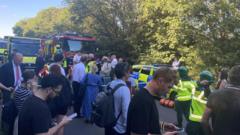
The local emergency response was immediate and immense. The East of England Ambulance Service quickly declared a Major Incident, mobilizing over 20 ground ambulances, six air ambulances, and specialized Hazardous Area Response Teams (HART). Rescue crews had to navigate fields to treat victims, setting up a family reception and staging point nearby at Progress Park.
The Hard Questions Facing Investigators
The Rail Accident Investigation Branch (RAIB) immediately deployed inspectors to the site to gather physical evidence. Everyone in the rail industry is asking the exact same question: how did two passenger trains end up occupying the exact same section of track at the same time?
Historically, British rail safety underwent a massive overhaul following disasters like the Ladbroke Grove crash in 1999. Systems like the Train Protection and Warning System (TPWS) and the advanced European Train Control System (ETCS) were specifically designed to prevent this exact scenario. They are supposed to automatically apply a train's brakes if it passes a red signal or travels too fast toward another vehicle.
Rail safety experts note that because this was a rear-end collision involving two vehicles traveling in the same direction, the trailing train was obviously moving faster than the train in front of it. This points to a finite list of mechanical or human failures:
- A catastrophic signaling equipment failure that gave a green light to a blocked section.
- A severe driver error or medical emergency where signals were completely misread or ignored.
- A profound mechanical failure in the braking system of the trailing train, preventing it from stopping despite active safety intervention.
Compounding the shock is the rolling stock itself. One of the trains involved was a brand-new East Midlands Railway "Aurora" train, which only entered public service recently. These modern fleets boast advanced crumple zones and structural integrity standards designed to shield passengers from intense forces. While those design elements likely prevented a much higher death toll, they didn't stop a fatal outcome for the driver at the point of impact.
Systemic Precedents and Rail Infrastructure Strain
To understand why the Bedford crash is sending shockwaves through the Department for Transport, you have to look at the recent timeline of UK rail incidents. For nearly twenty years, the network avoided multi-passenger fatalities resulting from train-on-train collisions. That streak broke in small increments.
In 2021, a low-speed collision between two trains at a junction near Salisbury injured dozens. In late 2024, a head-on crash on a single-track line in Talerddig, Powys, resulted in one fatality. Both of those earlier incidents occurred during autumn, where poor track adhesion—often caused by crushed leaves creating a slick film on the rails—compromised braking distance.
The Bedford crash happened in mid-June. Seasonally slick tracks cannot be blamed here. The Midland Mainline had recently undergone significant electrification and infrastructure upgrades meant to handle higher speeds and tighter scheduling intervals.
When you push an aging infrastructure network to run more frequent services using higher-speed trains, the margin for error shrinks to near zero. If a signaling system lags or a computer script fails for even a few seconds, the physical safety buffers built into the system can fail completely.
What Travelers and Commuters Need to Do Now
If you rely on East Midlands Railway or use the London St. Pancras hub, the fallout from this disaster will impact your travel patterns for days, if not weeks.
First, do not attempt to travel on the Midland Mainline corridor immediately. EMR suspended all services running in and out of London St. Pancras right after the crash, and the line will remain entirely blocked while the RAIB conducts forensic tracking and physical clearance of the heavy wreckage. Check National Rail Enquiries before heading to any station in the region.
Second, if you had tickets booked for travel during this disruption, save your digital or physical receipts. Under standard UK rail passenger rights, you are entitled to a full refund or alternative routing options via the East Coast or West Coast mainlines, though those networks are experiencing massive knock-on crowding.
The physical investigation will eventually clear, but the regulatory scrutiny is just starting. Expect the RMT and ASLEF unions to demand immediate, sweeping safety audits on all newly deployed rolling stock and upgraded signaling blocks across the country. Mainline rail travel remains statistically safer than driving, but the Bedford crash proves that the system's high-tech armor is far from invincible.