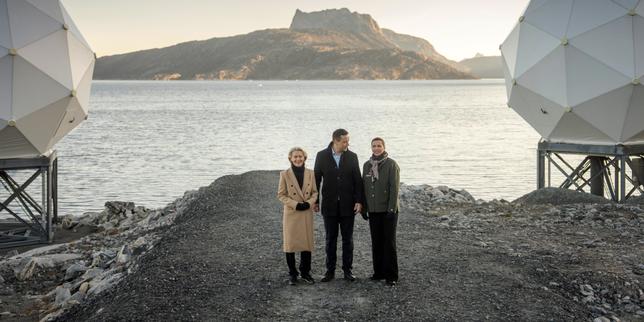
Brussels wants Greenland closer. The European Union has quietly intensified efforts to draw the world's largest island into its economic and political orbit, promising deeper integration, financial aid, and strategic partnership. This diplomatic charm offensive is not driven by sudden altruism. Beneath the surface lies a desperate scramble for rare earth elements, critical minerals, and maritime trade routes opening up as the Arctic ice cap recedes.
Anyone tracking European foreign policy for more than a week recognizes the standard playbook. Bureaucrats draft memoranda, promise sustainable development funds, and talk grandly about shared democratic values. Yet this approach routinely crashes against the jagged realities of Arctic geopolitics. Greenland is not a minor province waiting for a European savior. It is an expansive self-governing territory within the Kingdom of Denmark, sitting on billions of dollars in untapped critical raw materials while balancing the aggressive economic overtures of Beijing and Washington.
Understanding why the European Union is tightening its grip requires looking past official press releases and examining raw supply chains. Modern high-tech manufacturing, defense systems, and green energy transitions depend entirely on minerals like neodymium, dysprosium, and cobalt. China currently dominates global extraction and processing facilities, leaving Western industrial powerhouses dangerously exposed. Brussels needs an alternative source of supply. Greenland sits at the top of the list.
The Mineral Vault Beneath the Ice
Geologists have mapped massive deposits of critical raw materials across Greenland. The Kvanefjeld project in the south and the Tanbreez deposit contain staggering quantities of rare earths alongside uranium and zinc. These resources represent the holy grail for European automotive manufacturers and defense contractors trying to decouple from Chinese dominance.
Mining in the Arctic is brutally difficult. Extreme weather, lack of infrastructure, and a fragile local ecosystem turn every extraction project into an engineering nightmare. Companies must build ports, power plants, and housing from scratch in sub-zero conditions. Financial backers frequently grow nervous when capital expenditures spiral out of control before a single ton of ore leaves the ground.
Local politics add another layer of friction. Greenlandic society remains deeply divided over heavy industry. Fishing and hunting still form the backbone of the traditional economy, and coastal communities worry about environmental contamination ruining the waters. A political shift in Nuuk can instantly derail years of foreign investment planning. When the Inuit Ataqatigiit party won power on an anti-uranium platform, they effectively blocked several multi-billion-dollar mining ventures overnight. Brussels politicians sitting in comfortable offices in Belgium routinely underestimate how fiercely local populations protect their sovereignty after centuries of Danish colonial rule.
Geopolitical Chess Match in the North Atlantic
The European Union is not the only player courting Nuuk. Washington maintains a massive military footprint at Thule Air Base, now officially renamed Pituffik Space Base, which forms a vital node in North American missile defense architecture. The United States has poured diplomatic energy into opening a consulate in Greenland and offering economic cooperation packages to counter Chinese influence.
Beijing understands the game well. Chinese state-owned enterprises attempted to buy abandoned naval facilities and secure mining concessions years ago. While local and Danish pressure successfully blocked those specific land grabs, Chinese capital continues to probe for openings through junior mining partnerships and infrastructure funding offers.
Brussels responds with checkbook diplomacy. The European Union has signed memorandums of understanding with Greenland focusing on sustainable raw material supply chains. These agreements pledge financial assistance and technical cooperation. The underlying message is unmistakable. Trade with Europe, align with Western security standards, and receive development capital.
The Sovereignty Trap
Greenland operates under a self-rule act passed in 2009, which grants Nuuk the legal right to declare total independence from Denmark whenever its people choose. Full independence carries a massive financial catch. Copenhagen currently provides an annual block grant of roughly four billion Danish kroner, accounting for a huge portion of the territorial budget. Without this financial lifeline, an independent Greenland would immediately go bankrupt unless new revenue streams from mining and commercial fisheries came online instantly.
This dynamic creates a delicate balancing act for Greenlandic leaders. Prime Minister Múte Bourup Egede and his administration want full economic independence from Denmark, but they refuse to trade one colonial master for another. Accepting massive influxes of money or regulatory control from Brussels or Washington invites a new form of economic dependency.
European officials talk endlessly about partnership among equals, but trade agreements heavily favor the industrial importer over the raw resource provider. Greenlandic politicians are entirely aware of this historical pattern. They watched African and South American nations supply raw materials to wealthy industrial powers for generations while retaining little domestic wealth. Nuuk wants to avoid becoming merely a frozen quarry for European electric vehicle factories.
What Brussels Gets Wrong
The fundamental flaw in the European strategy lies in treating Greenland as a regulatory frontier rather than an emerging nation-state with distinct national interests. Bureaucrats in Brussels approach the Arctic through the lens of climate change monitoring and green taxonomy regulations. They demand stringent environmental standards that can make large-scale mining economically unviable for private operators.
If European leaders genuinely want secure access to rare earth elements, they must offer more than soft loans and bureaucratic oversight. They need to finance the actual heavy infrastructure required to move minerals out of the Arctic safely. They must also accept that Greenlandic authorities will prioritize local employment, environmental protection, and cultural preservation over European industrial timelines.
The ice is melting. Shipping lanes are opening up, bringing the Arctic closer to major global economic hubs. The scramble for the high north will accelerate regardless of whether European diplomats manage to craft coherent policies or remain bogged down in institutional hand-wringing.
Greenland holds the cards. The European Union needs its minerals to survive the green transition. Nuuk knows this reality better than anyone else in the room.
The Reality of Extraction Timelines
Commercial reality rarely matches political ambition. Even if regulatory hurdles vanish tomorrow, bringing a rare earth mine from exploration to full production takes a decade or more. Complex chemical separation processes require specialized facilities that currently do not exist in Europe. Extracting ore in Greenland is only half the battle. Processing it without relying on Chinese refining monopolies remains a massive technical bottleneck that European industrial policy has yet to solve.
The push to secure Arctic supply chains looks less like a masterstroke of geopolitical strategy and more like a desperate reaction to a looming industrial crisis. Brussels is waking up late to a game that other powers began playing years ago.
The relationship between the European Union and Greenland will deepen out of sheer necessity, but the path forward will be fractured by political resistance, environmental anxiety, and fierce competition from global rivals. The Arctic is no longer a quiet frozen periphery. It is the new front line of global resource competition, and the stakes are rising with every melting meter of ice.