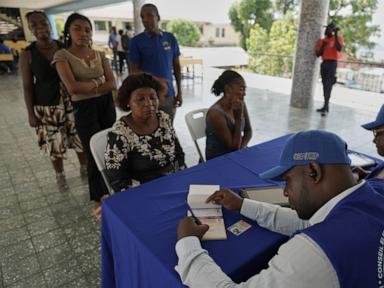
The ink on the voter registration card smells like bureaucratic hope, but the air outside smells like cordite.
Port-au-Prince does not wake up to alarm clocks anymore. It wakes up to the distinct, rhythmic stutter of automatic gunfire echoing across concrete ravines. In neighborhoods carved into hostile fiefdoms by rival factions, the simple act of putting one foot in front of the other is an exercise in profound, heart-stopping calculation. Yet, beneath the smoke and the omnipresent dread, a fragile machinery is grinding back to life. Voter registration has begun.
Consider what happens next: a mother of three steps out of a corrugated metal shack, clutching a worn birth certificate wrapped in a plastic grocery bag to shield it from the dust. She knows the statistics. She knows that large swaths of the capital are controlled by men who measure their authority in calibers rather than constituents. She knows that democracy here is not an abstract political theory debated in air-conditioned lecture halls. It is a physical risk. Every block she walks toward the registration center is a negotiation with hazard.
This is the strange, bruised reality of Haiti right now. The nation is attempting to build a political future while its present is being systematically held hostage.
To understand why anyone would brave the crossfire for a piece of paper, you have to look past the breaking news alerts that reduce an entire culture to a monolith of despair. For years, the vacuum at the top of the state has sucked the oxygen out of daily life. Hospitals run out of gauze. Schools lock their doors. Streets empty out long before dusk. The gangs did not just conquer territory; they conquered routine. They replaced the clumsy, corrupt machinery of governance with the absolute, terrifying clarity of the gun.
Power hates a vacuum, but it also fears a voice.
When election officials set up registration tables—sometimes behind hastily erected barricades, watched over by a multinational security force struggling to stretch its resources too thin—they are performing an act of quiet rebellion. To register a voter is to declare that tomorrow exists. It is a stubborn insistence that the men with rifles do not get to write the final sentence of the national story.
Walk with me through downtown Port-au-Prince on a registration morning. The heat is heavy, oppressive, sticking to the skin like wet wool. The pavement radiates a shimmering glare. Every shadow looks like a potential ambush. A group of young men stand on a corner, watching the passing foot traffic with neutral, unreadable expressions. Are they lookouts? Are they ordinary citizens wondering where their next meal will come from? In this city, you learn quickly that certainty is a luxury reserved for outsiders.
Inside a designated community center, a clerk with sweat beading on his forehead operates a battered laptop connected to a dusty generator. The generator rattles with a deafening, mechanical cough. It drowns out the distant pop of a pistol, but everyone hears it anyway. They have learned to internalize the noise.
A young man steps up to the desk. He is twenty-four. He has never voted in a national election. He has lived through earthquakes, cholera outbreaks, blockades, and the assassination of a president. To him, politics is not about tax policy or infrastructure spending. It is about survival. It is about whether an ambulance can reach his neighborhood without being stopped at an illegal checkpoint. It is about whether his younger sister can walk to the market without fear.
"Why risk it?" I asked him quietly, gesturing toward the street outside where an armored vehicle crawled past a mountain of uncollected garbage.
He did not hesitate. "If I stay home, I give them everything," he said, tapping his finger against the wooden desk. "They want us to disappear. Registering is staying visible."
That is the invisible stake of this moment. Visibility.
For months, international commentators have debated the logistics of intervention, the funding shortfalls of the security mission, and the constitutional legitimacy of transitional councils. These are vital discussions, but they happen at a 30,000-foot view that misses the mud on the ground. On the ground, the struggle is intensely granular. It is about the courage of a clerk who shows up for work despite receiving anonymous threats. It is about the defiance of an elderly man who refuses to let his right to choose be canceled by neighborhood thugs.
The international community watches through drone feeds and diplomatic cables, often shaking its head at the sheer complexity of the crisis. They talk about governance milestones and electoral roadmaps as if they were assembling flat-pack furniture. But democracy in a failed state is not a kit you unbox and click into place. It is forged in the furnace of daily terror. It is messy, incomplete, and terrifyingly fragile.
Critics will point out, quite rightly, that holding elections while armed groups control eighty percent of the capital is a logistical nightmare bordering on the absurd. They will ask how a fair vote can happen when candidates cannot campaign safely and voters cannot cross neighborhood lines without risking their lives. These are not cynical objections; they are hard, mathematical truths.
Yet, waiting for absolute safety in Haiti is a trap. If the baseline for democracy is total peace, then the waiting will stretch into infinity, and the gangs will institutionalize their rule permanently. The start of voter registration is an imperfect, bruised gamble. It acknowledges that you cannot wait for the storm to pass before you start rebuilding the roof. You have to nail the boards down while the wind is still howling.
Consider the alternative. The alternative is silence. The alternative is a generation growing up believing that power only flows from the barrel of a stolen assault rifle. The alternative is total erasure.
The sun begins its descent behind the jagged silhouette of the mountains overlooking the bay, casting a bruised purple light over the city. The registration center closes its doors for the day. The metal shutters are pulled down with a loud, metallic clatter that rings out like a closing vault. The clerk packs the digital logs into a secure case, his shoulders sagging with an exhaustion that goes deep into his bones. Outside, the street vendors pack up their unsold wares. The shadows lengthen. The night belongs to the patrol cars and the unseen watchers in the dark.
Tomorrow, the generators will cough back to life. The lines will form again. The plastic bags will protect the birth certificates. And somewhere in the smoky haze of the capital, a pencil will touch paper, leaving a tiny, indelible mark against the dark.