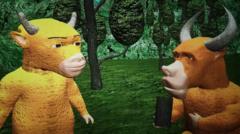
The screen flickered. A horse galloped across a digital expanse, its limbs stiff, its eyes fixed in a state of permanent, glassy terror. It looked less like a noble steed and more like a discarded polygon from a forgotten 2005 video game console. In any other corner of the internet, this would have been a fleeting curiosity—a two-second GIF shared by anonymous critics, mocked on forums, and buried beneath the avalanche of daily media consumption.
Instead, it became a phenomenon.
Clips circulated. Laughter echoed through group chats. Memes morphed from mild amusement into a collective, bewildered affection. But something unusual happened next. The mockery did not curdle into disdain. It softened. It turned into curiosity. And then, against every rule of modern cinematic economics, millions of people bought tickets. They walked into dark theaters not to jeer at a failure, but to witness something honest.
By the time the dust settled, the box office numbers told a story that stunned the industry. A movie skewered for terrible animation had transformed into a massive commercial triumph in China.
How did we get here?
To understand the roar of the crowd, we have to look past the balance sheets and examine why human beings fall in love with the unpolished.
The Architecture of Perfection
We live in an era of terrifyingly smooth surfaces.
Every pixel on our phones is calibrated. Every cinematic blockbuster is scrubbed, color-graded, and rendered by armies of anonymous digital artists working eighty-hour weeks under the quiet hum of liquid-cooled servers. We are fed perfection until our teeth ache. A modern superhero movie features digital doubles so immaculate that even the dust motes falling in the background are mathematically simulated to evoke awe.
Yet awe is exhausting. Perfection leaves no room for the audience. When a film is engineered to the millimeter, it functions like a spotless glass wall; you can admire the view, but you cannot touch it, and you certainly cannot leave a mark.
Consider a hypothetical animator named Li Wei. Picture him sitting in a cramped apartment in Shenzhen at three o'clock in the morning, staring at a render queue that has failed for the fourth time. He is tired. The studio budget is evaporating. The deadline was yesterday. He does not have the software power of a Hollywood conglomerate, nor does he have a hundred specialists to fix the twitch in a character’s wrist. He has a mouse, a keyboard, and a deadline.
When you watch a film born from that kind of desperation, you can feel the human pulse beneath the geometry.
The viral animation that sparked this cinematic storm was not born of laziness. It was born of strain. It was the visual equivalent of someone running uphill in a heavy winter coat, breathing hard, refusing to stop. Audiences sensed that exertion long before they bought a ticket. They recognized the sweat.
The Shift from Irony to Empathy
At first, the internet treated the film as a punching bag. That is our default setting now. Irony is the armor we wear to protect ourselves from being sincere about what we like.
A clip drops. We laugh because laughing together makes us feel safe. We retweet the awkward frame where a character’s face stretches into an impossible parallelogram. We write witty quips about the budget.
Then, something shifts.
Someone points out that despite the wobbly movement, the story's emotional core actually lands. Another viewer notes that the voice acting carries a raw, desperate sincerity that no billion-dollar studio can fake. Bit by bit, the irony begins to crack.
This is the psychological pivot. We move from Look at how funny this mistake is to Look at how hard they tried.
Empathy is a quiet insurgent. It sneaks past our cultural cynicism when we least expect it. When viewers realized that the creators of this viral anomaly were not cynical cash-grabbers, but under-resourced artists attempting something wildly beyond their technical reach, the dynamic changed entirely. The audience stopped acting as hostile judges and became protective co-conspirators.
They bought tickets to reward the effort. They showed up because in a marketplace dominated by safe, sterile sequels, there is something deeply thrilling about watching a massive, beautiful, clumsy swing for the fences.
The Economics of Vulnerability
Hollywood spends hundreds of millions of dollars trying to manufacture virality. They conduct focus groups. They analyze sentiment data. They test endings on weary audiences in suburban malls to ensure no one is confused, offended, or challenged.
And yet, audiences grow increasingly indifferent.
The box office success of an awkwardly animated film in China exposes a crack in the corporate formula. It proves that what people crave is not technical perfection, but resonance.
Think about the art that stays with you across a lifetime. It is rarely the most technically flawless. It is the record with the slightly distorted vocal track, the novel with the messy third act, the film where the seams show. Why? Because those flaws prove that a human being was here. They prove that someone took a risk without a safety net.
When a movie goes viral for bad animation and then conquers the box office, it sends a terrifying message to boardroom executives: you cannot algorithm your way into soul. You can spend three hundred million dollars on physics engines, but if the story lacks a heartbeat, the audience will feel the coldness of the steel. Conversely, give people an imperfect vessel carrying a genuine human struggle, and they will carry it across the finish line themselves.
The Lingering Echo
The theater lights come up.
The credits roll over a soundtrack that was likely mixed on modest equipment in a room with cheap soundproofing. The audience stands, stretches, and gathers their coats. They are buzzing. They are not talking about the fidelity of the fur rendering or the ray-traced reflections in the water. They are talking about the characters. They are arguing about the choices made in the final scene. They are alive.
Outside, the neon lights of the city blur into the damp pavement. Somewhere in a studio across town, a tired animator is closing their laptop, wondering if anyone noticed the hours they poured into a single, clumsy frame of a galloping horse.
They noticed.
And for a brief, rare moment in the history of cinema, the clumsy stride of the underdog outran the polished march of the machine.