Canberra just pulled off a massive diplomatic coup in the South Pacific, and it completely disrupts Beijing's regional playbook.
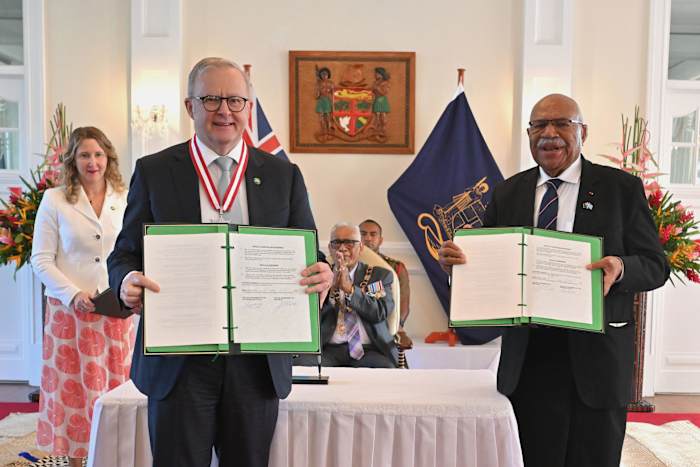
On Monday, Australian Prime Minister Anthony Albanese and Fijian Prime Minister Sitiveni Rabuka met in Suva to sign a historic bilateral defense alliance named the Ocean of Peace Alliance. Alongside it came the Vuvale Union, a sweeping economic treaty locking in over 1 billion Australian dollars ($693 million USD) of Australian investment into Fiji over the next ten years.
This isn't just another dry diplomatic photo-op with traditional kava ceremonies. It is a binding mutual defense treaty. For Fiji, it marks the first formal military alliance in its history. For Australia, it represents a rapid escalation in a high-stakes chess match against China's growing military footprint.
The Reality of the Ocean of Peace Alliance
The core of this treaty is remarkably blunt. If either nation faces an armed attack, both countries are obligated to "act to meet the common danger." The text states clearly that an assault on either country poses an immediate threat to the peace and security of the entire Pacific.
This creates a serious security umbrella. Albanese made it clear that an attack on Fiji by an external force now triggers full Australian military support. It forces both nations to consult immediately on any security developments that threaten their sovereignty.
We aren't looking at an isolated deal either. The Ocean of Peace Alliance is explicitly designed to expand. It is open to other Pacific nations with standing militaries. New Zealand, Papua New Guinea, and Tonga are already lined up as potential future participants. New Zealand's Prime Minister Christopher Luxon has already signaled Wellington's interest in joining the alliance.
What makes this a masterclass in regional strategy is how fast Canberra is moving. For 75 years, Australia relied on a single major formal alliance structure—the ANZUS treaty signed in 1951 with the United States and New Zealand. In less than a year, the Albanese government has added two brand-new mutual defense treaties, locking down Papua New Guinea last year and now securing Fiji. Add last week's Nakamal Agreement with Vanuatu, which explicitly blocks foreign powers from building military bases on those islands, and you see a clear containment wall being built.
Why Fiji is the Ultimate Prize in the Pacific Chessboard
Geopolitics is entirely about geography, and Fiji sits dead center in the maritime supply lines connecting Australia and New Zealand to North America.
When China signed a secretive security pact with the Solomon Islands in 2022, alarm bells went off in Canberra and Washington. The fear of a Chinese naval base right on Australia's doorstep became a real contingency. By locking down Fiji, Australia secures a central hub.
The deal isn't entirely about warships and troops. It is heavily anchored in cash and mobility. The Vuvale Union treaty guarantees a massive funding injection for Fiji's domestic infrastructure, health, and education systems. Crucially, it hints at expanded visa access for Fijians moving to Australia.
Rabuka is playing a delicate double game here. He told reporters in Suva that he does not expect severe pushback from Beijing, claiming the deal doesn't threaten Fiji's relationship with China. He wants Chinese infrastructure money while relying on Australian hardware to guarantee his country's sovereignty. It is a smart, pragmatic stance, but it ignores the reality of the geopolitical friction happening right outside his window.
Beijing Sends a Supersonic Message
If anyone doubted how much this deal irks China, Beijing provided a highly coordinated response on the exact same day.
Hours after the treaty was signed in Suva, Chinese state media confirmed that a Chinese submarine test-launched a long-range ballistic missile carrying a dummy warhead directly into the South Pacific. While Chinese officials called it routine training, the timing is incredibly loud. It is the first time China has dropped a missile into the Pacific since a similar test two years ago.
Australian Foreign Minister Penny Wong confirmed that Beijing gave Australia an advance heads-up about the launch, but she didn't mince words. She called the test destabilizing and criticized China's rapid military buildup for its total lack of transparency.
This missile launch proves exactly why Australia is willing to spend billions of dollars shoring up these island nations. The Pacific is no longer a sleepy maritime backwater. It is an active arena of great power competition.
The Next Moves in the Pacific Power Struggle
The ink is barely dry on the Suva agreements, but the regional schedule shows no signs of slowing down.
Albanese flies straight to the Solomon Islands on Tuesday to meet with Prime Minister Matthew Wale. The goal is to review and potentially undo the 2022 security deal that the Solomons signed with Beijing. If Australia can convince the new government in Honiara to pivot away from China's orbit, it will represent a total wipeout of China's security ambitions in the region.
By Wednesday, the leaders of Papua New Guinea and Tonga will land in Brisbane. The defense treaty between Australia and PNG officially takes effect this week, creating a unified northern and eastern security zone.
For watchers of international relations, the lesson here is simple. Domination in the Pacific won't be won by broad, generic declarations. It is won on the ground through specific, legally binding bilateral defense treaties, hard infrastructure spending, and deep institutional integration. Australia just raised the ante significantly, and China's missile launch shows they know exactly what time it is. Keep a close eye on the Solomon Islands over the next 48 hours; that is where the next fracture line will appear.