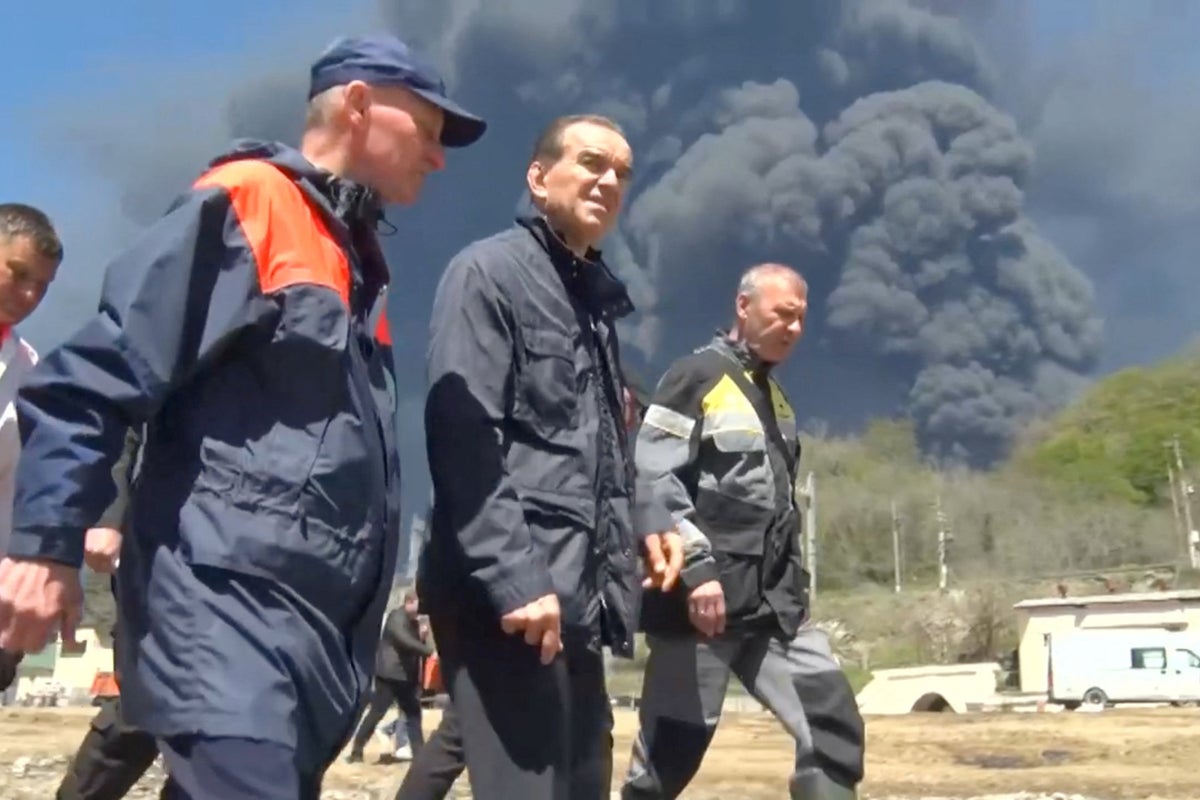
The operational integrity of Russia’s energy export model is currently undergoing a stress test that traditional defensive doctrines failed to anticipate. While individual strikes on oil refineries are often reported as isolated tactical events, they represent a systemic campaign designed to exploit the specific physical and economic bottlenecks of the Russian midstream sector. The recent, repeated strikes on high-capacity refining facilities—specifically the third major engagement in a two-week window—reveal a shift from symbolic disruption to a calculated degradation of the Russian fuel supply chain. This analysis deconstructs the mechanics of these strikes through the lens of industrial attrition, infrastructure fragility, and the logistical constraints of rapid repair in a sanctioned environment.
The Architecture of Vulnerability
Refineries are not monolithic structures; they are delicate ecosystems of high-pressure vessels, volatile chemical reagents, and specialized heat exchange units. To understand why a "massive" fire at a single facility creates ripples across a national economy, one must map the Three Pillars of Refinery Fragility.
1. The Distillation Column Bottleneck
The primary atmospheric and vacuum distillation units (CDU/VDU) are the heart of any refinery. These towers, often exceeding 50 meters in height, are the most difficult components to replace. Unlike storage tanks, which are low-tech steel shells, distillation columns are custom-engineered for the specific crude assay of a region. A kinetic strike on a CDU does not merely halt production; it removes the facility’s ability to separate raw crude into usable fractions like naphtha, diesel, and kerosene.
2. Thermal Feedback Loops
Oil fires are categorized by their extreme thermal intensity and the "cascade effect." When a strike successfully ignites a primary processing unit, the resulting heat weakens the structural integrity of adjacent pipelines and pressurized storage. The firefighting challenge is not just extinguishing the flame, but preventing the thermal expansion of nearby volatiles from triggering secondary explosions. This explains the "massive" scale of recent incidents: the fire is rarely contained to the impact point; it follows the path of the flammable inventory throughout the manifold system.
3. Precision vs. Mass
Modern long-range strike capabilities have moved beyond "area bombing" to "functional defeat." By targeting the cracking units or the control rooms specifically, an adversary can render a multi-billion dollar asset inert with a payload that weighs less than a standard motorcycle. The cost-to-damage ratio favors the attacker by orders of magnitude, creating an economic asymmetry that traditional air defenses struggle to counter.
The Cost Function of Repair and Sanctions
The duration of a refinery’s downtime is the most critical variable in the attrition equation. In a pre-2022 environment, a major fire might result in a 3-to-6-month outage. Under the current sanctions regime, this timeline expands exponentially due to the Western Technology Dependency.
Most sophisticated Russian refineries utilize high-efficiency components—turbines, catalysts, and electronic control systems—sourced from Western conglomerates such as Siemens, Honeywell, or Schneider Electric. Because these parts are now restricted, Russia faces a three-way choice for every damaged facility:
- Cannibalization: Stripping parts from less critical refineries to fix high-priority ones, which leads to a slow, systemic decline in total national refining capacity.
- Reverse Engineering: Attempting to manufacture clones of complex Western parts, a process that is prone to high failure rates and extended lead times.
- Substitution: Sourcing less efficient alternatives from non-sanctioning countries, which often requires a complete overhaul of the refinery’s process flow, essentially rebuilding the plant from the ground up.
Logistical Cascades and Domestic Inflation
The strike campaign targets the domestic stability of the Russian state as much as its export revenue. The Russian economy operates on a delicate balance between crude exports and domestic fuel subsidies. When refining capacity is lost, the following causal chain is activated:
- Supply Contraction: Reduced output of refined products (gasoline and diesel) forces a reliance on existing stockpiles.
- Export Substitution: To maintain revenue, the state may export raw crude that would have been refined internally. However, raw crude is sold at a steeper discount under price caps compared to refined fuels.
- Price Spikes: If the deficit becomes acute, domestic prices for diesel—critical for both the agricultural sector and military logistics—begin to rise.
- The Agricultural Feedback Loop: Increased fuel costs for planting and harvesting translate directly into food inflation, a metric that the Russian Central Bank has historically struggled to contain.
The Geography of Interdiction
The third strike in two weeks signals a "saturation strategy." By hitting facilities in rapid succession, the attacker prevents the redistribution of specialized firefighting equipment and engineering teams. Russia’s geography, while vast, is a double-edged sword. Most major refineries are concentrated in the European part of the country to be closer to both the oil wells and the export terminals. This concentration allows a centralized strike campaign to hit a significant percentage of total national throughput within a relatively small operational radius.
The "Massive" nature of the fire at the most recent target suggests that defensive measures—such as GPS jamming or anti-drone netting—are failing to keep pace with the evolution of strike technology. There is a clear threshold where the frequency of strikes outpaces the rate of industrial recovery. Once this threshold is crossed, the refining sector enters a state of permanent capacity degradation.
Strategic Realignment of Defensive Assets
Russia now faces a "Protector’s Dilemma." Every Pantsir or S-400 system moved to protect a refinery is a system removed from the front lines or from protecting high-value political targets in Moscow. This internal tension is a core objective of the strike campaign. The goal is to force the Russian military to choose between its offensive capabilities and the survival of its primary economic engine.
The logic of these strikes suggests a move toward "The Siege of the Hinterland." By systematically de-energizing the Russian interior, the adversary shifts the friction of war away from the trenches and into the boardrooms and fuel stations of the Russian heartland. The persistence of the "massive" fire, even after days of attempted containment, serves as a visible indicator of the strain on civil and military resources.
The operational focus must now shift to the Crude-to-Product Ratio. If Russia is forced to export more raw crude because it cannot refine it, the global market may see a temporary dip in crude prices due to oversupply, but the Russian state will see a permanent decline in its profit margins. The strategic play for the coming months is the monitoring of Russian refined product exports. A sustained drop of 10% or more in diesel exports would indicate that the "massive" fires have reached a tipping point, moving from a nuisance to a structural failure of the Russian energy complex.
Defense of these assets requires more than kinetic intercepts; it requires a redundant, modular approach to infrastructure that Russia currently lacks. The lack of modularity means that every successful strike is a long-term wound. As the frequency of these engagements increases, the interval between "massive" fires will likely shrink, leading to a state of perpetual industrial emergency.