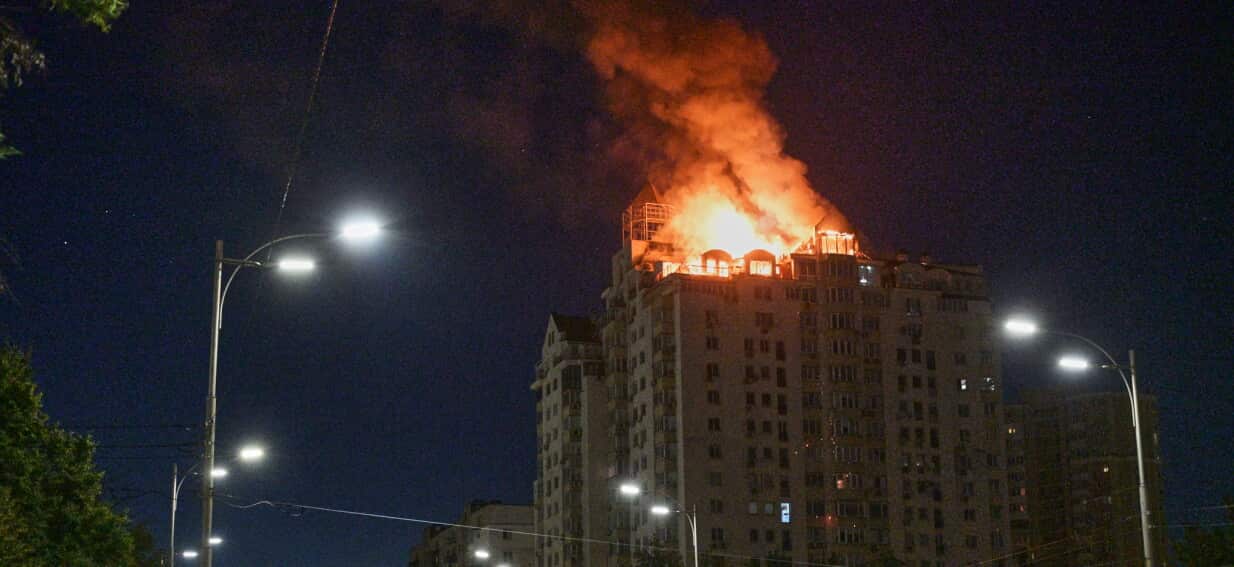
The crimson sunset observed over Caracas days after a devastating seismic doublet—comprising 7.2 and 7.5 magnitude earthquakes—is not a geological omen, an unscientific harbinger of aftershocks, or a manifestation of rare co-seismic "earthquake lights." It is a highly quantifiable manifestation of atmospheric optics. The phenomenon, known regionally in northern South America as a candilazo, operates at the intersection of structural boundary layer disruption and long-range aerosol transport. By examining the mechanics of photon scattering through fluid dynamics and optical physics, we can deconstruct the precise structural variables that transformed a standard tropical twilight into an exceptional atmospheric event.
The Optical Mechanics of Rayleigh Scattering
To understand the intensity of the Caracas phenomenon, one must map the primary mechanical driver of atmospheric color variation: Rayleigh scattering. This elastic scattering of light occurs when the scatterer—typically gaseous molecules such as nitrogen ($N_2$) and oxygen ($O_2$)—has a diameter significantly smaller than the wavelength of the incident electromagnetic radiation.
The mathematical foundation of this process dictates that the intensity of the scattered light ($I$) is inversely proportional to the fourth power of its wavelength ($\lambda$):
$$I \propto \frac{1}{\lambda^4}$$
Because blue and violet wavelengths are shorter ($\approx 400–450\text{ nm}$) than red and orange wavelengths ($\approx 600–700\text{ nm}$), they scatter at an efficiency roughly an order of magnitude greater during solar zenith. However, at solar sunset, the geometric relationship between the observer and the sun alters the optical path length, or airmass ($AM$).
When the sun sits on the horizon, solar radiation must traverse up to 38 times the atmospheric mass compared to a perpendicular vertical path. This expanded trajectory acts as a natural bandpass filter. The short-wavelength blue light experiences near-total attenuation via multiple scattering events before reaching the observer, leaving the unscattered, longer-wavelength red and orange spectrum to dominate the visual field.
Secondary Aerosol Forcing: The Post-Seismic Boundary Layer and Saharan Translocation
While Rayleigh scattering by clean gas molecules explains standard sunsets, it fails to account for the extreme color saturation observed post-disaster. The exceptional chromatic intensity of the Caracas event requires evaluating a secondary mechanism: aerosol forcing within the planetary boundary layer and lower troposphere. This can be conceptualized through two distinct particulate variables.
Localized Tectonic Particulates
The structural failure of high-density urban masonry across Caracas and the coastal state of La Guaira acted as a mechanical source for localized airborne particulate matter ($PM_{10}$ and $PM_{2.5}$). The energy dissipation of 7.2 and 7.5 magnitude quakes pulverized concrete, plaster, and dry soils, launching fine-grain mineral dust into the lower troposphere.
When these larger anthropogenic particles populate the atmosphere, the system transitions from pure Rayleigh scattering toward Mie scattering mechanics, where particle sizes are comparable to or larger than the wavelength of light. While Mie scattering is typically wavelength-independent (explaining why clouds appear white), a highly specific concentration of fine, sub-micron dust can selectively scatter remaining mid-spectrum greens and yellows, sharpening the contrast of the deep red wavelengths.
Transatlantic Aeolian Transport
The localized structural dust did not operate in isolation. Satellite data from NASA's Earth Observatory confirms that northern South America was simultaneously experiencing a seasonal influx of Saharan dust. This mineral dust is lofted from North Africa into the Saharan Air Layer (SAL) and transported thousands of kilometers across the Atlantic Ocean via low-level trade winds.
| Aerosol Type | Primary Particle Size Range | Optical Dynamics |
|---|---|---|
| Gaseous Molecules ($N_2$, $O_2$) | $< 1\text{ nm}$ | Pure Rayleigh scattering; total attenuation of blue spectrum over long paths. |
| Seismic Structural Debris | $1.0\text{ \mu m} - 10\text{ \mu m}$ | Boundary-layer Mie scattering; alters optical depth and local light dispersion. |
| Saharan Mineral Dust | $0.1\text{ \mu m} - 4\text{ \mu m}$ | Mid-tropospheric absorption and scattering; amplifies red-to-orange hue saturation. |
The intersection of these two distinct aerosol inputs significantly increased the atmosphere’s total Optical Depth ($\tau$). The collective particulate volume acted as a hyper-efficient filtering medium, stripping away residual ambient light and yielding an amplified, saturated crimson profile.
Empirical Boundary Conditions and Anomalous Classification
A critical failure in public reporting of post-disaster anomalies is the conflation of unrelated physical events due to temporal proximity. Social media speculation frequently miscategorized the Caracas candilazo as "earthquake lights" (EQL). Disproving this requires an analytical comparison of the boundary conditions governing both phenomena.
True EQL is a documented, yet rare, geoelectric manifestation. The dominant hypothesis for EQL centers on the activation of peroxy defects in igneous rocks under extreme tectonic stress. When rocks slide and grind past one another, chemical bonds break, releasing mobile electronic charge carriers known as positive holes ($p$-holes). These charges propagate rapidly through the rock strata toward the earth-atmosphere interface, ionizing local air molecules and generating brief, localized, luminous plasma discharges.
The Caracas event fails every diagnostic criterion for geoelectric EQL:
- Temporal Scaling: EQL occurs co-seismically (seconds to minutes before or during fault rupture). The Caracas red sky manifested several days after the primary seismic doublet.
- Spatial Extent: EQL is a highly localized phenomenon confined to the immediate vicinity of the fault trace or topographic peaks. The candilazo blanketed the entire metropolitan basin and extended uniformly across coastal states.
- Duration: EQL flashes are transient, lasting from milliseconds to several minutes. The Caracas event adhered strictly to solar tracking, persisting throughout the standard duration of a civil and nautical twilight.
Systemic Forecasting and Public Trust Vulnerabilities
The operational takeaway from the Caracas atmospheric event centers on emergency management infrastructure rather than meteorology. In the immediate aftermath of a natural disaster, population centers experience an acute drop in information reliability, creating a fertile environment for digital misinformation and systemic panic.
The core vulnerability in crisis communications is the human cognitive bias toward pattern recognition amidst trauma. When a population experiencing a severe crisis (nearly 2,000 casualties and over 60,000 reported missing) witnesses a stark, visually ominous atmospheric shift, they naturally attempt to establish a causal link to the ongoing threat vector.
To mitigate this, municipal response frameworks must treat atmospheric optics as a predictable component of post-seismic public management. The structural collapse of an urban center guarantees an elevated atmospheric particulate load. When seasonal meteorological vectors like Saharan dust plumes are known to be active, public information officers should preemptively distribute basic physical explanations of expected optical phenomena.
By framing these striking visual events as predictable results of environmental physics rather than unexplained anomalies, emergency agencies can preserve institutional authority, suppress destabilizing rumors, and ensure that civil focus remains directed entirely toward verifiable recovery logistics.