The smell of burnt paper is different when it carries two hundred years of history. It is heavier. It sticks to the back of the throat like a physical weight. On the night of September 2, 2018, the sky over Rio de Janeiro didn’t just turn orange from the flames consuming the Museu Nacional; it turned gray with the carbonized fragments of South America’s soul.
Imagine a researcher—let’s call her Elena—standing behind the police cordons that night. She isn't watching a building burn. She is watching the precise moment the record of an entire civilization vanishes. In her mind, she sees the Bendegó meteorite, a five-ton iron giant that survived the fires of space only to be licked by the flames of human neglect. She thinks of Luzia, the oldest human remains found in the Americas, whose skull was currently being baked in a furnace of crumbling masonry.
When the sun rose, the National Museum was a hollowed-out skull of a palace. The 20 million items it housed were, for the most part, gone. This wasn't just a loss for Brazil. It was a lobotomy performed on the collective memory of the world.
The Anatomy of a Tragedy
Fire is a fast predator. It doesn't care about the uniqueness of a T-Rex skeleton or the linguistic value of indigenous recordings that existed nowhere else on Earth. The disaster was a result of a slow-motion car crash of budget cuts and infrastructure decay. For years, the museum had been starved of the resources needed for basic maintenance. The hydrants didn't work. The wood was dry. The tragedy was written in the ledgers long before the first spark ever flew.
But the story didn't end in the soot.
In the months following the disaster, a strange thing happened. The mourning turned into a meticulous, agonizingly slow kind of hope. It started with the "ghost hunters"—the archaeologists and technicians who donned masks and sifted through the rubble by hand. They weren't looking for gold. They were looking for fragments of Luzia’s face. They were looking for the mineral samples that could still tell the story of the Earth's crust.
Sifting Through the Silence
Recovery in a post-fire landscape isn't about grand gestures. It is about the brush.
Consider the patience required to sort through tons of debris to find a single tooth. The team at the Museu Nacional didn't just find Luzia; they found 80% of her fragments. It was a miracle of grit. They treated the wreckage like an archaeological site, mapping the fallen floors to predict where specific collections might have landed.
The recovery effort became a masterclass in resilience. Pieces of the Egyptian collection, once thought to be dust, emerged from the ash. The Greco-Roman vases, though scarred, still held their shape. These objects had survived millennia, and they were not going to let a single night of fire erase them.
There is a psychological shift that happens when you lose everything. You stop taking the "given" for granted. Every recovered shard became a victory. Every identified fossil was a middle finger to the void.
The New Architecture of Memory
The reconstruction of the palace is not a simple matter of slapping on a new coat of paint. You cannot rebuild a 19th-century imperial residence with modern shortcuts without losing the "feeling" of the space. The Quinta da Boa Vista, the park surrounding the museum, has long been a lung for the people of Rio. Families picnic in the shadow of the scorched walls.
The challenge lies in the tension between restoration and evolution. Does one rebuild exactly what was there, or do we leave the scars visible?
The current plan involves a massive international collaboration. Germany, UNESCO, and various private entities have stepped in, not just with money, but with expertise. They are building a museum for the 21st century—one that understands that a museum is not a tomb for dead things, but a living laboratory.
The new Museu Nacional will be safer, certainly. It will have sprinklers that work and wiring that doesn't fray. But more importantly, it will be a testament to the fact that culture is not a luxury. It is the bedrock of identity. When the museum burned, Brazilians realized that their history was fragile. They realized that if they didn't fight for their past, they wouldn't have a map for their future.
The Invisible Stakes
Why should someone in London, Tokyo, or New York care about a pile of rocks in Rio?
Because the Museu Nacional held the keys to understanding how humans migrated across continents. It held the botanical secrets of the Amazon before the age of mass deforestation. To lose these things is to lose the data points we need to survive the coming centuries.
We often think of museums as static places—dusty halls filled with things we looked at once on a school trip. But they are actually our insurance policies. They are the backups for the hard drive of humanity. When the backup fails, we are left guessing.
The workers today are not just builders; they are healers. They are stitching the fabric of a nation back together, one stone at a time. The palace facade is being restored to its former yellow glory, but the interior will be a different beast. It will be modern, accessible, and designed to ensure that a tragedy of this scale never happens again.
The Return of the Meteorite
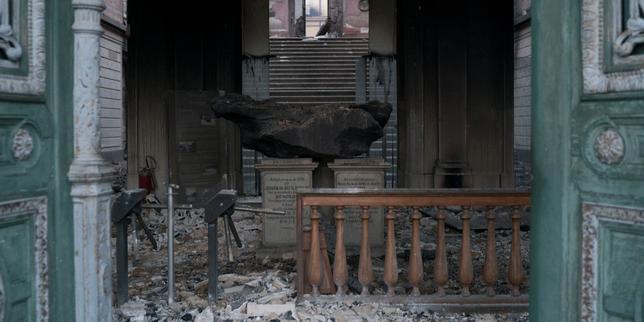
If you visit the site today, you can still feel the echo of that night. The Bendegó meteorite still stands in the entrance. It is a massive, pitted hunk of iron that looks like it belongs in another world. It survived the fire because it was forged in a much hotter one.
It stands as a symbol of the entire project. It is scarred, it is heavy, and it is still here.
The museum is slowly coming back to life. The first sections of the palace's exterior have been unveiled, glowing in the Rio sun like a promise kept. The collections are being rebuilt through donations from other institutions and the tireless work of researchers who refuse to let the fire have the last word.
Elena, our hypothetical researcher, would no longer be standing behind a police line. She would be in a temporary lab, perhaps looking through a microscope at a charred piece of wood, finding the cellular structure that proves it was a specific, ancient tree. She would be smiling, not because the pain is gone, but because the work is continuing.
History is not what happens to us. It is what we choose to save.
The fire was a lesson in the cost of indifference. The recovery is a lesson in the power of persistence. As the doors of the Museu Nacional prepare to open in stages over the coming years, they won't just be letting people into a building. They will be reopening a portal to everything we thought we had lost.
The ash has settled. The ghosts have been named. Now, the heavy lifting of remembering begins in earnest.
A museum is not its walls. It is the stubborn refusal to let the past stay buried.