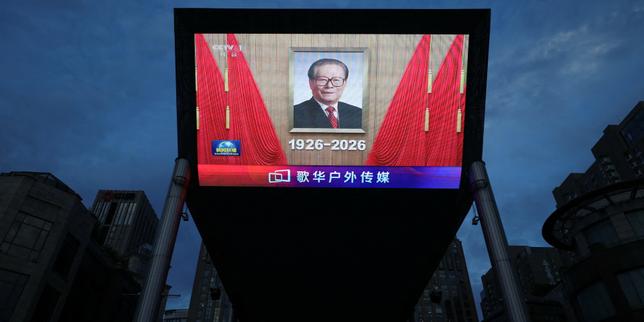
The transition of political power in China following the 1989 Tiananmen crisis remains the most significant case study in regime survival for any modern authoritarian state. When Jiang Zemin assumed the leadership, the Communist Party faced a structural existential threat: the breakdown of ideological cohesion and the specter of institutional disintegration. The contemporary official commemoration of Jiang’s birth anniversary by the current administration is not merely ceremonial; it is a calculated effort to synchronize the historical narrative of the 1990s with current national objectives.
To understand Jiang’s contribution to the state’s continuity, one must evaluate his governance as a dual-track strategy. He did not choose between liberalization and repression; he synchronized them to serve the survival of the governing apparatus. Recently making headlines in related news: Why the PoJK Protests Demand Global Attention Right Now.
The Mechanism of Ideological Containment
In the immediate aftermath of 1989, the regime’s legitimacy was in a state of terminal decline. Jiang’s initial challenge was the internal "historical nihilism" that threatened to erode the Party’s monopoly on memory and meaning. His solution was a formalization of ideological boundaries. By promoting the "Three Represents," Jiang effectively expanded the Party's recruitment base to include private entrepreneurs—a maneuver that integrated the very class that might otherwise have become a nucleus for independent political organization.
This was not an abandonment of socialist principles but a tactical inclusion. By reclassifying economic winners as stakeholders in the system, Jiang mitigated the risk of the middle class forming an opposition bloc. This created a co-optation engine that persists in modified forms today. Where critics saw a move toward capitalism, analysts identify a mechanism to prevent the formation of autonomous civil society institutions. More insights regarding the matter are detailed by TIME.
The Structural Cost of Economic Growth
Jiang’s economic reform agenda—exemplified by the shuttering of uncompetitive state-owned enterprises and the push toward WTO accession—functioned as a high-stakes trade-off. The "painful changes" of the 1990s were intended to generate sufficient economic performance to substitute for ideological consensus. This is the "Performance Legitimacy" model: if the Party provides material advancement, the citizenry concedes political agency.
This model contained a built-in cost function: the rapid expansion of private markets created immense wealth inequality and systemic corruption. Jiang managed this volatility by maintaining a strict, centralized grip on the state’s strategic pillars—telecommunications, energy, and finance—while allowing the peripheral economy to flourish. The current administration’s shift toward technological autonomy and stricter state regulation represents a corrective, attempting to re-center the economy under direct Party supervision, a process made possible only because Jiang established the baseline market infrastructure first.
The Analytical Disconnect in Modern Reappraisals
Observers often misidentify the relationship between Jiang’s era and current leadership policies. The common error is to frame the two as binary opposites—Jiang as the "reformer" and the current leadership as the "repressor." This binary fails to account for the continuity of the institutional objective: the neutralization of internal shocks.
The structural reality is as follows:
- Crisis Identification: Both regimes operate under the assumption that political stability is a prerequisite for economic viability.
- Resource Allocation: Both prioritize the consolidation of central authority over decentralized economic experimentation.
- Information Control: Both utilize systemic campaigns—whether they are named "Spiritual Civilization" or contemporary "Ideological Sphere" directives—to ensure the intellectual landscape remains congruent with state objectives.
Operationalizing the Legacy
The administrative "hard-wiring" performed during the 1990s—such as the creation of the patriotic education curriculum—was a strategic investment in long-term behavioral compliance. By anchoring national identity to the Party’s survival, the state created a durable defense against Western ideological influence.
The current administration’s reliance on this framework demonstrates its effectiveness. The modern emphasis on "technological sovereignty" and "state-led growth" is the logical evolution of the foundations laid during the post-1989 restructuring. The state is no longer merely managing an economy; it is integrating the economic engine directly into the state’s security apparatus.
Strategic Forecast
The integration of private sector entities into state-aligned strategic planning will continue to accelerate. The historical precedent of Jiang’s era provides the current leadership with the confidence that the state can manage the contradictions of a market economy without sacrificing political control. Future shifts will focus on:
- Institutional Hardening: Continued removal of bureaucratic nodes that act as buffers between local economic actors and central directives.
- Cognitive Security: Expanding the perimeter of protected national history to include the economic achievements of the post-Tiananmen era as intrinsic to the Party’s mandate.
- Resource Re-centralization: Using state-controlled financial instruments to dictate the developmental trajectory of emerging technology sectors, ensuring that capital deployment aligns with core party objectives rather than market-driven incentives.
The current administration is not departing from Jiang’s playbook; it is completing the project of state-led integration he initiated. The focus has moved from survival—the primary goal in 1989—to preeminence.