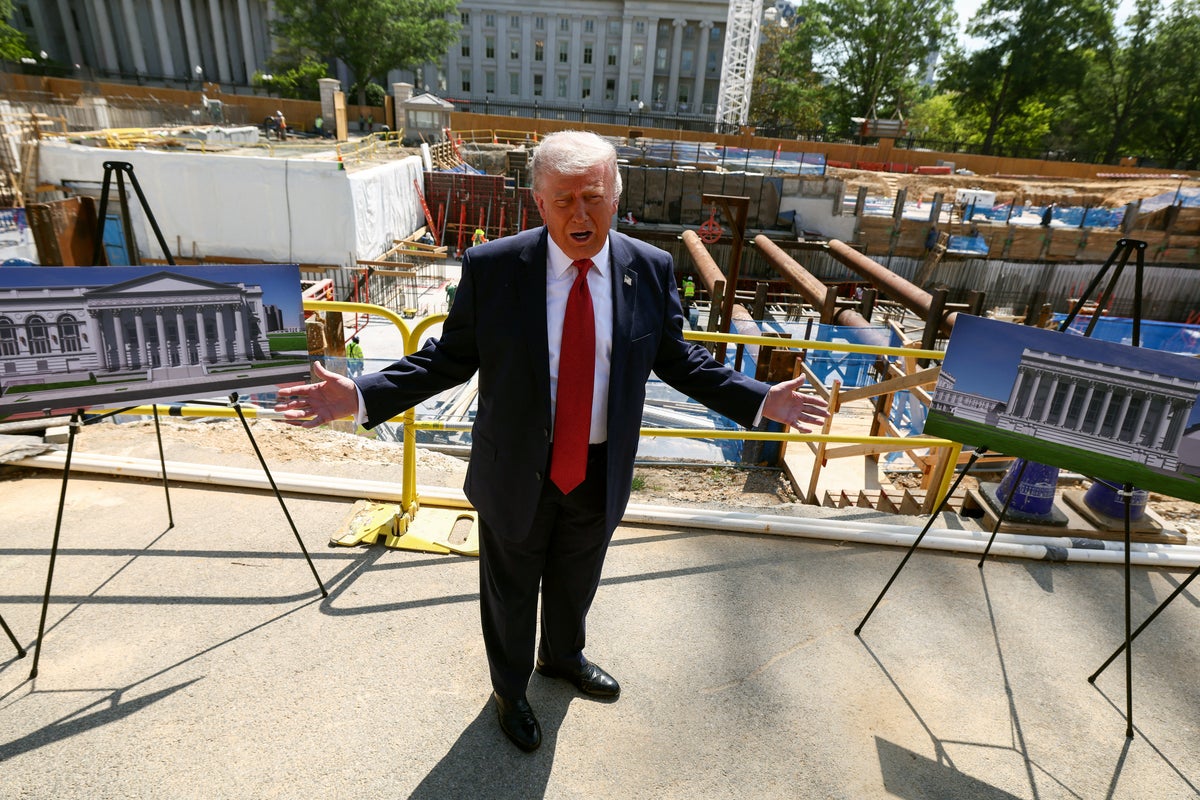
The core conflict in the federal appeals court over the construction of the $400 million White House ballroom is not a dispute about preservation ethics or architectural aesthetics. It is a structural test of a specific executive doctrine: whether the velocity of executive action can outpace the mechanics of judicial standing. When Department of Justice lawyers admitted to the U.S. Court of Appeals for the D.C. Circuit that the executive branch could theoretically bulldoze the Statue of Liberty without judicial interference if it acted quickly enough, they were not offering a literal policy proposal. They were outlining the logical conclusion of a strict administrative theory where injury-in-fact cannot be established retroactively against a completed executive fait accompli.
To understand the mechanics of this litigation, one must separate the political rhetoric surrounding the destruction of the East Wing from the institutional frameworks governing federal property, national security exemptions, and Article III standing. The legal battleground exposes a critical friction point between statutory preservation mandates and the absolute defense of executive structural modification.
The Tri-Partite Statutory Framework of Federal Property Alteration
Executive authority over historic landmarks is bound by three intersecting statutory structures. Under standard operating conditions, these statutes create a mandatory regulatory pipeline designed to prevent unvetted structural modifications to historic assets.
+--------------------------------------------------------------------------+
|                       FEDERAL PROPERTY ALTERATION                        |
+--------------------------------------------------------------------------+
                                     |
              +----------------------+----------------------+
              |                      |                      |
              v                      v                      v
   [Public Buildings Act]    [National Historic   [Anti-Deficiency Act]
   Requires explicit house     Preservation Act]    Prohibits unauthorized
   and senate committee     Section 106 mandatory  private-to-public asset
   authorizations for funds. consultation process.    commingling frameworks.
The first structural pillar is the Public Buildings Act (40 U.S.C. § 3307), which dictates that no public building may be constructed, altered, or acquired involving an expenditure exceeding a specific statutory threshold unless authorized by concurrent resolutions of the Senate and House committees on public works. The executive contention bypasses this by framing the ballroom as an entirely privately funded gift to the nation, bypassing traditional appropriations.
The second pillar is Section 106 of the National Historic Preservation Act (NHPA) (54 U.S.C. § 306108). This mechanism requires federal agencies to take into account the effects of their undertakings on historic properties and afford the Advisory Council on Historic Preservation a reasonable opportunity to comment. The statute functions as a procedural brake, forcing a deliberate, transparent evaluation period before any physical demolition occurs.
The third pillar is the Anti-Deficiency Act (31 U.S.C. § 1341), which limits executive action by barring the acceptance of voluntary services or private funding structures for public works projects without explicit statutory authorization. This prevents the executive branch from executing large-scale capital improvements through off-budget mechanisms, which would otherwise eliminate congressional oversight via the appropriations process.
The Standing Bottleneck and the Velocity Defense
The crux of the Department of Justice’s defense relies on creating a structural bottleneck within the doctrine of Article III Standing. For an organization like the National Trust for Historic Preservation to maintain a suit in federal court, it must satisfy three constitutional variables:
- Injury-in-Fact: A concrete and particularized invasion of a legally protected interest.
- Causation: A direct causal connection between the injury and the challenged conduct.
- Redressability: A high probability that a favorable court decision will remedy the injury.
The DOJ's strategic position leverages a structural flaw in the variable of redressability. By accelerating physical demolition—exemplified by the rapid removal of the White House East Wing—the executive branch deliberately alters the material state of the asset before a court can issue an injunction.
The mechanism can be mathematically conceptualized as a race between two operational velocities: the Execution Velocity ($V_e$) of physical demolition and the Adjudication Velocity ($V_a$) of the federal judiciary.
$$V_e > V_a$$
When the physical asset is altered faster than the legal system can process a preliminary injunction, the injury transitions from threatened to irreversible. If a structure is already leveled, an injunction preventing its demolition is functionally moot. Because a federal court cannot order the retroactive un-demolition of a historic structure, the element of redressability drops to zero. Without redressability, the plaintiff lacks constitutional standing, forcing the dismissal of the lawsuit regardless of whether the initial action violated the NHPA or the Public Buildings Act.
This operational reality explains the hypothetical example involving the Statue of Liberty raised by Judge Patricia Millett. The DOJ’s affirmation that "nothing can be done" if the government acts too quickly is a precise statement on the limitations of judicial power. It demonstrates that under a strict standing framework, speed is a functional substitute for statutory authorization.
The National Security Exception and Injunction Dissolution
To weaponize this velocity strategy in court, the executive branch relies on a compounding variable: the National Security Exception. Following security failures at external venues, such as the shooting near the Washington Hilton during the White House Correspondents' Dinner, the administration reframed the ballroom from a luxury capital project to critical defensive infrastructure.
This pivot shifts the legal evaluation from administrative procedure to a balancing test of equities under the framework governing preliminary injunctions. A court evaluating an injunction must weigh four specific inputs:
- The plaintiff's likelihood of success on the merits.
- The threat of irreparable harm to the plaintiff if the injunction is denied.
- The balance of hardships between the plaintiff and defendant.
- The overarching public interest.
By introducing elements of presidential safety, state-of-the-art medical facilities, and drone-proof architectural components into the court record, the executive branch heavily skews the balance of hardships and public interest variables.
Under established Supreme Court precedent, federal courts are structurally conditioned to defer to executive assessments of national security risks. When the DOJ argues that halting construction exposes the chief executive to assassination vectors, the judicial branch faces an asymmetric risk profile. The potential harm of an administrative procedural error (proceedings without congressional sign-off) is vastly outweighed by the existential harm of a compromised executive compound.
Institutional Precedent and the Risk of Systemic Atrophy
The strategic long-term risk of this legal approach is the structural neutralization of procedural statutory law. If the D.C. Circuit accepts the argument that a lack of judicial standing prevents interference once an asset is rapidly altered, it establishes a reliable blueprint for bypassing legislative oversight on all federal property.
This creates a structural loop hole:
[Executive Intent to Modify Asset]
               │
               ▼
[Execute Rapid Demolition (High Ve)] ──► [Bypass NHPA / Procedural Mandates]
               │
               ▼
[Material State Altered Intermeadiately]
               │
               ▼
[Court Evaluates Injunctive Relief] ──► [Redressability Matrix Equals Zero]
               │
               ▼
[Dismissal via Lack of Article III Standing]
The primary limitation of this strategy is its absolute dependence on physical control over the asset. The executive can only employ this mechanism on properties under direct operational command of the executive branch, such as military bases, the White House complex, or lands managed by the National Park Service. It cannot be deployed against private holdings or state properties where the initial access itself would constitute a trespass actionable under different standing requirements.
The Legislative Counterweight
Because the judicial branch is structurally constrained by Article III standing rules, the only durable counter-strategy lies within the legislative branch's core power of the purse. Rather than relying on third-party preservation groups to litigate procedural compliance, Congress must utilize its spending power to check executive velocity.
The optimal strategic move to preserve statutory boundaries is the deployment of targeted riders in mandatory appropriations bills. By explicitly defunding the operational security personnel, equipment procurement, and maintenance staff required to operate any structure built without statutory compliance, Congress can neutralize the utility of the completed project. This shifts the calculation for the executive: while physical velocity can beat a judicial injunction, it cannot force the future allocation of operational funds required to utilize the unlawfully constructed asset. The battle shifts from a race of physical demolition to a war of structural financial attrition.