The water doesn't just sit there. It breathes.
Standing on the edge of a rewilding site in the deep, damp heart of Britain, you can hear the change before you see it. A year ago, this valley was a drain. It was a straight, efficient, and utterly lifeless line of water meant to move rain from point A to point B as quickly as possible. It was a victory for human engineering and a disaster for everything else. Then, the crates arrived.
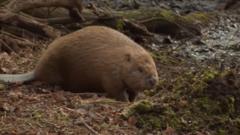
Within those wooden slats were the outcasts of the British countryside: beavers. To the bureaucrats, they were a "reintroduction trial." To the farmers downstream, they were a potential menace. But to the ecosystem, they were the return of the master builders who had been missing for four hundred years.
Twelve months have passed since those beavers first slapped their tails against the surface of their new home. It hasn't been a fairy tale. It has been a messy, muddy, and often desperate struggle for survival that mirrors our own clumsy attempts to fix a planet we spent centuries breaking.
The First Night of the Rest of Their Lives
Imagine being a pioneer dropped into a dark forest with nothing but your teeth and a vague sense of where North might be. That is the reality for a translocated beaver. They don’t arrive with a blueprint. They arrive with trauma.
When the first pair was released—let’s call them the Founders—they didn’t immediately start building an architectural marvel. They hid. For weeks, the monitoring teams saw nothing but ripples in the moonlight. This is the part the brochures leave out. Reintroduction isn't a "plug and play" solution. It is a period of profound vulnerability.
The Founders had to learn the specific language of this particular stream. They had to find the softest willow, the sturdiest alder, and the spots where the current wouldn't tear their hard work apart in a spring flash flood. They were foreigners in their own ancestral lands.
Success.
Then, the first winter hit.
In a standard news report, this is a sentence about "seasonal challenges." In reality, it was a battle of calories. The beavers had to cache enough food underwater to survive when the banks froze solid. If they miscalculated the depth of their pond, the ice would lock them out of their own larder.
We often think of nature as a balanced machine, but it’s more like a high-stakes poker game. One bad freeze, one stray predator, or one catastrophic bank collapse, and the "trial" is over. The fact that they survived at all is a testament to an evolutionary stubbornness that we have largely forgotten in our climate-controlled lives.
The Engineering of Chaos
By the six-month mark, the landscape began to look broken. To the untrained eye, a beaver site looks like a construction zone managed by a lunatic. Trees are felled at awkward angles. Piles of mud and sticks block the "clean" flow of the river. Deep, treacherous pools form where there used to be walkable grass.
But look closer.
The "chaos" is actually the most sophisticated water management system in existence. While human engineers spend millions on concrete flood defenses, the beavers were doing it for the price of a few aspen branches.
Consider the "leaky dam" effect. During a heavy downpour, a straight river acts like a flume, carrying a wall of water toward the nearest village. A beaver dam, however, is a filter. It slows the energy of the water. It spreads the flow across the floodplain, allowing the earth to drink.
Last autumn, when the region was hit by a month’s worth of rain in forty-eight hours, the downstream gauges told a story that the spreadsheets couldn't ignore. The peak flow—the moment when the river is at its most dangerous—was delayed and dampened. The beavers had created a buffer. They had turned a threat into a resource.
The Human Toll of Thrown Sticks
It would be dishonest to say everyone is cheering.
The human element is where rewilding often hits a wall. For a farmer who has spent generations keeping his fields dry, a beaver is not a "keystone species." It is a saboteur.
One evening, I spoke with a local land manager who had spent his career maintaining the drainage ditches. To him, the beavers were undoing his life’s work. There is a deep, psychological friction when we stop trying to dominate nature and start trying to negotiate with it.
The "ups and downs" of the past year aren't just biological. They are social.
How do we compensate someone for a lost crop when the "culprit" is a species we were supposed to protect? This is where the story gets thorny. The "success" of a beaver trial is often measured in how many people don't complain.
The compromise came when a local volunteer group stepped in to install "beaver deceivers." These are simple pipes that trick the beavers into thinking their dam is still holding water, while silently siphoning the overflow away from the farmer's field.
It was a truce.
Not a perfect one, but a necessary one. It reminds us that we cannot simply "return" nature like a retail purchase. We have to make room for it in our own lives, and that usually means a loss of control.
The Return of the Silence
A year later, the valley is unrecognizable.
The straight line of the river is gone. In its place is a mosaic of pools, reeds, and marshland. The silence of the "efficient" drain has been replaced by the cacophony of life.
Dragonflies, whose larvae need the still water of a beaver pond, have returned in numbers not seen in decades. Otters, those nomadic hunters, have moved in to feed on the fish that now hide in the underwater stick-piles. Kingfishers dive into the deep, clear water.
There is a physical sensation to this place now. It feels heavy with potential. It feels wet in a way that isn't just mud and puddles. It feels like a lung that has finally been allowed to expand after being bound for centuries.
The beavers themselves?
They are still there, working the night shift. They are oblivious to the "ups and downs" we record in our journals. They don't know they are a "success story." They only know that when the sun goes down, there is wood to be gnawed and mud to be piled.
They are the architects of the midnight flood, and they have reminded us that the world is much bigger, and much more resilient, than our spreadsheets allow.
The water keeps rising, and for the first time in four hundred years, that's exactly what it's supposed to do.