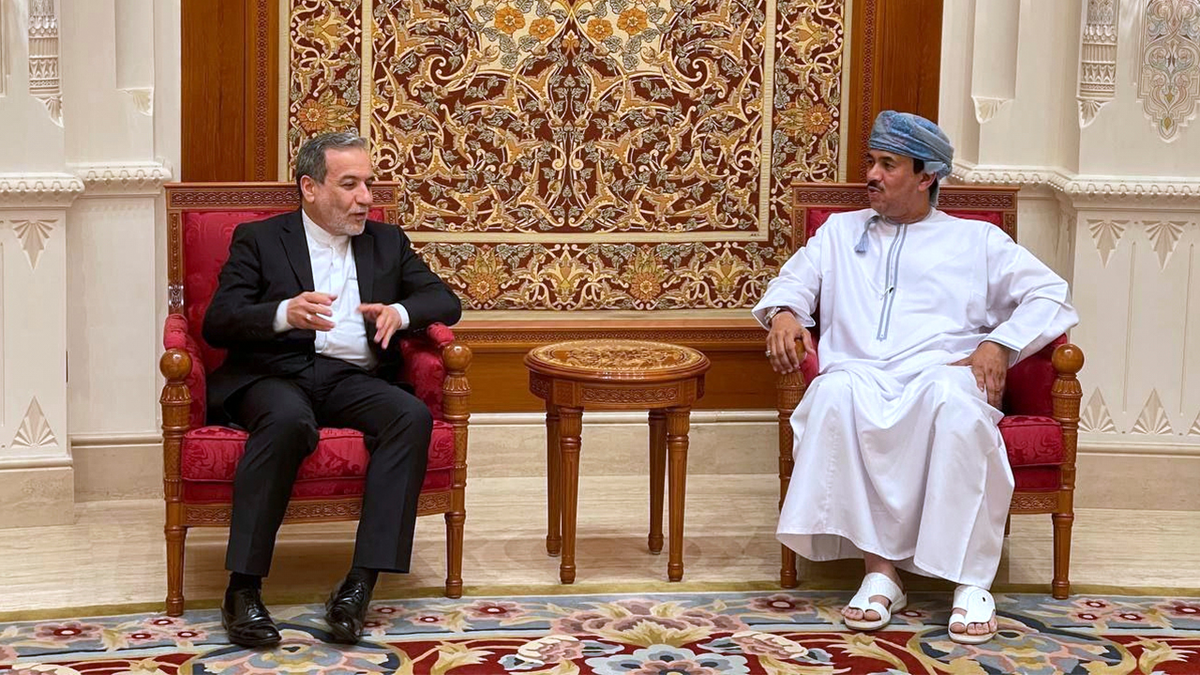
The mainstream media loves a "leadership crisis" narrative because it’s easy to sell. It paints a picture of a fractured regime on the brink of collapse, with reformers like Masoud Pezeshkian and pragmatists like Mohammad Bagher Ghalibaf supposedly sharpening knives for Foreign Minister Abbas Araghchi. The prevailing gossip suggests Araghchi is being targeted for his "subservience" to the Islamic Revolutionary Guard Corps (IRGC).
It’s a neat story. It’s also completely wrong. Don't forget to check out our earlier post on this related article.
If you think Pezeshkian or Ghalibaf are genuinely shocked by Araghchi’s alignment with the IRGC, you don’t understand how the Islamic Republic functions. In Tehran, "friction" is often a feature, not a bug. The idea that Araghchi is a failing diplomat caught between two fires ignores the reality that he is exactly where the system needs him to be.
The False Dichotomy of Reformers vs. The Guard
The biggest lie in geopolitical analysis is the "Good Cop, Bad Cop" routine played out by Iranian factions. We are told Pezeshkian represents the "reformist" hope for engagement, while the IRGC represents the "hardline" wall of resistance. To read more about the history of this, The Guardian provides an in-depth summary.
In reality, the Iranian state is a singular organism with different limbs. The IRGC isn't a separate entity interfering in foreign policy; it is the foundation of foreign policy. Any Foreign Minister who isn't "subservient" to the IRGC would be physically unable to execute their job. Araghchi’s supposed sin—coordinating closely with the military wing—is actually his primary job description.
When Pezeshkian or Ghalibaf leak "discontent" about Araghchi, they aren't trying to fire him. They are signaling. To the West, they signal that there is a "moderate" faction worth negotiating with if only the "hardliners" could be sidelined. To the domestic audience, they are distancing themselves from the inevitable economic pain that comes from failed sanctions relief. It is political theater at its most cynical.
Araghchi as the Necessary Lightning Rod
Abbas Araghchi is not a victim of a power struggle; he is the shield.
By allowing rumors of his removal to circulate, the administration creates a buffer. If a diplomatic initiative fails, it’s Araghchi’s "weakness." If the IRGC escalates in the region and ruins a deal, it’s Araghchi’s "subservience." He is a professional scapegoat.
The Western press falls for this every time. They report on "internal rifts" as if they are watching a democratic cabinet shuffle. They miss the fact that Supreme Leader Ali Khamenei holds the final word on every major move. If Araghchi were truly out of step with the regime's goals, he would have been gone in an afternoon. The fact that he remains—amidst the noise—proves he has the mandate that actually matters.
The Ghalibaf Factor: Opportunism, Not Ideology
Let’s talk about Ghalibaf. The Speaker of the Parliament is often portrayed as a pragmatist looking for "stability."
Don't be fooled. Ghalibaf is a political survivor who understands that the IRGC is the ultimate kingmaker. His supposed critique of Araghchi isn't about policy; it’s about positioning. By criticizing the Foreign Minister for being too close to the Guard, Ghalibaf is actually trying to out-maneuver the Guard's own political favorites. It is a game of "who can be the best servant to the Supreme Leader."
By attacking Araghchi, Ghalibaf is attempting to consolidate power within the conservative camp, not change the direction of Iranian foreign policy. He wants to be the one holding the leash, not the one being led by it.
Why the "Crisis" Narrative Fails the Reality Test
The "crisis" narrative assumes that the Iranian leadership is disorganized. I’ve watched analysts predict the "imminent collapse" of the clerical establishment for decades. They always fail because they underestimate the regime’s ability to use internal conflict as a pressure valve.
- Negotiation Leverage: By appearing divided, Iran makes the West think they need to offer "concessions" to help the "moderates" stay in power. It’s a classic bazaar tactic.
- Plausible Deniability: If the Foreign Ministry agrees to something the IRGC hates, the IRGC can simply ignore it, claiming the "moderates" don't speak for the military.
- Domestic Distraction: While the public debates Araghchi’s future, they aren't focusing on the double-digit inflation or the systemic mismanagement of the energy sector.
The Math of Survival
Consider the strategic equation of the Iranian state:
$$S = \frac{R + M}{E}$$
Where $S$ is survival, $R$ is ideological rigidity, $M$ is military posturing (IRGC), and $E$ is economic engagement. Araghchi’s role is to maximize $E$ without diminishing $R$ or $M$. It is a mathematical impossibility to please everyone in this equation. Therefore, the "failure" of the Foreign Minister is a mathematical certainty, regardless of who holds the office.
If you replaced Araghchi tomorrow with a carbon copy or a complete opposite, the results would be the same. The constraints of the office are set by the Office of the Supreme Leader and the National Security Council. The Minister is merely the face of those constraints.
Stop Looking for "Change" in Personalities
The obsession with whether Araghchi stays or goes is a distraction from the structural reality. Iran is currently navigating a transition period where the IRGC is transitioning from a military force into a dominant economic and political conglomerate.
In this new reality, the Foreign Ministry is becoming a subsidiary of the Guard’s strategic wings. Araghchi isn't "subservient" by choice; he is an employee of a firm that has already been bought out.
When you read headlines about "Pezeshkian seeking removal," ask yourself: What would a new minister do differently? Would they stop the proxy wars? No. Would they dismantle the nuclear program? No. Would they defy the Supreme Leader? Absolutely not.
The Brutal Truth
The "leadership crisis" is a vanity project for journalists who want to believe that Iran is one cabinet shuffle away from becoming a Western-style republic.
Araghchi is staying because he is useful. He is being criticized because it is useful. The friction is the fuel that keeps the machine running. If there were no crisis, the regime would have to invent one to keep the world guessing.
The next time you hear that the Iranian government is "fractured," remember that a fracture in a bone makes it grow back stronger. In Tehran, conflict isn't a sign of weakness; it’s a sign that the theater is still open for business.
Stop looking at the actors. Watch the director.


