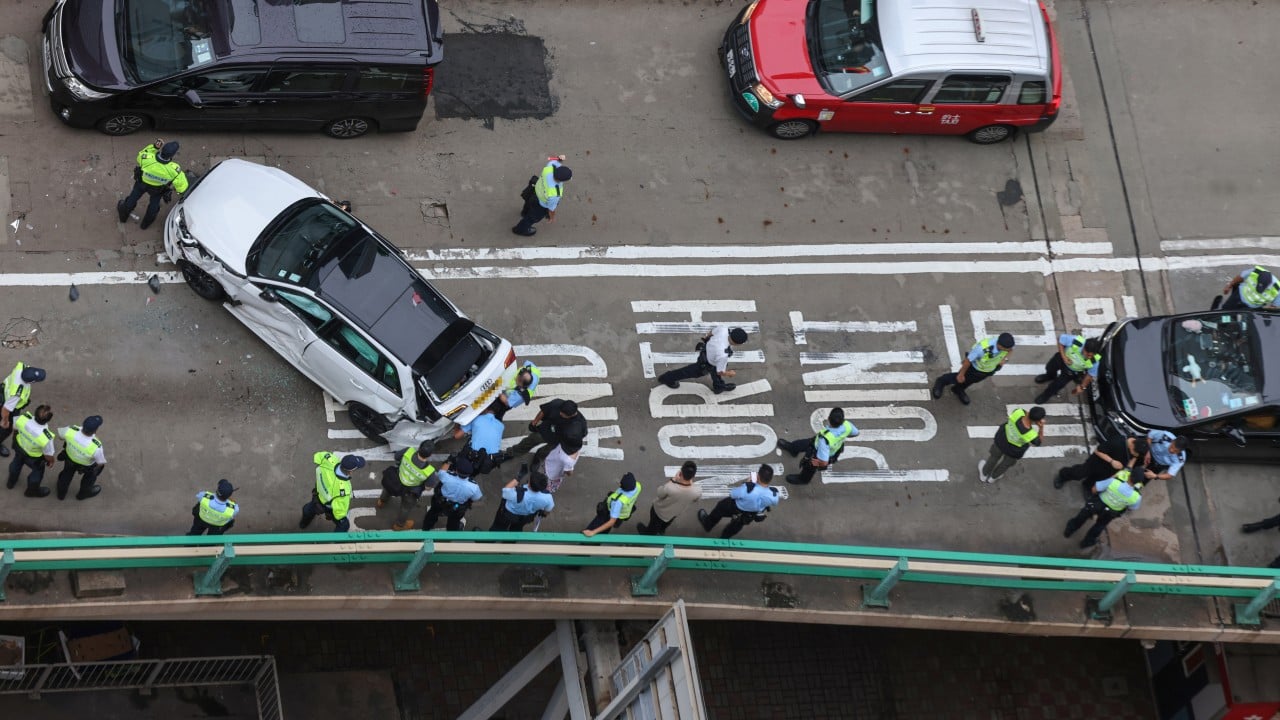
Urban vehicular pursuits represent a highly volatile intersection of kinetic energy, infrastructure constraints, and human cognitive failure. When a high-speed chase in a hyper-dense environment like Hong Kong culminates in a multi-vehicle collision, public reporting typically focuses on the sensational elements of the arrest. A rigorous structural analysis, however, reveals that these incidents are predictable outcomes of specific systemic variables. By deconstructing the operational mechanics of urban pursuits, we can understand the friction points between law enforcement tactics, driver psychology, and urban architecture.
The Kinematic Friction of Dense Infrastructure
The core constraint of any urban pursuit is space. In a highly built-up metropolitan area, the margin for error approaches zero due to three primary structural factors:
- Spatial Confinement: Narrow lanes, elevated viaducts, and localized bottlenecks compress the available maneuvering area. Unlike wide suburban corridors, urban street grids restrict lateral evasion, forcing fleeing drivers into linear trajectories where cross-traffic intersections become high-risk impact zones.
- Velocity-Density Asymmetry: As a vehicle's velocity increases, the time window for surrounding drivers to perceive, process, and react shrinks exponentially. In a five-vehicle pileup, the primary mechanism of compounding failure is the sudden reduction of braking distances for completely uninvolved motorists trapped in adjacent lanes.
- Kinetic Energy Dissipation: When a fleeing vehicle loses control at high speed, its kinetic energy ($E_k = \frac{1}{2}mv^2$) must be absorbed. In a dense environment, this energy is rarely dissipated through empty space or soft barriers; instead, it is transferred directly into immovable urban infrastructure or surrounding civilian vehicles.
This structural reality creates a compounding hazard loop. The moment a driver decides to flee, the urban grid transforms from a transport network into a high-density obstacle course where a single tactical error guarantees multi-point collateral damage.
The Risk-Reward Symmetry of Fleet Interdiction
Law enforcement agencies operate under a continuous cost-benefit calculation during active pursuits. The decision to maintain, escalate, or terminate a high-speed chase relies on balancing the severity of the immediate threat against the potential hazard of the pursuit itself.
The Tactical Evaluation Framework
[Suspect Risk Profile] ---> [Tactical Decision Engine] ---> [Pursuit Continuation]
                                      |
[Infrastructure Density] -------------+--------------------> [Active Termination]
The tactical decision engine weighs variables across three distinct areas:
- The Offense Threshold: Pursuing officers must evaluate whether the suspect poses an ongoing, severe threat to public safety that outweighs the immediate danger of a high-speed chase. Minor traffic violations or property crimes rarely justify sustained high-speed urban interdiction.
- Environmental Degradation: Factors such as pedestrian density, weather conditions, and school zones act as automatic termination triggers. If the environmental risk profile spikes, the tactical utility of an immediate arrest drops to zero.
- The Counter-Productive Pursuit Paradox: A critical limitation of active interdiction is that the act of chasing often increases the suspect's erratic behavior. As police proximity narrows, the suspect's cognitive load increases, leading to desperate, high-risk maneuvers that elevate the probability of a catastrophic system failure, such as a multi-vehicle crash.
Cognitive Cascades and the Mechanics of the Crash
The transition from a high-speed chase to a multi-vehicle collision is rarely a single isolated event. It is almost always a cascade of cognitive and mechanical failures.
When a fleeing driver hits speeds drastically exceeding the design limits of urban roads, tunnel vision sets in. The human visual field narrows at high velocities, blinding the driver to peripheral hazards such as merging vehicles or changing traffic signals.
This sensory deprivation is compounded by mechanical limitations. Standard consumer vehicles are not engineered to sustain extreme lateral forces while navigating tight urban geometries at high speeds. Brake fade occurs rapidly under repeated, panic-induced deceleration, drastically extending stopping distances precisely when precision is required.
When the leading vehicle experiences a loss of traction or impacts an obstacle, a chain reaction occurs. The trailing civilian vehicles, operating under normal commuting parameters, are caught in a reaction-time deficit. The human brake-response lag—typically 1.5 seconds under surprise conditions—ensures that by the time an adjacent driver recognizes the hazard, the physical space required to avoid a collision has already been consumed.
Operational Mitigation Strategies
To break the cycle of high-speed urban crashes, municipal transit networks and law enforcement agencies must shift from reactive pursuit models to proactive technological and architectural containment.
- Predictive Geofencing and Tire Deflation: Instead of sustained high-speed tracking, modern interdiction relies on synchronized intervention. Deploying remote-controlled tire deflation devices at downstream bottlenecks allows officers to neutralize a vehicle's velocity before it enters highly congested zones.
- Tactical Air Support Coordinated Disengagement: The integration of real-time aerial tracking allows ground units to drop back, artificially lowering the suspect's adrenaline levels and reducing their speed, while maintaining continuous surveillance until the vehicle stops in a controllable zone.
- Targeted Infrastructure Hardening: Designing urban choke points with energy-absorbing barriers and smart traffic management systems enables city centers to dynamically alter signal timing, flushing out traffic ahead of a pursuit corridor to minimize the vehicle density available for collateral impact.
The ultimate resolution of urban flight risk lies not in matching the reckless velocity of a fleeing suspect, but in systematically restricting the spatial and mechanical options available to them.