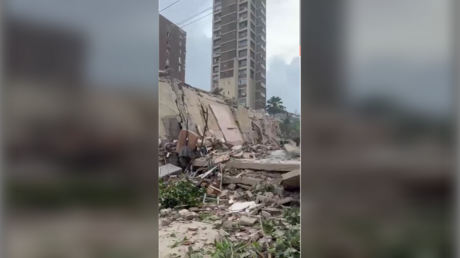
The double-strike seismic event that occurred in northern Venezuela on June 24, 2026, presents a stark case study in how cumulative structural deficits multiply the destructive power of natural phenomena. When a magnitude 7.2 foreshock was followed 39 seconds later by a magnitude 7.5 mainshock along the Boconó-Morón-El Pilar fault system, the physical shaking was only the proximate trigger. The systemic collapse of multi-story buildings in Caracas neighborhoods like Altamira, Los Palos Grandes, San Bernardino, and Caricuao reflects a predictable structural failure rate. This rate is driven by decades of unchecked urban densification, a prolonged absence of regulatory enforcement, and a severe deficit in civil maintenance.
To properly evaluate the scale of this disaster, analysts must move past superficial media reports of "swaying buildings" and isolate the underlying physics of the event. The destruction is a function of two distinct variables: the unique geological mechanism of a seismic doublet and the specific vulnerabilities built into the Venezuelan capital’s urban grid.
The Doublet Mechanism: Compounded Wave Amplification
The primary driver of the physical destruction was the rapid succession of the two tremors. The first event, registering a magnitude of 7.2, initiated at 6:04 PM local time at a depth of approximately 22 kilometers. While a standalone 7.2 earthquake induces major structural stress, the subsequent 7.5 magnitude mainshock struck less than 40 seconds later at a shallower depth of 10 kilometers. This spatial and temporal proximity created a destructive compounding effect.
Seismic doublets of this scale bypass standard post-hole or independent fracture mechanics through a specific sequence:
- Foreshock Saturation: The initial 7.2 wave front forced buildings through rapid cycles of elastic deformation—the temporary bending of steel and concrete designed to absorb energy. This energy absorption maxed out the material threshold of older concrete structures, initiating internal micro-fissures and degrading structural cohesion.
- The 39-Second Baseline Shift: Before structures could settle back into static equilibrium or shed the residual kinetic energy, the 7.5 mainshock arrived. Because the building materials were already holding high internal stress and structural integrity was partially degraded, their capacity to withstand further lateral force dropped significantly.
- Resonance and Shallow Frequency Transference: The shallower depth of the second shock (10 kilometers) meant less crustal attenuation. The high-frequency surface waves directly matched the resonant frequencies of mid-to-high-rise residential structures in Caracas, leading to immediate structural failures.
The Cost Function of Infrastructure Vulnerability
The geographical distribution of building collapses across Caracas is not random. It maps directly onto three distinct architectural and engineering eras, each defined by specific failure vectors.
Modernist Soft-Story Failures (Altamira and Los Palos Grandes)
The high-end districts of northern Chacao, including Altamira and Los Palos Grandes, feature a high density of mid-century modern apartment blocks. These buildings frequently utilize a structural design known as a "soft-story." The ground floors are left open or sparsely partitioned to accommodate parking garages or commercial lobbies, while the upper floors are heavy, rigidly compartmentalized residential units.
During the June 2026 doublet, these open ground floors acted as lateral structural bottlenecks. Lacking sufficient shear walls to distribute the horizontal forces generated by the strike-slip faulting, the ground columns experienced severe bending stress. Once these lower columns sheared, the upper floors dropped vertically, crushing the base levels in a classic pancake collapse.
Unreinforced Masonry and Informal Densification (The Barrios)
In contrast to the engineered failures of the valley floor, the informal settlements flanking the city hillsides present a different risk profile: unreinforced masonry (URM). These structures rely on heavy clay brick or cinder block walls without internal steel rebar matrixing or concrete tie-beams.
The mechanism of failure here is shear failure due to out-of-plane loading. When horizontal ground shaking hits a URM wall perpendicular to its surface, the wall lacks tensile strength to resist the bending force. Entire facades separated instantly from floor diaphragms, causing full structural collapse and sliding down steep topography. This dynamic triggered cascading failures on lower terraced dwellings.
Deferred Maintenance in Mass Public Housing (Caricuao and San Bernardino)
Large-scale public housing complexes constructed in the latter half of the 20th century suffered from a different structural deficit: aggressive concrete carbonation and structural corrosion. In these dense residential blocks, atmospheric carbon dioxide penetrates the outer layers of concrete over decades, lowering the internal pH.
Once this chemical shift reaches the embedded steel rebar, the steel oxidizes and expands. This internal expansion cracks the surrounding concrete from the inside out, a process known as spalling. Decades of deferred maintenance and lack of waterproof sealing left these load-bearing columns severely degraded before the June 24 events. When the high-magnitude doublet struck, columns that had lost up to 30% of their effective steel diameter failed under the compressive loads.
Systemic Bottlenecks in Post-Event Mitigation
The immediate impact of the structural damage was made worse by critical failures across the city's utility grids. This dynamic severely hampered initial emergency response and search-and-rescue efforts.
- Telecommunications Blackout: Cellular networks and data routing hubs failed across the capital region within minutes of the mainshock. This was caused by a combination of structural damage to cellular towers, immediate power grid trips, and severe network congestion as millions of users attempted to place calls simultaneously. The resulting lack of real-time telemetry left civil protection authorities operating without a clear picture of where collapses were concentrated.
- Transportation Gridlock: Damage at the Simón Bolívar International Airport in Maiquetía—including cracked tarmac surfaces and debris inside the main terminal—forced the immediate cancellation of all arriving and departing flights. This effectively isolated the capital from rapid international or long-distance domestic logistics. On the ground, debris from collapsed buildings blocked major thoroughfares like the Francisco Fajardo highway, preventing emergency vehicles from moving between the eastern and western sectors of the valley.
- Secondary Fire Risks: Strike-slip seismic events cause significant ground displacement, which shears buried utility lines. The rupture of low-pressure domestic gas networks across dense urban sectors creates an immediate risk of large-scale fires. This hazard is compounded by a simultaneous drop in municipal water pressure due to ruptured water mains.
Strategic Operational Directives
Managing the aftermath of the June 2026 earthquake requires moving away from ad-hoc emergency management and transitioning to a highly structured resource-allocation model. Civil protection and municipal authorities must prioritize immediate stabilizing actions.
First, engineers must immediately establish a structural triaging system using a standard red/yellow/green tagging matrix. Given the high probability of strong aftershocks along the Boconó fault line, structures showing signs of partial failure—such as diagonal cracking in concrete beams or visible settlement—must be cleared of all personnel immediately. Rescuers must not enter buildings with compromised soft-stories until temporary steel shoring or timber cribbing is installed to prevent further vertical collapse.
Second, rescue operations must prioritize the use of heavy acoustic and thermal imaging equipment over manual debris removal. The high density of concrete slab collapses means that survival voids are small and highly unstable. Disrupting the debris pile without precise localization data can trigger secondary collapses within the rubble, neutralizing potential survival spaces.
Third, the immediate re-establishment of a localized, low-bandwidth communication network is critical. This should be achieved by deploying portable satellite terminals and temporary mesh-network nodes to key municipal sectors. Re-establishing basic data links for emergency services takes precedence over restoring commercial networks, as it allows for the structured coordination of medical transit and heavy machinery deployment across the city’s blocked transportation corridors.