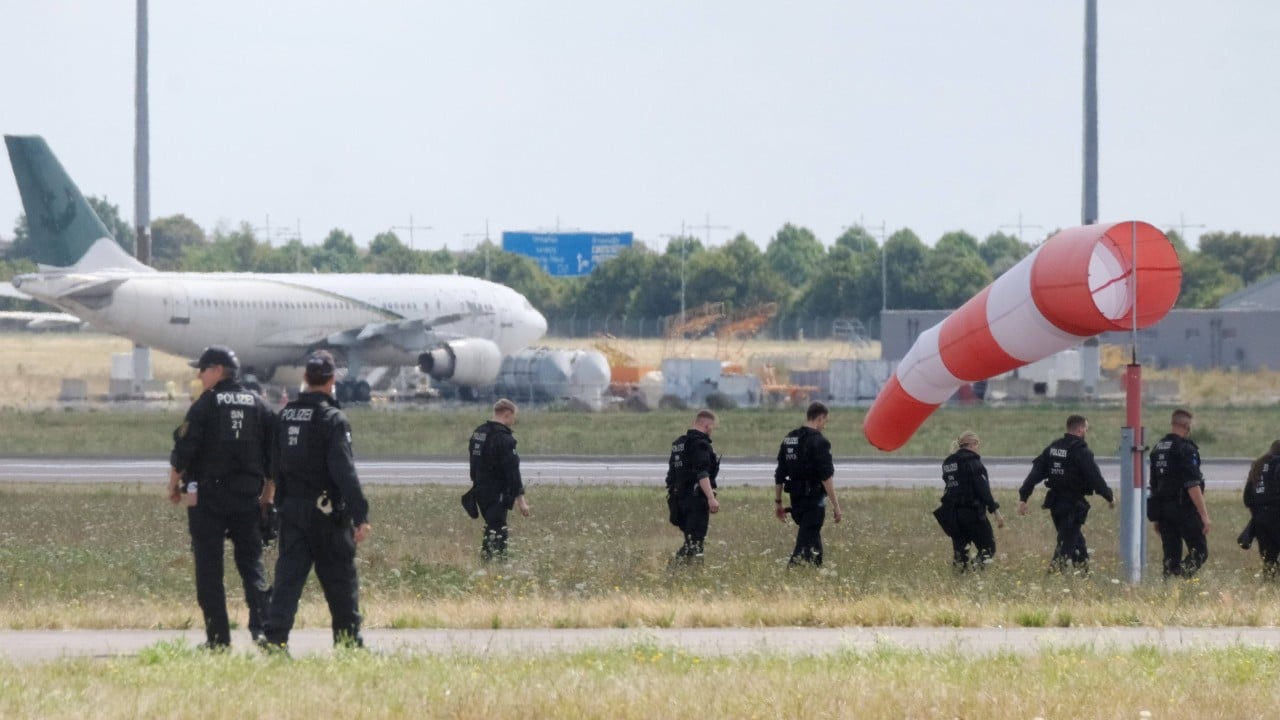
The discovery of an explosives-laden quadcopter at Leipzig Halle Airport shifts the security calculus across European critical infrastructure. Security agencies transitioned their assessments from tracking opportunistic reconnaissance flights to managing active, kinetic sabotage. The mechanical failure of the detonator prevented structural destruction of a Ukrainian Antonov cargo aircraft, yet the operational parameters of the incident reveal systemic vulnerabilities in civil-military aviation defense.
The Vector Mechanics and Structural Vulnerabilities
Commercial transport hubs operate on principles of high-throughput efficiency rather than hardened military perimeter defense. Leipzig Halle Airport spans thousands of hectares of open tarmac, mixing passenger terminals, massive logistics hubs operated by freight carriers, and designated zones for heavy Ukrainian transport aircraft. Commercial radar arrays are optimized to track high-altitude, high-speed transponder-emitting aircraft. They are fundamentally blind to low-altitude, low-radar-cross-section micro-UAVs operating beneath standard clutter thresholds.
The device recovered near the southern runway weighed down an unshielded quadcopter frame with approximately 800 grams of military-grade plastic explosives, combining PETN and hexogen compounds. Commercial aircraft skins utilize aluminum alloys measuring roughly three millimeters in thickness. A localized blast yield of this magnitude in direct contact with a fuselage or fuel bladder creates a catastrophic structural failure mode.
The structural risk profile involves three distinct operational components:
- The perimeter penetration vector, which exploits expansive spatial boundaries where physical fencing acts as a deterrent rather than an impenetrable kinetic barrier.
- The payload delivery mechanism, utilizing commercial off-the-shelf drone architectures capable of precision GPS waypoint navigation without active radio-frequency control links.
- The target selection matrix, prioritizing nodes that serve a dual-use function for both commercial freight and military supply lines to Ukraine.
The Attribution Problem and Hybrid Warfare Economics
Determining state responsibility in modern deniable operations requires examining the cost-benefit asymmetry of hybrid warfare. Traditional military doctrines rely on clear chains of attribution to trigger deterrence mechanisms or collective defense clauses. State-sponsored proxy networks deliberately exploit this friction by utilizing decentralized recruitment, cryptocurrency remuneration, and compartmentalized task execution.
State intelligence services operating aggressive sabotage campaigns do not require absolute operational success to achieve strategic value. The cost of procuring, programming, and deploying a commercial quadcopter equipped with improvised explosives is negligible compared to the economic disruption caused by airspace closures, emergency forensic investigations, and the diversion of counterterrorism resources.
When a secondary freight aircraft strikes an unidentified aerial object during climb-out while responding to airspace management adjustments, the disruption multiplies. The psychological and economic friction scales exponentially relative to the minimal capital expenditure of the threat actors.
The Shift From Disruption to Kinetic Interdiction
Previous incursions documented across European aviation facilities were classified primarily as intelligence gathering or baseline nuisance flights. Intelligence assessments from institutions like the International Institute for Strategic Studies noted dozens of unauthorized overflights without explosive payloads. The inclusion of an active detonation system invalidates historical baseline assumptions.
Security planners can no longer treat airspace infractions as the work of unauthorized hobbyists or copycat actors. The presence of military-grade plastic explosives points directly to supply chains accessible only through state-backed munitions channels or professional illicit armaments markets.
The technological and operational gap between detection and neutralization remains wide. Counter-drone technologies deployed at civilian airports generally rely on radio-frequency triangulation or optical tracking. If an autonomous drone executes a pre-programmed flight path using pre-loaded coordinates without emitting control signals, electronic jamming countermeasures fail to intercept the unit. Kinetic net-guns, directed-energy weapons, and localized geofencing enforcement systems must evolve to protect multi-modal transport hubs that lack point-defense missile batteries.
Strategic Interventions for Critical Logistics Nodes
Mitigating persistent aerial threats to high-value logistics infrastructure requires a structural overhaul of airport security perimeters. Passive fencing must be augmented by active, multi-spectral sensor grids capable of identifying low-radar-cross-section targets in adverse weather and night conditions.
Airport operators must integrate acoustic sensors, thermal imaging, and short-range active radar arrays specifically calibrated for micro-UAV detection into a unified command-and-control software layer. Furthermore, supply chain verification protocols for adjacent freight operations must account for insider threats and perimeter breaches that occur outside standard passenger screening hours.
Intelligence sharing between national counterterrorism units and private logistics operators must transition from reactive notifications to real-time telemetry integration. If state-backed proxy networks continue to view European transport infrastructure as a low-risk theater for asymmetric pressure, the frequency of kinetic attempts will accelerate.
Deploy comprehensive, multi-spectral drone detection grids along the immediate perimeter of all dual-use logistics hubs, pairing passive radio frequency monitors with active short-range radar and optical tracking systems to eliminate reliance on traditional air traffic control radar.
An armed drone found at a German airport raises hybrid security concerns in Europe
This video provides an overview of the security incident at the German airport and the ongoing investigations into the drone discovery.
http://googleusercontent.com/youtube_content/1