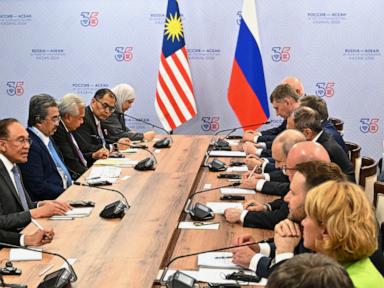
The June 2026 Russia-ASEAN summit in Kazan represents a calculated attempt by Moscow to diversify its economic dependencies away from Western networks and institutional architectures. While standard journalistic narratives frame this summit as a superficial diplomatic charm offensive or a symbolic celebration of the 35th anniversary of bilateral relations, a structural evaluation reveals a deeper, mechanics-driven economic calculus. Moscow is attempting to establish an asymmetrical trade ecosystem, utilizing its surplus energy and agricultural yields to secure critical alternative supply chains across Southeast Asia.
This integration strategy operates under structural constraints. The Association of Southeast Asian Nations (ASEAN) is not a monolithic economic entity; it functions as a highly fragmented coalition of ten distinct sovereign markets, each balancing competing alignments with Washington, Beijing, and Moscow. To evaluate the actual viability of Russia’s economic pivot to the East, the integration model must be broken down into three core analytical mechanisms: the energy arbitrage asymmetry, the structural friction of non-Western clearing mechanisms, and the political hedging constraints of member states.
The Mechanism of Energy Arbitrage and Discount Pricing
The primary economic incentive driving Southeast Asian engagement with Moscow is the acquisition of heavily discounted hydrocarbons. Following Western sanctions, Russia altered its global supply architecture, shifting volumes to any market capable of absorbing production without triggering secondary sanction thresholds. For developing economies within ASEAN, the cost function of energy is the fundamental determinant of industrial productivity and domestic inflation management.
The flow of Russian crude and refined products into markets like the Philippines, Indonesia, Thailand, and Vietnam operates via a specific commercial incentive structure:
- The Price-Discount Delta: Russian Urals crude trades at a persistent discount relative to Brent benchmarks. For fiscal architectures under severe budgetary pressure from global fuel price volatility, importing discounted Russian crude provides immediate relief to national balance-of-payments.
- Refinery Configuration Compatibility: Vietnam and Indonesia possess specific industrial refining capacities that can process heavier, sour Russian blends when blended with domestic sweet crude. This maximizes refining margins for state-owned energy enterprises.
- Strategic Stockpiling Demands: Rapidly industrializing nations utilize these lower-cost imports not merely for immediate consumption, but to construct long-term strategic reserves, decoupling their domestic industrial base from Western market fluctuations.
This trade vector remains transactional. The primary limitation of this mechanism is its vulnerability to maritime logistics costs and the tracking of the global shadow fleet. The transport cost function expands exponentially over the long-distance maritime corridors from Baltic or Black Sea ports to the Malacca Strait, eating into the net discount margins available to Southeast Asian buyers.
Clearing Friction and Financial Market Architecture
The execution of expanded business ties requires cross-border capital flows that bypass Western financial systems. The exclusion of major Russian financial institutions from the SWIFT network creates a operational bottleneck for bilateral trade. To circumvent this, the Kazan summit focused heavily on structural financial engineering, emphasizing the creation of a non-aligned monetary architecture.
The proposed architecture relies on two distinct operational vectors:
Bilateral Currency Swaps
Moscow is pushing for direct clearing mechanisms that settle trade invoices in national currencies—such as the Russian Ruble, Malaysian Ringgit, Indonesian Rupiah, and Vietnamese Dong. This eliminates the necessity of the US dollar or Euro as a clearing currency. The economic friction here is liquidity mismatch. Russia accumulates substantial holdings of regional currencies that it cannot easily convert or spend on global markets, creating an structural imbalance in central bank reserves.
Alternative Messaging Systems
The integration of Russia’s System for Transfer of Financial Messages (SPFS) with national payment architectures across ASEAN is a technical priority. This process encounters resistance from regional commercial banks that maintain extensive exposure to the US financial system. These institutions face an existential compliance risk: adopting alternative Russian financial infrastructure threatens their access to the global dollar clearing house, creating a powerful disincentive for mainstream corporate adoption.
The Geopolitical Hedging Matrix of ASEAN
The viability of Russia’s strategy depends on the internal political geometry of ASEAN member states. The regional bloc explicitly avoids formal alignment with any single global superpower, utilizing a strategy of strategic diversification to maximize national sovereignty.
The response to Russia’s overtures varies based on national strategic vulnerabilities:
| Nation | Strategic Alignment Vector | Primary Economic Interest from Russia |
|---|---|---|
| The Philippines | High security alignment with the US; currently holds the rotating ASEAN presidency. | Energy diversification, agricultural imports (fertilizers), and balancing Chinese regional hegemony. |
| Malaysia | Strict non-aligned stance; active interest in BRICS integration. | Advanced industrial cooperation, military hardware maintenance, and technology transfer. |
| Vietnam | Traditional defense ties with Moscow balanced by deep trade integration with the US and China. | Legacy defense procurement, oil and gas exploration joint ventures in the South China Sea. |
| Indonesia | Independent foreign policy focused on domestic industrialization. | Food security inputs (wheat, potash) and infrastructure investment capital. |
This fragmentation guarantees that a unified ASEAN-wide economic bloc with Russia will not materialize. Instead, the integration strategy will manifest as a series of isolated, bilateral economic corridors. While Philippine President Ferdinand Marcos Jr. co-chaired the summit due to institutional obligations, Manila's security dependence on Washington limits its capacity to engage in deep structural or military-technical cooperation with Moscow. Conversely, nations like Malaysia under Anwar Ibrahim view engagement with Russia as a viable mechanism to hedge against Western economic pressures and diversify their geopolitical portfolios.
Structural Bottlenecks to Long-Term Capital Flow
The Kremlin's emphasis on expanding direct investment and industrial cooperation faces severe market realities. Russian capital is constrained by domestic war-economy requirements and capital controls, limiting the volume of outward Foreign Direct Investment (FDI) available for Southeast Asian infrastructure. Concurrently, Southeast Asian conglomerates remain highly risk-averse regarding direct investment in the Russian domestic market due to legal uncertainties, asset seizure risks, and the logistical challenges of operating within a sanctioned economy.
The institutional framework established in Kazan—predicated on a "just and democratic multipolar world order"—serves as an ideological framework to justify these economic shifts. However, ideological convergence does not erase commercial risk. The industrial cooperation discussed in Kazan will likely remain limited to narrow, state-backed sectors where sovereign guarantees insulate entities from market forces, such as civil nuclear energy projects, state-to-state agricultural supply agreements, and specialized metallurgy.
The trajectory of Russia-ASEAN economic relations will not be defined by rapid integration or absolute decoupling. The relationship will settle into a high-friction, low-velocity trade equilibrium. Southeast Asian nations will continue to absorb discounted Russian commodities to optimize their domestic cost functions, but they will systematically reject any institutional or financial integration deep enough to trigger Western secondary sanctions. Moscow will achieve a partial diversification of its export destinations, but it will fail to transform ASEAN into a frictionless replacement for its lost European markets. The strategic play for regional corporate actors is to exploit short-term commodity discounts through specialized intermediaries while maintaining absolute insulation within their core financial clearing channels.

