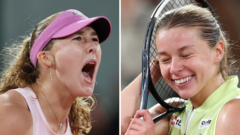
The 2026 French Open men singles final presents an asymmetric competitive landscape defined by a profound divergence in physical expenditure, baseline efficiency, and structural paths to the championship match. On one side, second seed Alexander Zverev enters his fourth Grand Slam final carrying the burden of historical conversion failures and a quantifiable physical load from a four-set semifinal victory over Jakub Mensik. On the other side, tenth seed Flavio Cobolli advances to his maiden Major final via an absolute expenditure minimum, benefiting from a last-minute semifinal walkover due to Matteo Arnaldi contracting a viral illness. This optimization asymmetry disrupts conventional baseline forecasting metrics, making the upcoming final less about historical prestige and more about the interplay of physical decay versus competitive friction.
The predictive architecture of this matchup relies on dissecting three structural pillars: baseline attrition rates, serving efficiency under maximum stress, and the psychological weight of historical conversion. By analyzing these vectors, we can map the exact mechanisms that will dictate the outcome on Court Philippe-Chatrier.
The Asymmetry of Kinetic Expenditure
The primary variable governing this final is the net physical energy differential between the two competitors. Tennis matches on clay surfaces scale linearly in metabolic demand due to longer rally lengths and sliding friction.
Total Tournament Court Time = Pre-Semifinal Hours + Semifinal Hours
Alexander Zverev’s path has forced a significant cumulative physical debt. His four-set semifinal win against Jakub Mensik (7-5, 6-2, 3-6, 6-3) demanded sustained baseline explosive movements over several hours, compounding the wear from his earlier four-set and five-set variables in the opening week. Zverev operates on a heavy-topspin, deep-court defensive axis that relies on sliding stability and lateral recovery. By forcing long exchange counts, clay accelerates muscular fatigue, which manifests explicitly as a drop-off in second-serve velocity and lateral foot speed in the third hour of play.
Conversely, Flavio Cobolli enters the final with zero semifinal court time. The withdrawal of Matteo Arnaldi eliminated a high-intensity, physical battle between compatriots. While a walkover introduces the risk of competitive rhythm disruption—specifically affecting a player's return timing and spatial awareness on a massive court—it yields a clean physical ledger. Cobolli’s cost function for the week is significantly lower than Zverev's. This provides the Italian with an extreme surplus of glycogen reserves and neurological freshness, critical assets for execution on slow, heavy clay.
Baseline Attrition and High-Volume Rally Mechanics
Clay-court efficiency is determined by a player's ability to generate heavy court penetration without increasing their unforced error rate. The tactical friction between Zverev and Cobolli will be fought inside the baseline containment zone.
The Zverev Baseline Wall
Zverev's defensive baseline metrics mirror a low-risk, high-return industrial machine. Standing at 6'6", his lateral coverage is exceptionally long, allowing him to neutralize aggressive angles that would end points against shorter athletes.
- The Forehand Wing as a Vulnerability Volatility Loop: Zverev’s backhand is structurally flawless, operating with a linear take-back and deep, predictable placement. However, his forehand features an elongated loop that breaks down under rapid depth alterations. If an opponent hits deep into his forehand corner, Zverev drops back, ceding court positioning.
- Serve Velocity Maintenance: Zverev relies on high first-serve win percentages to avoid baseline attrition. Against Mensik, he struck 8 aces and won 79% of his first-serve points. When his first-serve percentage drops below 65%, his exposure to extended rallies increases exponentially.
The Cobolli Aggression Index
Cobolli operates with an entirely different tactical blueprint, moving faster through the gears and taking the ball earlier on the rise to shorten points.
- Linear Court Penetration: Cobolli compensates for his lack of extreme defensive reach by stepping inside the baseline to dictate with an aggressive, whipping forehand.
- The Return Bottleneck: Cobolli’s primary challenge lies in neutralising Zverev's first serve. If Cobolli cannot consistently put returns past Zverev’s service line, he will find himself pinned into deep crosscourt exchanges, playing directly into the German’s backhand strength.
The Psychology of Grand Slam Title Conversion
The structural bottleneck for Alexander Zverev has never been physical capability or technical execution; it is conversion efficiency at the ultimate threshold.
Conversion Efficiency = Major Finals Won / Major Finals Played
Prior to this match, Zverev’s conversion metric stands at 0%. Having lost three previous Grand Slam finals, his psychological profile under peak pressure shows a quantifiable regression to passive defensive positioning. When tension rises, Zverev's second-serve launch mechanics alter, leading to double faults or highly attackable, low-velocity mid-court deliveries. The departure of tournament favorite Jannik Sinner earlier in the fortnight altered the tournament matrix, transferring absolute favoritism to Zverev. This shift modifies the pressure dynamic from a pursuit of victory to an acute obligation to avoid failure.
Cobolli enters completely decoupled from historical pressure. As the world number 10, reaching the final is a massive overperformance relative to baseline expectations. This psychological insulation permits high-risk execution. In tennis, a player with zero scar tissue in Major finals often executes with superior technical fluidness during high-leverage points compared to a veteran carrying historical pressure.
Strategic Forecasting Matrix
Evaluating the structural components of both players reveals the distinct conditions required for victory:
| Tactical Vector | Alexander Zverev Requirements | Flavio Cobolli Requirements |
|---|---|---|
| Service Execution | Maintain > 70% first-serve landing rate to limit break-point vulnerability. | Attack Zverev's second serve with deep, aggressive inside-out returns. |
| Rally Length Management | Cap exchanges under 8 shots by utilizing wide serving angles and short court put-aways. | Extend point duration past 10 shots to exploit Zverev's cumulative fatigue. |
| Court Positioning | Defend the baseline; avoid dropping more than two meters behind the Roland Garros logo. | Step into the court, taking time away from Zverev's long forehand take-back. |
The outcome relies on an inflection point in the second or third set. Zverev possesses the superior tactical toolkit and the experience required to dismantle a first-time finalist early in the match. However, if Cobolli extends the match duration past the two-hour mark by winning extended baseline points, the physical asymmetry caused by the semifinal walkover will manifest. Zverev's first-serve speed will decay, his forehand loop will become erratic under fatigue, and the psychological weight of his past finals will limit his risk-tolerance. Expect Cobolli to absorb an initial surge from the German before systematically breaking down Zverev's forehand wing in a grueling four-set upset, leveraging physical freshness to secure his first Major title.