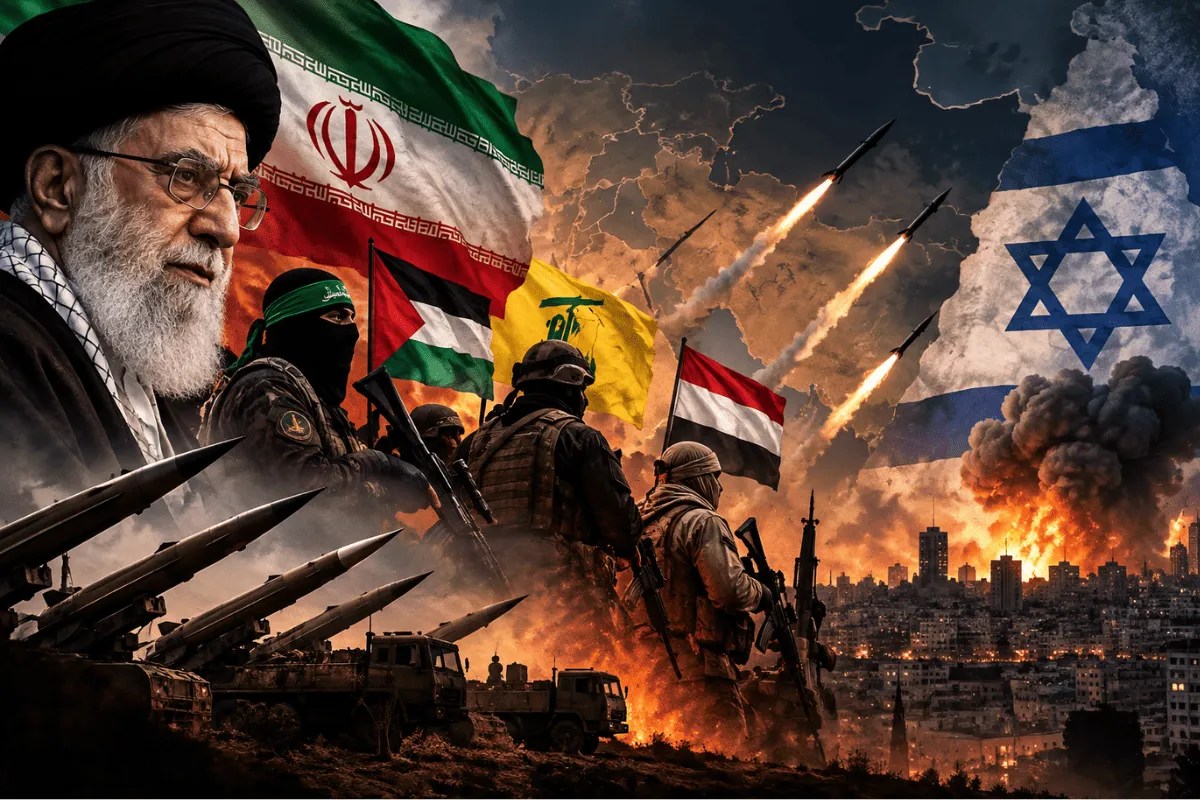
The structural equilibrium of the Middle East operates on a fragile calculus of deterrence, where strategic patience and calibrated proxy deployment dictate the threshold of conflict. Recent intelligence projections suggesting an imminent, synchronized multi-front offensive against Israel mirroring or exceeding the scale of October 7 require a fundamental shift in analytical perspective. Moving past sensationalist threat assessments demands a rigorous examination of the operational incentives, logistical constraints, and structural logic governing the Axis of Resistance—specifically the coordination matrix linking Tehran, Hezbollah, the Houthis, and remaining militant factions in Gaza.
Strategic coordination among decentralized state and non-state actors relies less on rigid tactical timetables and more on shared vulnerability thresholds. To understand why a coordinated mega-offensive remains a persistent operational objective yet faces severe systemic friction, one must deconstruct the mechanics of asymmetric alliance structures, military resource allocation, and the economic toll of protracted low-intensity attrition.
The Structural Mechanics of the Axis of Resistance
The operational architecture linking Iran to its regional partners is frequently mischaracterized as a monolithic command-and-control hierarchy. In practice, the network functions as an adaptive federation of interests bound by shared ideological objectives and financial-military patronage from the Islamic Revolutionary Guard Corps Quds Force.
The Command Disjunction
Decentralization grants regional actors operational autonomy while preserving strategic alignment with Tehran. Hezbollah operates as a heavily armed quasi-state entity with sophisticated command structures, domestic political stakes in Lebanon, and conventional military aspirations. Conversely, the Houthi movement in Yemen maintains distinct localized governance objectives alongside regional power projection capabilities focused on maritime choke points.
This structural dispersion introduces coordination friction. A synchronized, simultaneous escalation requires precise time-on-target synchronization across disparate communication networks, intelligence-sharing protocols, and logistics hubs. Any disruption in one sector—such as preemptive strikes on command infrastructure or severe degradation of communications equipment—cascades through the network, degrading the operational viability of simultaneous multi-front synchronization.
Resource Allocation and Attrition Dynamics
Sustained military operations depend on deep munitions reserves, secure supply lines, and financial reserves. The conflict trajectory since late 2023 has forced network participants to consume strategic assets at an unsustainable rate.
- Munitions Depletion: Precision-guided munitions, long-range ballistic missiles, and advanced loitering munitions are finite resources. Iran’s domestic defense industrial base faces bottlenecks in specialized microelectronics and raw materials required to scale production rapidly under international sanctions.
- Logistical Vulnerabilities: Overland supply corridors traversing Iraq and Syria are subject to continuous air interdiction and intelligence surveillance. The cost of transiting materiel increases proportionally with the intensity of regional intelligence, surveillance, and reconnaissance coverage maintained by opposing coalitions.
- Economic Feedback Loops: Continuous low-intensity conflict and severe maritime disruptions impose severe localized economic costs. Yemen faces acute internal humanitarian and financial pressures, while Lebanon's structural economic collapse limits Hezbollah's capacity to absorb prolonged infrastructure destruction without risking core domestic political legitimacy.
Assessing the Threat Matrix: Capabilities Versus Intentions
Evaluations of escalation risks frequently conflate long-term military doctrine with near-term execution feasibility. Strategic intent to alter the regional balance of power does not automatically translate into the tactical capacity to execute a comprehensive, multi-theater assault exceeding previous historical benchmarks.
The Myth of Seamless Integration
The operational premise of a unified mega-offensive assumes that all components of the regional network operate at peak readiness simultaneously. Tactical reality dictates otherwise. Hezbollah has absorbed targeted leadership losses, systematic degradation of specialized communications networks, and persistent tactical attrition along its southern border. Rebuilding operational depth requires time, institutional reorganization, and the replacement of specialized cadres, a process that cannot be accelerated arbitrarily.
Furthermore, domestic political calculations within member states act as natural friction points. In Lebanon, internal opposition to drawing the entire state into a catastrophic war of choice remains a significant constraint on Hezbollah’s escalation ceiling. The political cost of total societal devastation forces leadership to balance external ideological alignment against internal existential survival.
Deterrence Equilibrium and Escalation Dominance
Deterrence is not a static state; it is a dynamic equation governed by the perceived cost of retaliation versus the marginal utility of aggressive action. Israel maintains a qualitative military edge characterized by layered air defense systems, advanced intelligence penetration, and offensive cyber capabilities.
When analyzing the risk profile of a broader regional conflagration, decision-makers must weigh the deterrence threshold of opposing forces. If the projected cost—defined by the systemic destruction of state-adjacent infrastructure, severe economic isolation, and potential leadership decapitation—outweighs the political gains of a synchronized strike, the operational threshold rises significantly. Consequently, actors within the network frequently default to distributed, protracted attrition rather than high-risk, decisive engagements that invite disproportionate systemic retaliation.
The Logistics of Asymmetric Maritime and Territorial Interdiction
Regional projection relies heavily on geography and specialized power-projection vectors. The Red Sea theater managed by the Houthi movement demonstrates how asymmetric actors can disrupt global trade flows with relatively low-cost anti-ship ballistic missiles and uncrewed aerial vehicles. However, translating maritime disruption capability into decisive territorial outcomes against a deeply entrenched adversary remains structurally limited.
Maritime interdiction alters global supply chain economics and pressures international shipping insurance rates, but it does not directly alter the strategic military balance on land. Similarly, rocket and missile barrages launched from multiple vectors test the saturation limits of multi-layered air defense networks like Iron Dome, David's Sling, and Arrow systems. Yet, air defense performance metrics indicate that while saturation tactics impose high interception costs, they rarely achieve the strategic paralysis intended by attacking forces unless executed with a volume and precision that current stockpiles struggle to sustain.
Strategic Horizon and Operational Realities
Managing regional stability requires looking past alarmist narratives to evaluate the hard variables of military logistics, economic sustainability, and command resilience. A coordinated multi-front offensive on the scale of historical anomalies remains an aspirational doctrine rather than an imminent operational certainty. The structural frictions inherent in coalition warfare, combined with severe resource constraints and the high cost of comprehensive escalation, enforce a ceiling on near-term regional escalation. Intelligence apparatuses and security strategists must continuously monitor supply chain reconstitution rates, leadership communication integrity, and domestic sociopolitical pressures within member states to gauge true shifts in the regional equilibrium.
Execute localized, intelligence-led interdiction operations targeting supply bottlenecks in transit corridors while maintaining strategic defense posture across vulnerable sectors to neutralize asynchronous multi-front threats.