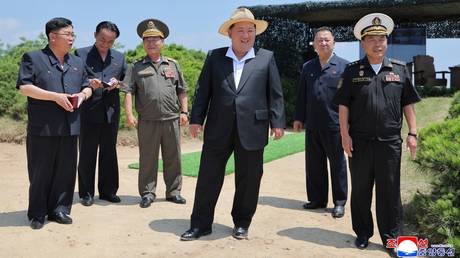
The deployment of strategic cruise missiles from surface combatants alters the maritime equilibrium in East Asia by compressing response timelines and complicating regional air defense architectures. When state media document a naval missile test overseen by leadership from a newly commissioned surface vessel, the event demands systematic decomposition rather than superficial political assessment. The integration of long-range strike capabilities into naval platforms represents a shift from static, land-based deterrence to mobile, multi-axis vector threats.
To evaluate the operational significance of this development, the event must be parsed through three analytical frameworks: structural platform capacity, missile propulsion and guidance mechanics, and the strategic doctrine governing maritime denial.
Platform Architecture and Hull-to-Effector Integration
Naval modernization requires the reconciliation of hull displacement with weapon system payload demands. The introduction of a new class of destroyer or corvette implies an attempt to transition from a legacy green-water navy, dominated by patrol craft, to a fleet capable of sustained operations farther from the coast.
Displacement and Space Constraints
A surface combatant serves as a mobile launching pad, meaning its effectiveness depends on hull stability and structural integrity during weapon egress. Standard naval engineering dictates that integrating vertical launch systems or angled launcher frames alters the vessel's center of gravity.
- Topside Weight Allocation: Placing missile canisters on the deck increases topside weight, which reduces the metacentric height of the ship. This compromise affects roll characteristics and survivability in rough seas.
- Structural Reinforcement: The exhaust plume of a strategic cruise missile generates significant thermal and mechanical stress. The vessel must incorporate reinforced steel plating and blast-deflection channels to prevent hull deformation during launch.
- Power Distribution: Modern missile systems require dedicated electrical sub-stations within the ship to power pre-launch diagnostics, target data upload, and fire control computers. This places a continuous load on the vessel’s main machinery.
Sensor Suites and Target Acquisition
A missile platform is only as effective as its target acquisition network. For a strategic cruise missile intended to strike targets at extended ranges, the ship's organic radar cannot provide over-the-horizon targeting due to the curvature of the earth.
The vessel must rely on external data links to receive coordinates. This operational dependency reveals a critical vulnerability. If the data link between land-based command centers, airborne surveillance assets, and the vessel is disrupted, the ship's offensive utility degrades immediately. The presence of surface-search radars on the new vessel suggests it can track localized surface targets, but long-range land-attack or anti-ship missions require a unified command, control, communications, computers, intelligence, surveillance, and reconnaissance network.
Missile Propulsion and Guidance Mechanics
The weapon tested from the new surface combatant belongs to a class of long-range systems designed to fly low-altitude trajectories to evade radar detection. Assessing the mechanics of these systems reveals the engineering hurdles faced by the program.
Propulsion Trade-Offs
Strategic cruise missiles utilize a two-stage propulsion method. A solid-fuel booster provides the initial thrust necessary to clear the launch canister and accelerate the airframe to a velocity where the primary engine can ignite.
+------------------+     +------------------+     +----------------------+
|  Solid Booster   | --> | Booster Ejection | --> | Turbofan/Turbojet    |
| (Initial Thrust) |     |  (Sea Skimming)  |     | (Sustained Cruise)   |
+------------------+     +------------------+     +----------------------+
Once the booster detaches, a small turbojet or turbofan engine sustains subsonic cruise flight. Turbofan engines offer superior fuel efficiency, allowing for extended range, but require precise manufacturing tolerances for the miniature turbine blades. Turbojet engines are less complex to produce but consume fuel at a higher rate, which restricts the overall operational radius of the missile or demands a larger fuel tank, directly impacting the weapon's footprint inside the vessel.
Guidance and Terrain Profiles
To penetrate sophisticated integrated air defense systems, the cruise missile must execute low-altitude flight, often referred to as sea-skimming over water or terrain-following over land.
- Inertial Navigation Systems: The core guidance system relies on internal gyroscopes and accelerometers to track position relative to the launch point. Over long distances, these systems suffer from drift errors, where small inaccuracies accumulate over time.
- Terrain Contour Matching: To correct inertial drift, the missile requires secondary guidance mechanisms. This can include radar or optical altimeters that match the terrain below against pre-loaded digital elevation maps.
- Terminal Homing: In the final phase of flight, the missile switches to an active radar seeker or an infrared imaging sensor to identify and lock onto the specific target, compensating for any mid-course navigational deviation.
Strategic Doctrine and Maritime Denial
The deployment of these naval assets aligns with a broader doctrine designed to offset conventional military disadvantages through asymmetric capabilities.
The Vector Diversification Strategy
By placing strategic missiles on surface ships, a military forces adversaries to allocate surveillance and defensive assets across a wider geographic area. Land-based launchers are bound by terrain and can be tracked via satellite monitoring of known storage facilities and roads. A naval platform introduces a mobile variable that can reposition along coastlines, creating a 360-degree threat profile that complicates early warning calculations.
This dispersion of firepower creates a dilemma for regional air defenses. Instead of focusing radar arrays on known inland launch sectors, defensive systems must maintain constant vigilance across maritime approaches.
Tactical Limitations of the New Fleet
The operational utility of this new destroyer must be evaluated against the realities of naval warfare. While the vessel possesses offensive capabilities, its survival probability in a high-intensity conflict remains low due to structural deficits in defensive systems.
A modern naval vessel requires a layered defense framework to survive long enough to execute its offensive mission. This includes close-in weapon systems for terminal missile defense, point-defense surface-to-air missiles to counter airborne threats, and electronic warfare suites designed to jam incoming seeker heads. Observations of the new platform indicate a reliance on manually operated or semi-automated anti-aircraft artillery rather than automated vertical-launch surface-to-air missile systems.
This defensive deficit means the vessel is vulnerable to carrier-based aviation and submarine-launched anti-ship missiles. The platform operates primarily as a bastion defender, kept close to home shores under the umbrella of land-based air defense systems, rather than an independent blue-water asset capable of projecting power deep into open oceans.
Operational Readiness Realities
The transition from a single test launch to an operational naval capability involves systemic deployment steps that cannot be bypassed through political decrees.
First, the crew must achieve proficiency in handling live ordnance under diverse sea states. Loading, securing, and diagnostic testing of strategic missiles at sea requires specialized training and specialized support infrastructure. Second, the military must establish a secure, redundant command chain capable of authorizing the release of strategic weapons to a mobile naval asset. This requires encrypted, jam-resistant communications infrastructure that can function even under intense electronic attack.
The structural reality indicates that while the technology demonstration confirms a successful engineering milestone, the integration of these vessels into a cohesive, sustainable maritime strike force requires years of iterative development, logistical refinement, and fleet-wide training exercises. Future tracking of this naval asset must focus on its operational tempo, its participation in multi-ship exercises, and the development of auxiliary replenishment vessels, which would indicate a true shift toward sustained maritime power projection.