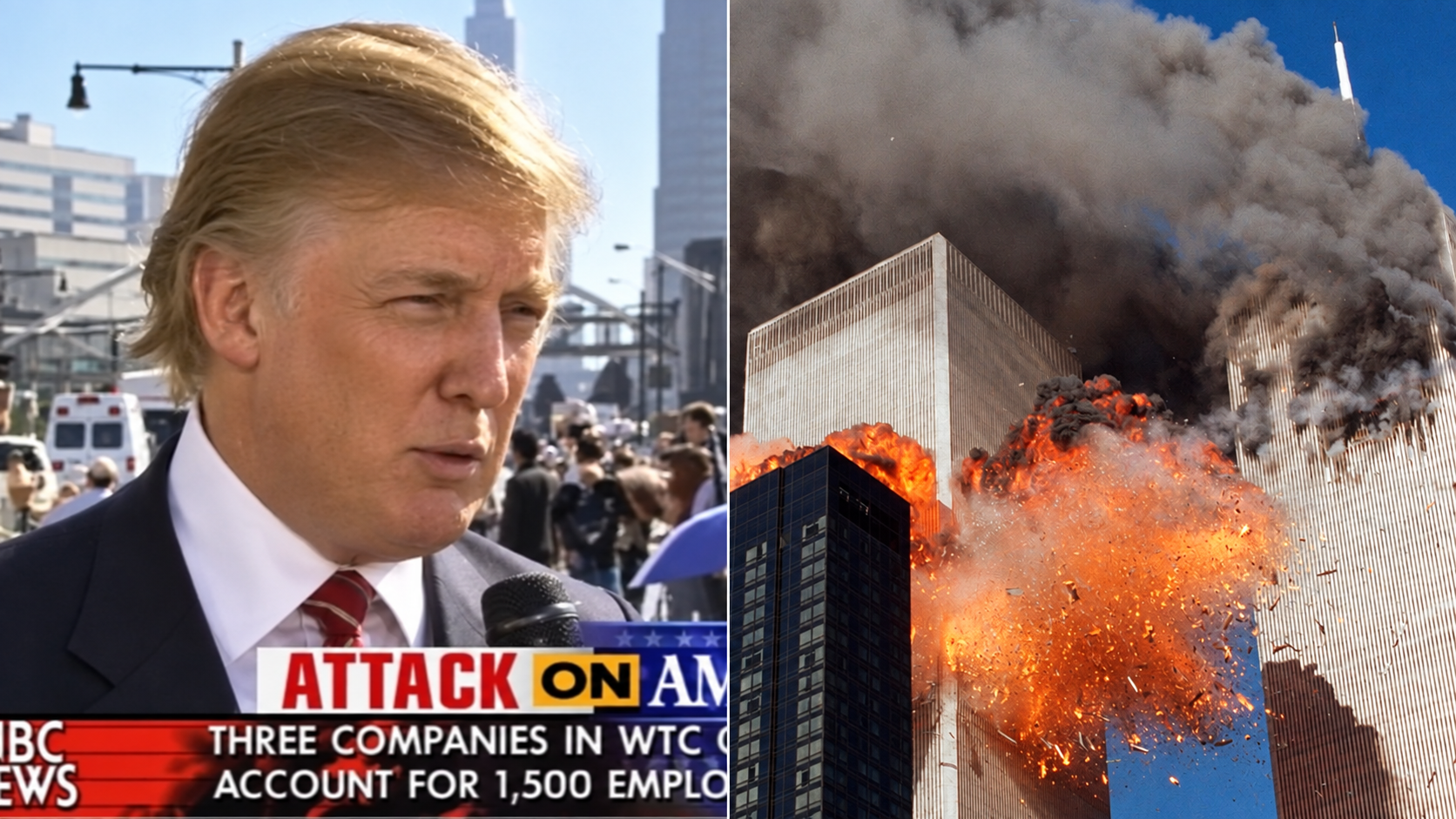
Mythmaking thrives on national trauma. When a president claims that firefighters physically hoisted him away from a crumbling skyscraper during the September 11 attacks, the statement immediately forces a collision between verified chronology and political self-mythology. Donald Trump’s recent declaration at a memorial event—recounting how big, strong firefighters grabbed him under the arms and ran with him from the vicinity of One Liberty Plaza—brings a quarter-century of shifting personal narratives back into sharp focus. Decades of reporting, archival footage, and public records establish that Trump was miles away at Midtown's Trump Tower when the towers fell. Yet, the compulsion to place oneself at the center of historic catastrophe remains a potent force in modern political communication.
Veterans of the New York City press corps remember the chaotic cadence of that autumn week. Information did not flow cleanly; it bled through static-heavy radio transmissions, panicked phone calls, and dense clouds of pulverized concrete drifting north over Manhattan. In that fog, reality fractured. Thousands experienced genuine terror, sudden evacuations, and near-misses. But the distance between experiencing the collective panic of a wounded metropolis and being physically swept off one’s feet by emergency personnel near Ground Zero on the morning of the attacks spans several miles and several hours of recorded reality.
The Evolution of a Testimony
Examining how political figures curate their personal histories reveals a distinct pattern of escalation. In the immediate aftermath of 2001, media interviews captured Trump talking about the scale of the destruction, mentioning his downtown properties, and later asserting that he had dispatched crews of construction workers to aid in site clearance. Over the years, those accounts grew more visceral. The scale shifted from observing damage and offering general support to active participation in rescue dynamics, culminating in the recent imagery of being bodily carried away from a creaking steel structure by emergency responders.
This narrative drift is rarely accidental. Human memory is notoriously malleable, shaped heavily by repetition, external validation, and the internal need to reconcile one's identity with monumental events. In political spaces, storytelling functions less as a strict accounting of facts and more as a symbolic reinforcement of presence and grit. When a speaker places themselves on the front lines, they are communicating an emotional truth to their audience regardless of what official logs or battalion chiefs recall.
Fact-checkers face a structural disadvantage when confronting these claims. Archives from the New York City Fire Department, statements from battalion leadership, and contemporaneous news coverage show no record of Trump being extracted from a collapsing building on September 11. When journalists point out these discrepancies, the defensive machinery pivots instantly. Institutional skepticism toward the media allows defenders to dismiss documentary evidence as partisan nitpicking, transforming a verifiable falsehood into a badge of persecution.
The Mechanics of Crisis Distortion
Why do these stories persist long after public databases have disproven them? Collective memory operates under different rules than historical research. During moments of profound existential threat, psychological defense mechanisms kick in. People compress timelines, conflate multiple days into a single terrifying afternoon, and absorb the harrowing experiences of others as their own.
Consider the environment around One Liberty Plaza in the days following the initial impact. Structural engineers and city officials wrestled with immense instability. Evacuations ordered due to fears of secondary collapses swept through journalists, rescue workers, and bystanders alike. It is entirely plausible that a real estate developer visiting the perimeter days later encountered the jittery atmosphere of a zone bracing for another collapse. Over twenty-five years, the blurred edges of a tense visit harden into the cinematic narrative of a dramatic, life-saving extraction.
Yet, public figures carry a heightened responsibility for historical accuracy, particularly when commemorating a tragedy that claimed thousands of lives and defined an era. First responders spent decades fighting for recognition, medical funding, and structural support. When unverified tales of personal heroism or dramatic escapes overshadow the grinding, anonymous labor of actual recovery workers, it distorts the public ledger.
The defense offered by administrative spokespeople—that private citizens are not meticulously documented every hour of the day—misses the fundamental critique. Nobody expects a ledger for every minute of a crisis. The issue arises when uncorroborated vignettes defy geographical and chronological laws, placing a high-profile observer directly into the boots of those who bore the physical brunt of the catastrophe.
As the years move the events of that Tuesday further into the domain of history rather than living memory, the guardians of the archive face an uphill battle. Eyewitness accounts fade, primary sources pass away, and political folklore hardens into accepted dogma for partisan loyalists. The challenge for contemporary journalism is not merely correcting the record once, but maintaining an unyielding anchor to verifiable reality as the mythmakers rewrite the past one speech at a time.