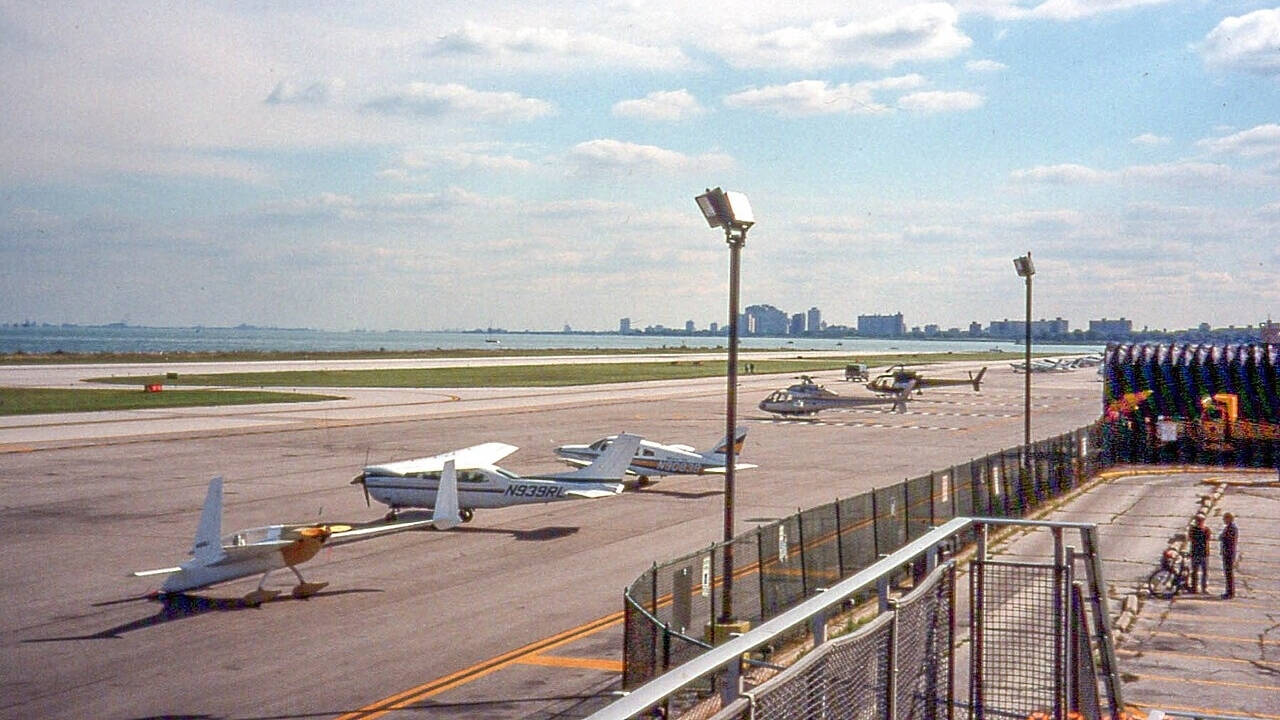
Urban infrastructure assets are rarely destroyed by bureaucratic attrition; they are terminated through unilateral executive fiat when the friction of governance exceeds the cost of regulatory penalty. On March 31, 2003, Chicago Mayor Richard M. Daley bypassed multi-year judicial proceedings and federal oversight by dispatching construction crews under the cover of darkness to gouge six massive, terminal X-shapes into the asphalt runway of Merrill C. Meigs Field. This midnight operation bypassed the Federal Aviation Administration, stranded sixteen aircraft, and converted a high-value downtown transit node into a blank slate. Twelve years later, the site evolved into a 40-acre public prairie and wetland ecosystem known as Northerly Island Park. Deconstructing this maneuver reveals the underlying cost-benefit calculations of municipal asset transformation, regulatory arbitrage, and the mechanics of forcing urban land-use changes against federal friction.
The Cost Function of Regulatory Evasion
Urban land allocation operates on a matrix of statutory commitments, lease agreements, and funding covenants. Meigs Field, positioned on a narrow man-made peninsula jutting into Lake Michigan, operated under historical federal grants. Acceptance of Airport Improvement Program funds bound the City of Chicago to grant assurances requiring the facility to remain operational. When political objectives diverge from statutory obligations, an executive must calculate the marginal cost of compliance versus the penalty for breach.
The city had previously attempted legal channels to shutter the airfield in 1996, only to face legislative counter-pressures from the State of Illinois that forced a reopening. By 2003, Daley faced a binding agreement to operate the facility through 2026. The executive decision tree was reduced to two paths:
- Engage in a protracted, multi-year litigation campaign with aviation advocacy groups and the federal government, risking judicial injunctions and political capital.
- Execute an irreversible physical destruction of the asset overnight, transforming a legal dispute over operations into a fait accompli over real estate.
The financial penalty for the midnight demolition was minor by municipal standards. The Federal Aviation Administration levied a $33,000 fine for failing to provide the mandatory 30-day advance notice of closure, and the city later repaid roughly $1 million in misapplied federal grants. By absorbing these nominal costs, the municipal government achieved permanent asset conversion for a fraction of the economic value generated by the land's subsequent repurposing. The regulatory fine functioned not as a deterrent, but as a predictable transaction fee for bypassing democratic and federal veto points.
The Mechanics of Urban Asset Conversion
The transformation of Northerly Island from an operational general aviation airstrip into a coastal wetland and public park demonstrates the friction inherent in large-scale ecological engineering within urban cores. Real estate situated on central business district waterfronts commands massive commercial and logistical utility. Converting such a parcel into low-density public green space requires a specific sequence of structural changes:
Physical neutralization required rendering the 3,100-foot runway permanently unlandable through heavy machinery gouges, neutralizing the immediate utility for corporate turboprops and private aircraft. Operational displacement rerouted the baseline general aviation traffic to alternative regional facilities like Chicago Executive Airport or Midway, shifting the logistical burden onto private operators while freeing downtown airspace from low-altitude flight paths. Ecological remediation involved removing impervious asphalt surfaces and importing native coastal, prairie, and wetland plant communities managed by the U.S. Army Corps of Engineers and the Chicago Park District to support Great Lakes migratory birds and amphibians.
This progression reveals a core principle of municipal real estate strategy: the elimination of high-value industrial or transportation infrastructure is irreversible precisely because the political capital required to rebuild an urban airstrip exceeds the capital required to dismantle one. Once the asphalt was broken, the path dependency shifted permanently toward recreational and ecological use.
The Security Rationalization Matrix
Public officials executing sudden infrastructural shutdowns typically deploy security rationalizations to blunt immediate legal challenges. In the wake of the September 11 attacks, Mayor Daley justified the destruction of Meigs Field by framing the downtown lakefront airstrip as a vulnerability—arguing that rogue aircraft landing adjacent to high-density skyscrapers created an unacceptable urban security risk.
This security argument created a rhetorical shield against federal intervention. While aviation associations countered that the closure was a long-held political ambition disguised as emergency defense, the post-9/11 geopolitical climate hobbled the federal government's appetite to forcefully reinstate an operational downtown airport against the explicit will of the mayor. The tactic exposes a vulnerability in federal aviation protections: local municipal authorities control the physical land access points, gate infrastructure, and surrounding municipal services. When an executive is willing to absorb minor regulatory sanctions and weaponize prevailing security anxieties, federal oversight mechanisms struggle to mount a rapid tactical defense.
Strategic Blueprint for Infrastructure Reclamation
The Meigs Field episode serves as a clinical case study in infrastructural termination. Municipalities seeking to repurpose high-value transport corridors or legacy industrial sites without navigating traditional planning deadlocks can extract three operational takeaways:
- Asset destruction precedes legal negotiation. Physical alteration of the terrain neutralizes the utility of the asset faster than any injunction can freeze administrative action.
- Regulatory fines are capital expenditures. A low administrative penalty relative to the underlying land value makes lawbreaking a viable financial optimization.
- Security narratives act as temporal buffers. Invoking existential safety concerns during periods of heightened geopolitical risk paralyzes standard regulatory review cycles long enough for physical remediation to take root.
Future urban planners and transit advocates must recognize that legal frameworks governing public assets are only as robust as the enforcement mechanisms backing them up. When those mechanisms rely on post-hoc financial penalties rather than real-time physical interdiction, determined executives can permanently alter city layouts over the course of a single night.


